QUESTION IMAGE
Question
name:
date
class period
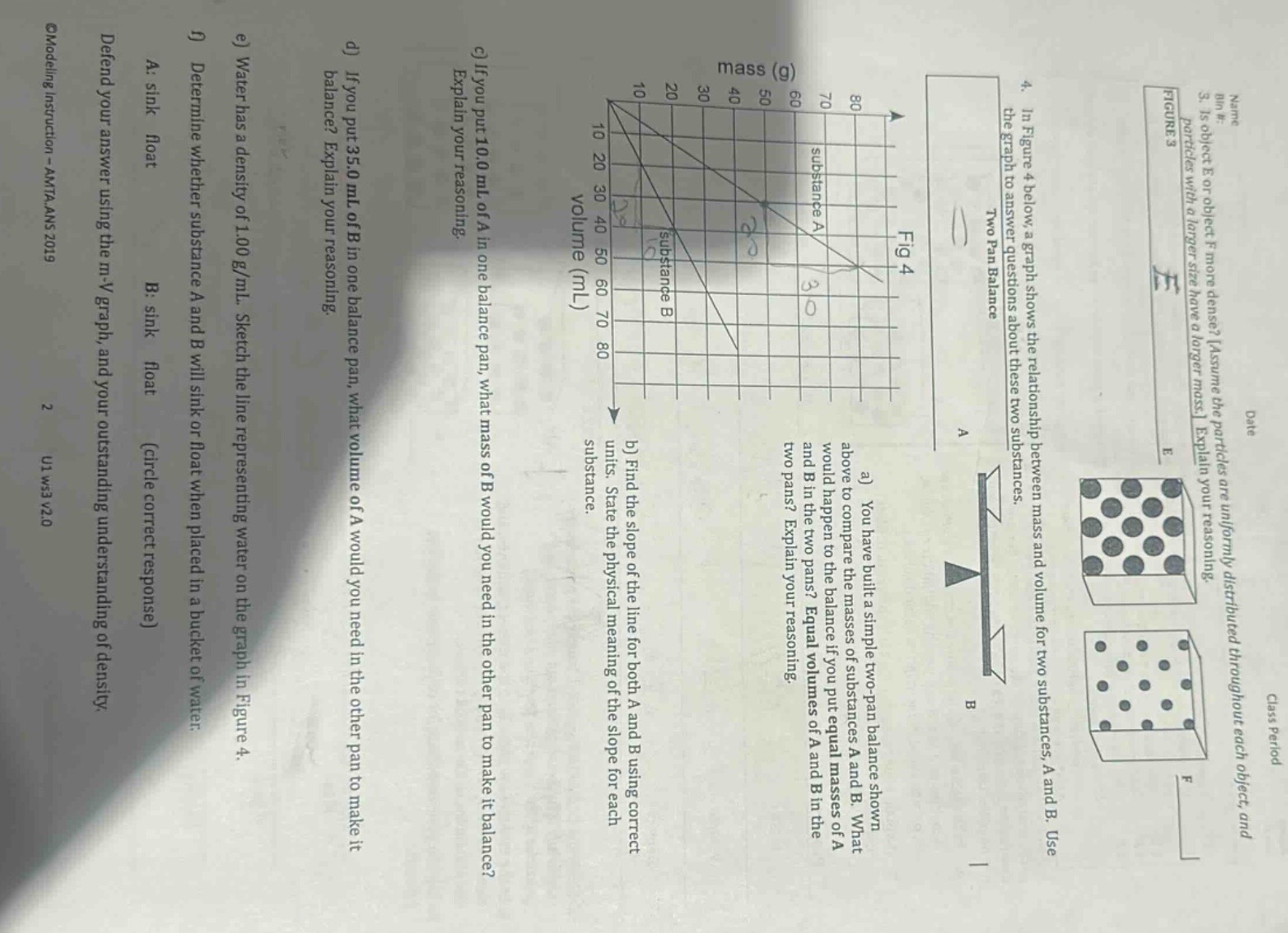
- is object e or object f more dense? assume the particles are uniformly distributed throughout each object, and particle with a larger size have a larger mass explain your reasoning.
figure 3.
- in figure 4 below, a graph shows the relationship between mass and volume for two substances, a and b. use the graph to answer questions about these two substances.
two pan balance
fig 4
a) you have built a simple two - pan balance shown above to compare the masses of substances a and b. what would happen to the balance if you put equal volumes of a and b in the two pans? explain your reasoning.
b) find the slope of the line for both a and b using correct units. state the physical meaning of the slope for each substance.
c) if you put 10.0 ml of a in one balance pan, what mass of b would you need in the other pan to make it balance? explain your reasoning.
d) if you put 35.0 ml of b in one balance pan, what volume of a would you need in the other pan to make it balance? explain your reasoning.
e) water has a density of 1.00 g/ml. sketch the line representing water on the graph in figure 4.
f) determine whether substance a and b will sink or float when placed in a bucket of water:
a: sink float
b: sink float
(circle correct response)
defend your answer using the m - v graph, and your outstanding understanding of density.
©modeling instruction - amta,ans 2019
2 u1 ws3 v2.0
Part b)
Step 1: Recall the formula for slope
The slope \( m \) of a line on a mass - volume (\( m - V \)) graph is given by the formula \( m=\frac{\Delta m}{\Delta V} \), where \( \Delta m \) is the change in mass and \( \Delta V \) is the change in volume.
Step 2: Calculate the slope for Substance A
For Substance A, we can take two points on the line. Let's take the points \((V_1, m_1)=(0,0)\) and \((V_2, m_2)=(80\space mL, 80\space g)\) (from the graph). Then the slope \( m_A=\frac{\Delta m}{\Delta V}=\frac{80\space g - 0\space g}{80\space mL-0\space mL}=\frac{80}{80} = 1\space g/mL\). The physical meaning of the slope for Substance A is that the density of Substance A is \( 1\space g/mL \) (since density \(
ho=\frac{m}{V} \), and the slope of the \( m - V \) graph is equal to the density).
Step 3: Calculate the slope for Substance B
For Substance B, let's take two points \((V_1, m_1)=(0,0)\) and \((V_2, m_2)=(80\space mL, 40\space g)\) (from the graph). Then the slope \( m_B=\frac{\Delta m}{\Delta V}=\frac{40\space g - 0\space g}{80\space mL - 0\space mL}=\frac{40}{80}=0.5\space g/mL \). The physical meaning of the slope for Substance B is that the density of Substance B is \( 0.5\space g/mL \) (since density \(
ho = \frac{m}{V} \), and the slope of the \( m - V \) graph is equal to the density).
Step 1: Determine the density of Substance A
From part (b), the density of Substance A, \(
ho_A = 1\space g/mL \).
Step 2: Use the density formula to find the mass
The density formula is \(
ho=\frac{m}{V} \), where \(
ho \) is density, \( m \) is mass, and \( V \) is volume. We know \( V = 10.0\space mL \) and \(
ho_A=1\space g/mL \). Rearranging the formula for mass, we get \( m=
ho\times V \).
Step 3: Calculate the mass of Substance A
Substitute \(
ho = 1\space g/mL \) and \( V = 10.0\space mL \) into the formula: \( m=1\space g/mL\times10.0\space mL = 10.0\space g \). To balance the two - pan balance, the mass of Substance B should be equal to the mass of Substance A. So we need to find the mass of Substance B that is equal to \( 10.0\space g \).
Step 4: Determine the density of Substance B
From part (b), the density of Substance B, \(
ho_B = 0.5\space g/mL \).
Step 5: Use the density formula to find the volume (or mass) of Substance B
We know that for the balance, \( m_A=m_B \). We can also use the density of B. Let's use the density formula for B: \(
ho_B=\frac{m_B}{V_B} \), and since \( m_B = m_A=10.0\space g \), we can find \( V_B \) or we can think in terms of the slope. Since the density of B is \( 0.5\space g/mL \), for a mass of \( 10.0\space g \), using \( m =
ho V \), we can also note that from the graph, when the mass of A is \( 10.0\space g \), the volume of A is \( 10.0\space mL \) (since \(
ho_A = 1\space g/mL \)). For B, since \(
ho_B=0.5\space g/mL \), if we want \( m_B = 10.0\space g \), then \( V_B=\frac{m_B}{
ho_B}=\frac{10.0\space g}{0.5\space g/mL}=20\space mL \). But we can also use the graph: the line for B has a slope of \( 0.5\space g/mL \), so when \( m = 10.0\space g \), \( V = 20\space mL \). But we need the mass of B. Wait, actually, we know that the mass of A is \( m_A=
ho_A\times V_A=1\space g/mL\times10\space mL = 10\space g \). For the balance to be balanced, \( m_B=m_A = 10\space g \). We can also check from the graph of B: when \( m = 10\space g \), what's the volume? But actually, since the density of B is \( 0.5\space g/mL \), if we use the fact that for the balance, the mass of B should be equal to the mass of A (\( 10\space g \)).
Step 1: Determine the density of Substance B
From part (b), the density of Substance B, \(
ho_B=0.5\space g/mL \).
Step 2: Calculate the mass of \( 35.0\space mL \) of Substance B
Using the density formula \( m=
ho V \), where \(
ho = 0.5\space g/mL \) and \( V = 35.0\space mL \), we get \( m_B=
ho_B\times V_B=0.5\space g/mL\times35.0\space mL = 17.5\space g \).
Step 3: Determine the density of Substance A
From part (b), the density of Substance A, \(
ho_A = 1\space g/mL \).
Step 4: Use the density formula to find the volume of Substance A with the same mass as Substance B
We know that for the balance, \( m_A=m_B \). So \( m_A = 17.5\space g \). Using the density formula for A, \(
ho_A=\frac{m_A}{V_A} \), we can rearrange it to \( V_A=\frac{m_A}{
ho_A} \).
Step 5: Calculate the volume of Substance A
Substitute \( m_A = 17.5\space g \) and \(
ho_A = 1\space g/mL \) into the formula: \( V_A=\frac{17.5\space g}{1\space g/mL}=17.5\space mL \).

Snap & solve any problem in the app
Get step-by-step solutions on Sovi AI
Photo-based solutions with guided steps
Explore more problems and detailed explanations
The slope of Substance A is \( 1\space g/mL \), which represents its density (mass per unit volume). The slope of Substance B is \( 0.5\space g/mL \), which also represents its density.