QUESTION IMAGE
Question
name: ____________________________ date: ____________
pedigrees
- what are pedigrees used for?
- make a key for the following: unaffected female/male; carrier female/male;
affected female/male.
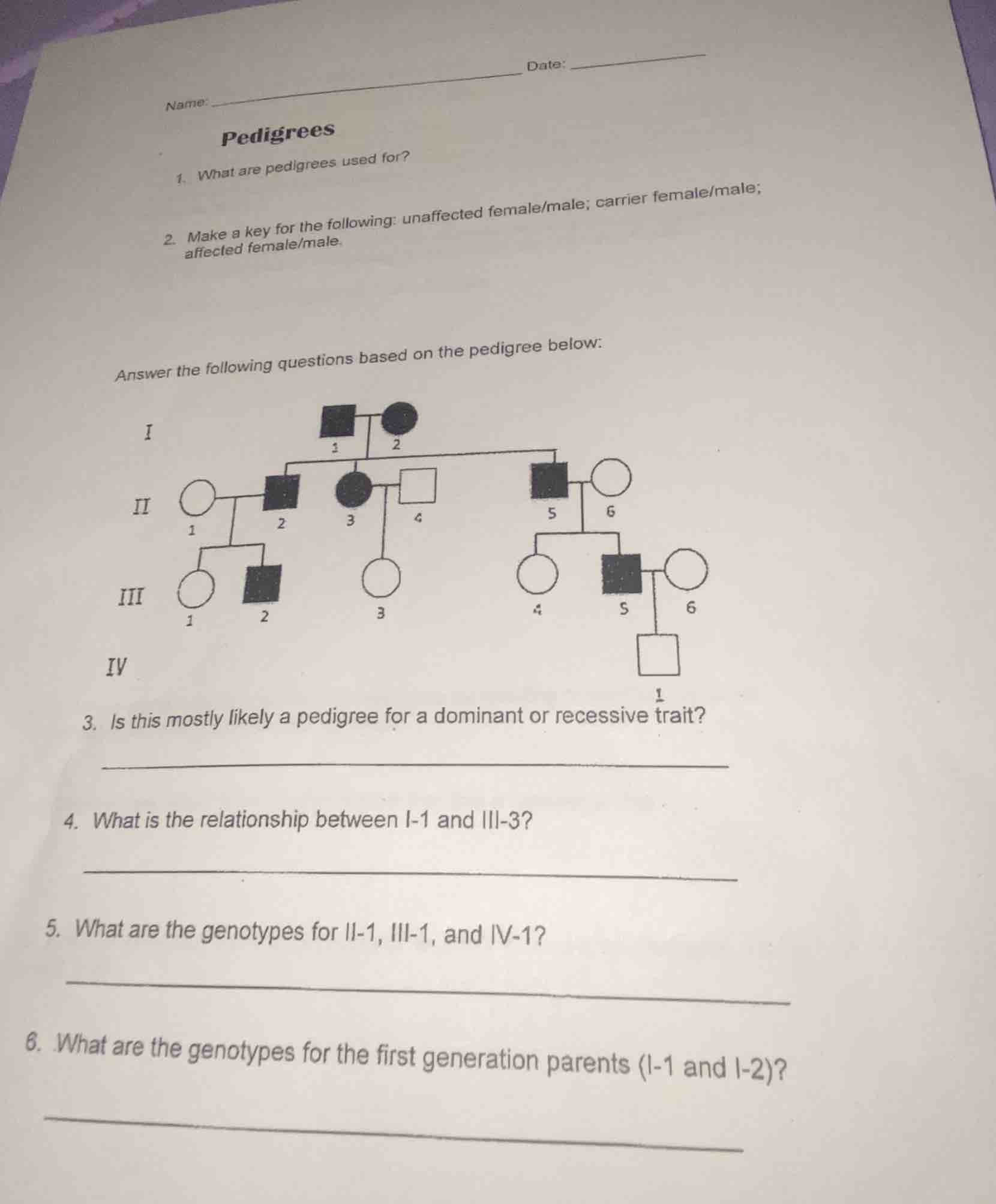
answer the following questions based on the pedigree below:
- is this mostly likely a pedigree for a dominant or recessive trait?
_____________________________________________________
- what is the relationship between i-1 and iii-3?
_____________________________________________________
- what are the genotypes for ii-1, iii-1, and iv-1?
_____________________________________________________
- what are the genotypes for the first generation parents (i-1 and i-2)?
_____________________________________________________
Brief Explanations
- Pedigrees are standardized diagrams that track genetic traits or disorders across generations of a family, helping to identify inheritance patterns and risk of passing on traits.
- A standard key uses consistent symbols for each category to make pedigrees interpretable.
- Dominant traits appear in every generation, and affected parents pass the trait to offspring; here, affected individuals are present in all generations, and affected parents have affected children, which matches dominant inheritance.
- Tracing the lineage: I-1 is the father of II-3, who is the mother of III-3, so I-1 is the grandfather of III-3.
- For a dominant trait (let the dominant allele = $A$, recessive = $a$): unaffected individuals have two recessive alleles. II-1 is unaffected, so genotype is $aa$. III-1 is unaffected, so genotype is $aa$. IV-1 is unaffected, so genotype is $aa$.
- The trait is dominant, and I-1 and I-2 are affected. They have an unaffected child (II-4), meaning each must carry a recessive allele to pass to the unaffected offspring, so their genotypes are $Aa$.

Snap & solve any problem in the app
Get step-by-step solutions on Sovi AI
Photo-based solutions with guided steps
Explore more problems and detailed explanations
- Pedigrees are used to trace the inheritance of genetic traits or disorders through multiple generations of a family, and to determine the probability of individuals inheriting or passing on a trait.
- Example key:
- Unaffected female: Empty circle
- Unaffected male: Empty square
- Carrier female: Half-filled circle
- Carrier male: Half-filled square
- Affected female: Fully filled circle
- Affected male: Fully filled square
- Dominant trait
- I-1 is the paternal grandfather of III-3 (or grandfather-granddaughter)
- II-1: $aa$; III-1: $aa$; IV-1: $aa$
- I-1: $Aa$; I-2: $Aa$