QUESTION IMAGE
Question
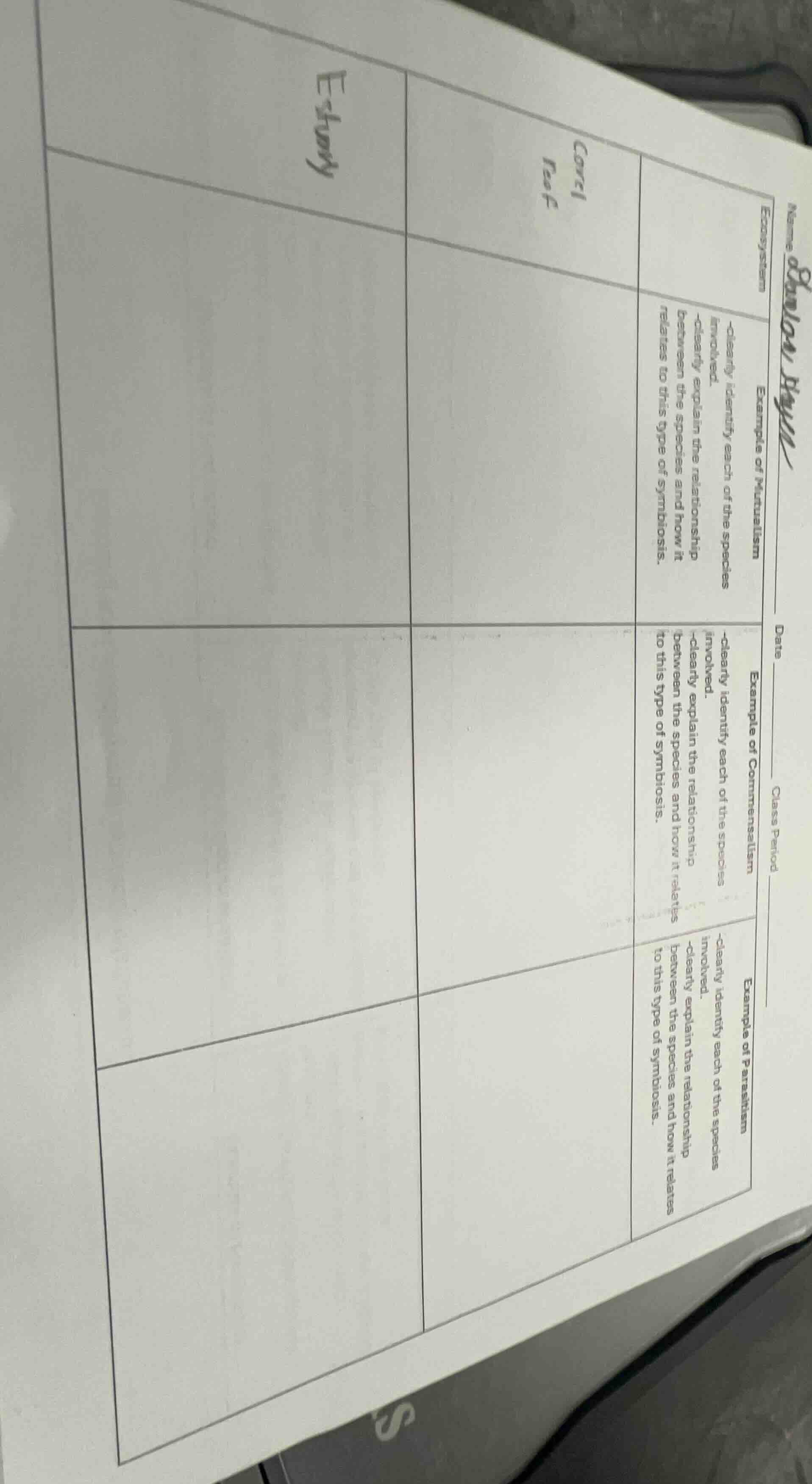
name:dateclass periodecosystem: estuaryexample of mutualism-clearly identify each of the species involved.-clearly explain the relationship between the species and how it relates to this type of symbiosis.coralzooxanthellaeexample of commensalism-clearly identify each of the species involved.-clearly explain the relationship between the species and how it relates to this type of symbiosis.example of parasitism-clearly identify each of the species involved.-clearly explain the relationship between the species and how it relates to this type of symbiosis.
Mutualism:
The estuary ecosystem has a mutualistic relationship between *salt marsh cordgrass (Spartina alterniflora) and nitrogen-fixing bacteria (Rhizobium)*. The bacteria live in root nodules of the cordgrass: the bacteria convert atmospheric nitrogen into a form the cordgrass can use for growth, and the cordgrass provides the bacteria with sugars and a protected habitat. Both species benefit, which fits mutualism.
Commensalism:
In an estuary, *barnacles (Balanus) and horseshoe crabs (Limulus polyphemus)* have a commensal relationship. Barnacles attach to the horseshoe crab's shell to gain access to moving water and food particles, while the horseshoe crab is neither helped nor harmed by the barnacles' presence. This matches commensalism, where one species benefits and the other is unaffected.
Parasitism:
In estuaries, *trematode flatworms (Echinostoma) are parasites of mussels (Mytilus edulis)*. The flatworm larvae infect the mussel's tissues, using the mussel as a host to feed and grow, which weakens the mussel and reduces its ability to reproduce. The flatworm benefits at the expense of the mussel, which defines parasitism.

Snap & solve any problem in the app
Get step-by-step solutions on Sovi AI
Photo-based solutions with guided steps
Explore more problems and detailed explanations
| Ecosystem | Example of Mutualism | Example of Commensalism | Example of Parasitism |
|---|