QUESTION IMAGE
Question
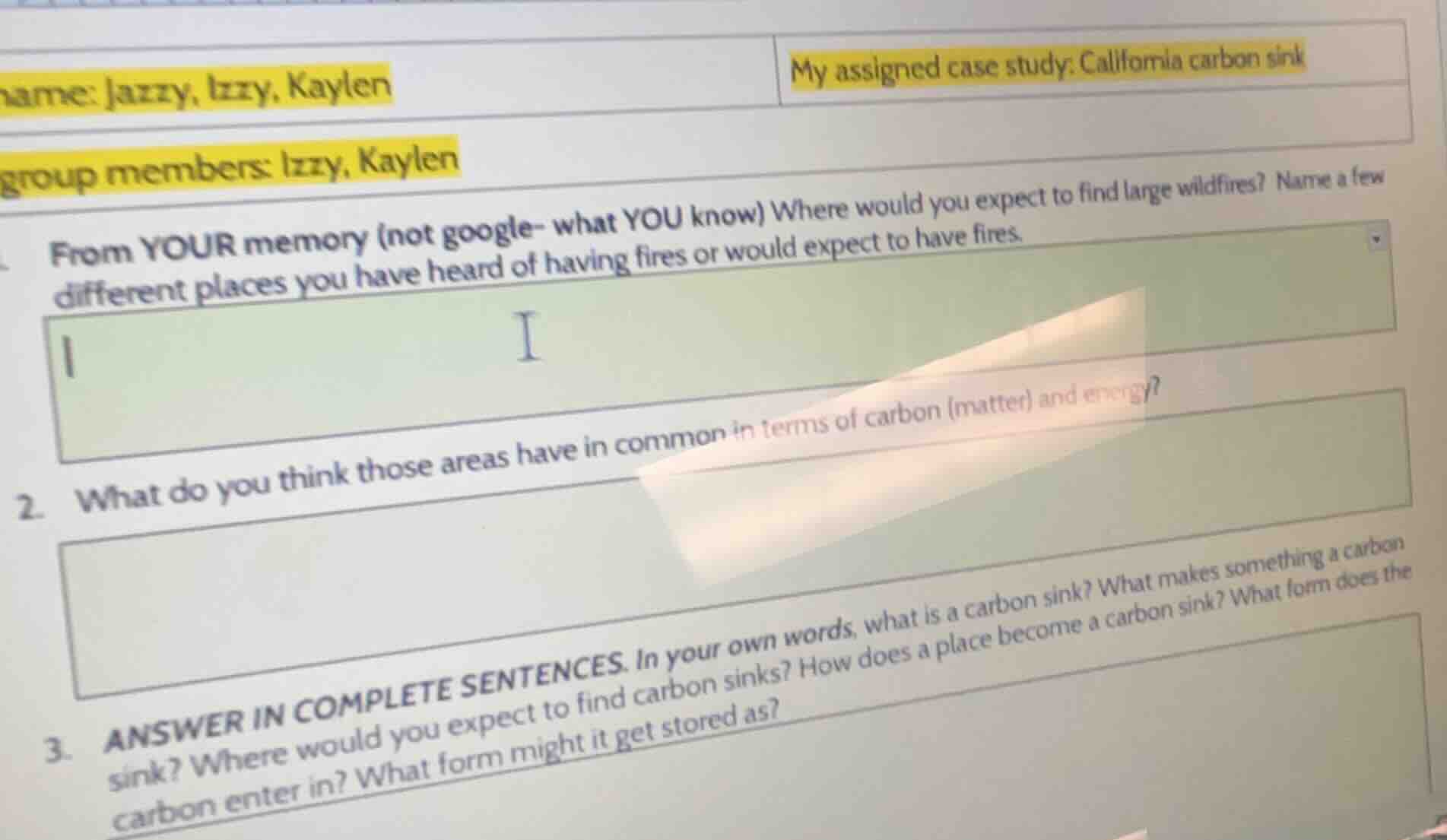
name: jazzy, izzy, kaylen my assigned case study: california carbon sink group members: izzy, kaylen 1. from your memory (not google- what you know) where would you expect to find large wildfires? name a few different places you have heard of having fires or would expect to have fires. 2. what do you think those areas have in common in terms of carbon (matter) and energy? 3. answer in complete sentences. in your own words, what is a carbon sink? what makes something a carbon sink? where would you expect to find carbon sinks? how does a place become a carbon sink? what form does the carbon enter in? what form might it get stored as?
- For question 1, places with large wildfires are typically dry, vegetation-dense regions that are prone to seasonal droughts, based on common knowledge of wildfire events.
- For question 2, these regions share high amounts of carbon stored in their vegetation (fuel for fires), and wildfires release stored carbon as CO₂, converting chemical energy in plants to heat/light energy.
- For question 3, a carbon sink is defined as a natural or artificial reservoir that absorbs and stores more carbon than it releases, with key details about their formation, locations, carbon intake, and storage forms based on carbon cycle basics.

Snap & solve any problem in the app
Get step-by-step solutions on Sovi AI
Photo-based solutions with guided steps
Explore more problems and detailed explanations
- Examples of places with large wildfires:
- California, United States
- Australian Outback, Australia
- Mediterranean regions (e.g., Greece, Spain)
- Siberia, Russia
- These areas have large stores of carbon in their dense, dry vegetation (like trees, brush, and grasses), which acts as fuel for wildfires. When wildfires occur, the stored carbon (matter) is released into the atmosphere as carbon dioxide. The chemical energy stored in the plant matter is converted into thermal (heat) and light energy during the combustion process.
- A carbon sink is a natural or human-made area that absorbs and holds more carbon from the atmosphere than it releases over time. Something is a carbon sink when its carbon intake rate exceeds its carbon output rate. Carbon sinks are most commonly found in forests, oceans, and wetlands. A place becomes a carbon sink when it has abundant organisms or structures that can take in carbon (like trees through photosynthesis, or ocean algae absorbing dissolved carbon dioxide). Carbon enters sinks primarily as atmospheric carbon dioxide (CO₂) – plants take it in via photosynthesis, and oceans absorb dissolved CO₂. Carbon is stored in sinks as organic matter (like tree trunks, soil humus, or marine organism biomass) or inorganic forms (like dissolved carbonate ions in ocean water, or fossil fuels that form over geologic time).