QUESTION IMAGE
Question
name (last) bernard (first) justice b
chapter 2 practice test
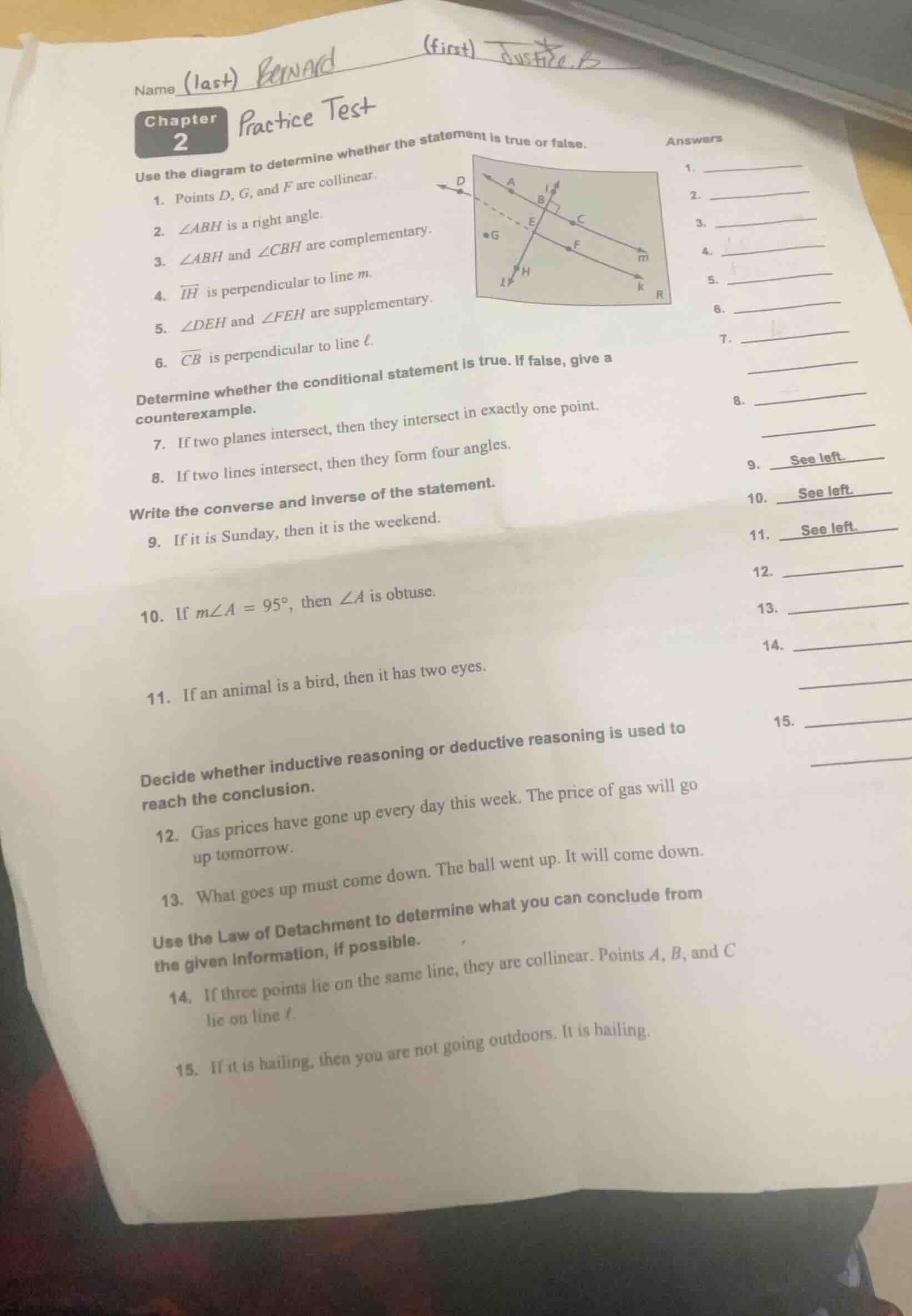
use the diagram to determine whether the statement is true or false.
- points d, g, and f are collinear.
- ∠abh is a right angle.
- ∠abh and ∠cbh are complementary.
- $overline{ih}$ is perpendicular to line m.
- ∠deh and ∠feh are supplementary.
- $overline{cb}$ is perpendicular to line ℓ.
determine whether the conditional statement is true. if false, give a counterexample.
- if two planes intersect, then they intersect in exactly one point.
- if two lines intersect, then they form four angles.
write the converse and inverse of the statement.
- if it is sunday, then it is the weekend.
- if $m∠a = 95^circ$, then $∠a$ is obtuse.
- if an animal is a bird, then it has two eyes.
decide whether inductive reasoning or deductive reasoning is used to reach the conclusion.
- gas prices have gone up every day this week. the price of gas will go up tomorrow.
- what goes up must come down. the ball went up. it will come down.
use the law of detachment to determine what you can conclude from the given information, if possible.
- if three points lie on the same line, they are collinear. points a, b, and c lie on line ℓ.
- if it is hailing, then you are not going outdoors. it is hailing.
answers
1.
2.
3.
4.
5.
6.
7.
8.
- see left.
- see left.
- see left.
12.
13.
14.
15.
Let's solve these problems one by one. We'll start with the true/false questions using the diagram, then move to conditional statements, converse/inverse, reasoning, and Law of Detachment.
Problem 1: Points \( D \), \( G \), and \( F \) are collinear.
- Collinear points lie on the same line. From the diagram, \( D \) is on a dashed line, \( G \) is a point near it, but \( F \) is on a different line (not the dashed one with \( D \) and \( G \)? Wait, no—wait, the dashed line: \( D \), \( E \), and the dashed line. Wait, maybe I missee. Wait, the diagram: \( D \) is on a line, \( G \) is a point, \( F \) is on another line. Wait, no—if \( D \), \( G \), \( F \): are they on the same line? The dashed line: \( D \), \( E \), and the dashed line. \( G \) is a point, maybe not on the same line as \( F \). Wait, maybe the dashed line is \( D - E - \dots \), and \( F \) is on a different line. So this statement is false? Wait, no—wait, maybe the diagram: \( D \), \( G \), \( F \): let's check. If \( D \), \( G \), \( F \) are not on the same line, then false. But maybe I'm wrong. Wait, maybe the dashed line includes \( D \), \( G \), \( F \)? No, \( F \) is on a line with \( C \), \( m \), etc. So probably false. Wait, but maybe the answer is false? Wait, maybe I need to re-examine. Alternatively, maybe the dashed line is \( D - G - F \)? No, \( F \) is on a line with \( F \) (arrow). Wait, maybe the first problem: Points \( D \), \( G \), and \( F \) are collinear. So if they lie on the same straight line, true; else false. From the diagram, \( D \) is on a line (dashed), \( G \) is a point, \( F \) is on another line (solid). So they are not collinear. So answer: False.
Problem 2: \( \angle ABH \) is a right angle.
- A right angle is \( 90^\circ \). From the diagram, \( \ell \) (the vertical line) has a right angle symbol at \( B \) with line \( m \) (the horizontal line). So \( \angle ABH \): \( AB \) is on line \( m \), \( BH \) is on line \( \ell \), and there's a right angle symbol. So \( \angle ABH = 90^\circ \), so this is True.
Problem 3: \( \angle ABH \) and \( \angle CBH \) are complementary.
- Complementary angles add to \( 90^\circ \). \( \angle ABH \) is \( 90^\circ \) (right angle), \( \angle CBH \): since \( AB \) and \( CB \) are on the same line \( m \), \( \angle ABH + \angle CBH = 180^\circ \) (supplementary), not \( 90^\circ \). Wait, no—wait, \( \angle ABH \) is \( 90^\circ \), \( \angle CBH \): if \( AB \) and \( CB \) are a straight line (collinear), then \( \angle ABH + \angle CBH = 180^\circ \). So they are supplementary, not complementary. So this is False? Wait, no—wait, maybe \( AB \) and \( CB \) are on the same line, so \( \angle ABH \) is \( 90^\circ \), \( \angle CBH \) is also \( 90^\circ \)? Wait, no—the right angle is at \( B \) between \( m \) and \( \ell \). So \( \angle ABH \) is \( 90^\circ \), \( \angle CBH \) is also \( 90^\circ \)? Wait, no—line \( m \) is horizontal, line \( \ell \) is vertical, intersecting at \( B \) with right angle. So \( AB \) is on \( m \) (left of \( B \)), \( CB \) is on \( m \) (right of \( B \)), so \( AB \) and \( CB \) are a straight line (collinear), so \( \angle ABH \) is \( 90^\circ \) (between \( AB \) and \( BH \)), \( \angle CBH \) is \( 90^\circ \) (between \( CB \) and \( BH \)). Then \( \angle ABH + \angle CBH = 90 + 90 = 180^\circ \) (supplementary), not complementary (which is \( 90^\circ \)). So the statement says they are complementary (add to \( 90^\circ \)), but they add to \( 180^\circ \). So False? Wait, no—wait, mayb…

Snap & solve any problem in the app
Get step-by-step solutions on Sovi AI
Photo-based solutions with guided steps
Explore more problems and detailed explanations
Let's solve these problems one by one. We'll start with the true/false questions using the diagram, then move to conditional statements, converse/inverse, reasoning, and Law of Detachment.
Problem 1: Points \( D \), \( G \), and \( F \) are collinear.
- Collinear points lie on the same line. From the diagram, \( D \) is on a dashed line, \( G \) is a point near it, but \( F \) is on a different line (not the dashed one with \( D \) and \( G \)? Wait, no—wait, the dashed line: \( D \), \( E \), and the dashed line. Wait, maybe I missee. Wait, the diagram: \( D \) is on a line, \( G \) is a point, \( F \) is on another line. Wait, no—if \( D \), \( G \), \( F \): are they on the same line? The dashed line: \( D \), \( E \), and the dashed line. \( G \) is a point, maybe not on the same line as \( F \). Wait, maybe the dashed line is \( D - E - \dots \), and \( F \) is on a different line. So this statement is false? Wait, no—wait, maybe the diagram: \( D \), \( G \), \( F \): let's check. If \( D \), \( G \), \( F \) are not on the same line, then false. But maybe I'm wrong. Wait, maybe the dashed line includes \( D \), \( G \), \( F \)? No, \( F \) is on a line with \( C \), \( m \), etc. So probably false. Wait, but maybe the answer is false? Wait, maybe I need to re-examine. Alternatively, maybe the dashed line is \( D - G - F \)? No, \( F \) is on a line with \( F \) (arrow). Wait, maybe the first problem: Points \( D \), \( G \), and \( F \) are collinear. So if they lie on the same straight line, true; else false. From the diagram, \( D \) is on a line (dashed), \( G \) is a point, \( F \) is on another line (solid). So they are not collinear. So answer: False.
Problem 2: \( \angle ABH \) is a right angle.
- A right angle is \( 90^\circ \). From the diagram, \( \ell \) (the vertical line) has a right angle symbol at \( B \) with line \( m \) (the horizontal line). So \( \angle ABH \): \( AB \) is on line \( m \), \( BH \) is on line \( \ell \), and there's a right angle symbol. So \( \angle ABH = 90^\circ \), so this is True.
Problem 3: \( \angle ABH \) and \( \angle CBH \) are complementary.
- Complementary angles add to \( 90^\circ \). \( \angle ABH \) is \( 90^\circ \) (right angle), \( \angle CBH \): since \( AB \) and \( CB \) are on the same line \( m \), \( \angle ABH + \angle CBH = 180^\circ \) (supplementary), not \( 90^\circ \). Wait, no—wait, \( \angle ABH \) is \( 90^\circ \), \( \angle CBH \): if \( AB \) and \( CB \) are a straight line (collinear), then \( \angle ABH + \angle CBH = 180^\circ \). So they are supplementary, not complementary. So this is False? Wait, no—wait, maybe \( AB \) and \( CB \) are on the same line, so \( \angle ABH \) is \( 90^\circ \), \( \angle CBH \) is also \( 90^\circ \)? Wait, no—the right angle is at \( B \) between \( m \) and \( \ell \). So \( \angle ABH \) is \( 90^\circ \), \( \angle CBH \) is also \( 90^\circ \)? Wait, no—line \( m \) is horizontal, line \( \ell \) is vertical, intersecting at \( B \) with right angle. So \( AB \) is on \( m \) (left of \( B \)), \( CB \) is on \( m \) (right of \( B \)), so \( AB \) and \( CB \) are a straight line (collinear), so \( \angle ABH \) is \( 90^\circ \) (between \( AB \) and \( BH \)), \( \angle CBH \) is \( 90^\circ \) (between \( CB \) and \( BH \)). Then \( \angle ABH + \angle CBH = 90 + 90 = 180^\circ \) (supplementary), not complementary (which is \( 90^\circ \)). So the statement says they are complementary (add to \( 90^\circ \)), but they add to \( 180^\circ \). So False? Wait, no—wait, maybe I made a mistake. Wait, complementary is \( 90^\circ \), supplementary is \( 180^\circ \). So if \( \angle ABH = 90^\circ \) and \( \angle CBH = 90^\circ \), their sum is \( 180^\circ \), so supplementary. So the statement is false.
Problem 4: \( \overline{IH} \) is perpendicular to line \( m \).
- Perpendicular means they form a right angle. Line \( m \) is horizontal, \( \overline{IH} \) is vertical (line \( \ell \)), and there's a right angle symbol at \( B \) between \( m \) and \( \ell \). So \( \overline{IH} \) (on line \( \ell \)) is perpendicular to line \( m \). So True.
Problem 5: \( \angle DEH \) and \( \angle FEH \) are supplementary.
- Supplementary angles add to \( 180^\circ \). \( \angle DEH \) and \( \angle FEH \) are adjacent angles forming a linear pair (they share a common side \( EH \) and their non-common sides \( DE \) and \( FE \) are opposite rays, forming a straight line). So their sum is \( 180^\circ \), so they are supplementary. So True.
Problem 6: \( \overline{CB} \) is perpendicular to line \( \ell \).
- Line \( \ell \) is vertical, \( \overline{CB} \) is horizontal (on line \( m \)). Horizontal and vertical lines are perpendicular? Wait, no—\( \overline{CB} \) is on line \( m \) (horizontal), line \( \ell \) is vertical, so they are perpendicular (right angle at \( B \)). Wait, but \( \overline{CB} \) is part of line \( m \), which is perpendicular to line \( \ell \). So \( \overline{CB} \) is perpendicular to line \( \ell \). So True? Wait, line \( m \) is horizontal, line \( \ell \) is vertical, so they are perpendicular. So \( \overline{CB} \) (on line \( m \)) is perpendicular to line \( \ell \). So yes, true.
Problem 7: If two planes intersect, then they intersect in exactly one point.
- Planes intersect in a line, not a point. So the statement is false. Counterexample: Two planes (like the floor and a wall) intersect in a line (the edge where they meet), not a single point. So answer: False; counterexample: Two planes intersect in a line, not a point (e.g., the xy-plane and xz-plane intersect along the x-axis).
Problem 8: If two lines intersect, then they form four angles.
- When two lines intersect, they form two pairs of vertical angles, so four angles total (e.g., \( \angle 1, \angle 2, \angle 3, \angle 4 \)). So this is True.
Problem 9: Write the converse and inverse of "If it is Sunday, then it is the weekend."
- Converse: Switch hypothesis and conclusion: "If it is the weekend, then it is Sunday."
- Inverse: Negate both hypothesis and conclusion: "If it is not Sunday, then it is not the weekend."
Problem 10: Write the converse and inverse of "If \( m\angle A = 95^\circ \), then \( \angle A \) is obtuse."
- Obtuse angles are greater than \( 90^\circ \) and less than \( 180^\circ \).
- Converse: "If \( \angle A \) is obtuse, then \( m\angle A = 95^\circ \)." (Note: This is false, as an obtuse angle could be \( 100^\circ \), but the converse is just the structure, not the truth.)
- Inverse: "If \( m\angle A
eq 95^\circ \), then \( \angle A \) is not obtuse." (Also false, as \( \angle A \) could be \( 100^\circ \) and still obtuse.)
Problem 11: Write the converse and inverse of "If an animal is a bird, then it has two eyes."
- Converse: "If an animal has two eyes, then it is a bird." (False, e.g., a dog has two eyes but is not a bird.)
- Inverse: "If an animal is not a bird, then it does not have two eyes." (False, e.g., a cat is not a bird but has two eyes.)
Problem 12: Gas prices have gone up every day this week. The price of gas will go up tomorrow.
- This is inductive reasoning, as it uses specific observations (gas up every day this week) to make a general prediction (tomorrow). Inductive reasoning is based on patterns and past events.
Problem 13: What goes up must come down. The ball went up. It will come down.
- This is deductive reasoning, as it uses a general principle ("what goes up must come down") and a specific case ("the ball went up") to reach a conclusion ("it will come down"). Deductive reasoning uses general rules to infer specific cases.
Problem 14: Use the Law of Detachment. If three points lie on the same line, they are collinear. Points \( A \), \( B \), and \( C \) lie on line \( \ell \).
- Law of Detachment: If \( p \to q \) is true and \( p \) is true, then \( q \) is true.
- \( p \): Three points lie on the same line.
- \( q \): They are collinear.
- Given \( A \), \( B \), \( C \) lie on line \( \ell \) (so \( p \) is true), so we conclude \( A \), \( B \), \( C \) are collinear.
Problem 15: Use the Law of Detachment. If it is hailing, then you are not going outdoors. It is hailing.
- Law of Detachment: \( p \to q \) (hailing \( \to \) not going outdoors), \( p \) (it is hailing) is true, so \( q \) (you are not going outdoors) is true.
Final Answers (Summarized):
- False
- True
- False
- True
- True
- True
- False; Counterexample: Two planes intersect in a line, not a point.
- True
- Converse: If it is the weekend, then it is Sunday.
Inverse: If it is not Sunday, then it is not the weekend.
- Converse: If \( \angle A \) is obtuse, then \( m\angle A = 95^\circ \).
Inverse: If \( m\angle A
eq 95^\circ \), then \( \angle A \) is not obtuse.
- Converse: If an animal has two eyes, then it is a bird.
Inverse: If an animal is not a bird, then it does not have two eyes.
- Inductive Reasoning
- Deductive Reasoning
- Conclusion: Points \( A \), \( B \), and \( C \) are collinear.
- Conclusion: You are not going outdoors.