QUESTION IMAGE
Question
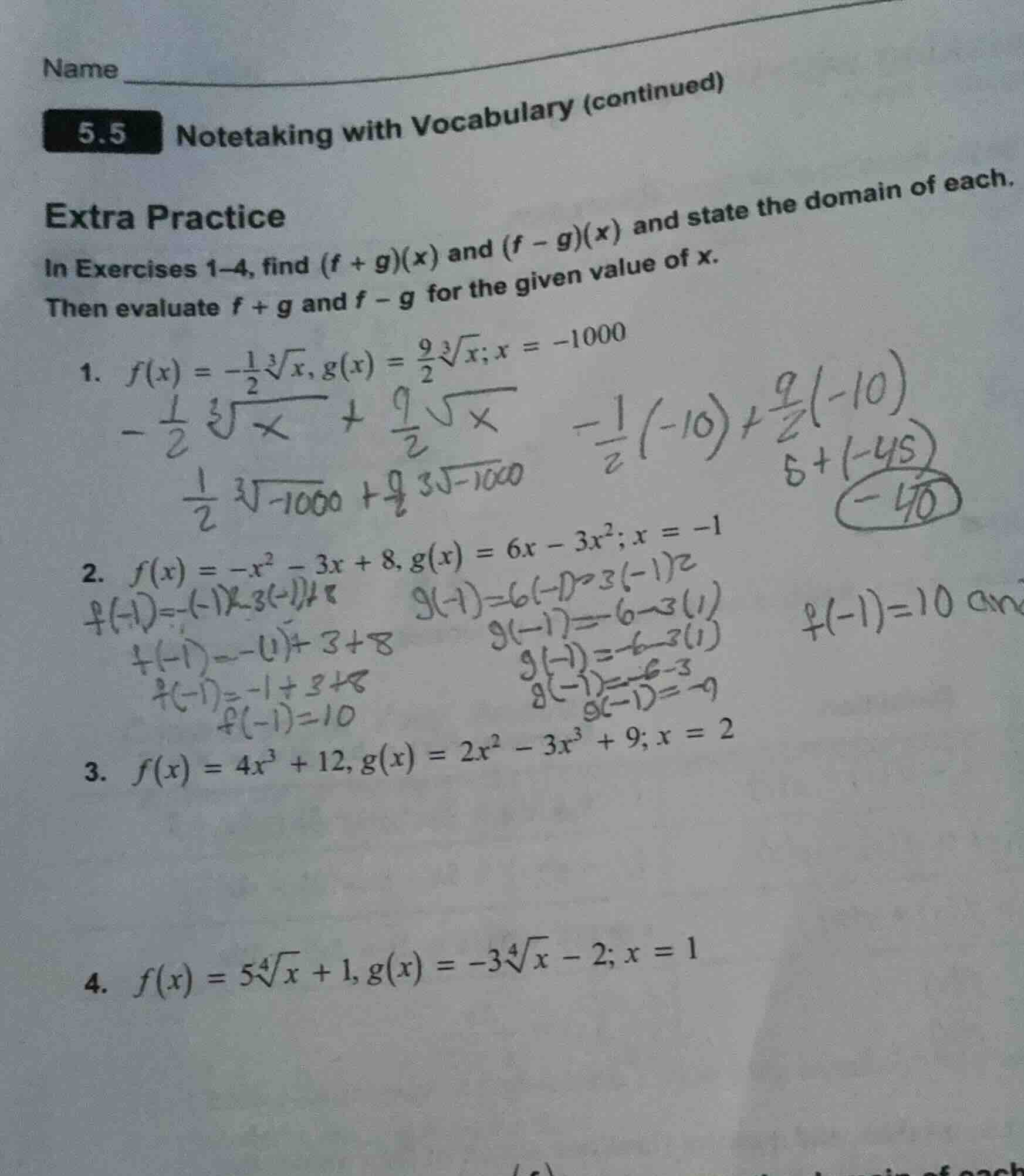
name
5.5 notetaking with vocabulary (continued)
extra practice
in exercises 1–4, find ((f + g)(x)) and ((f - g)(x)) and state the domain of each.
then evaluate (f + g) and (f - g) for the given value of (x).
- (f(x)=-\frac{1}{2}sqrt3{x}, g(x)=\frac{9}{2}sqrt3{x}; x = - 1000)
- (f(x)=-x^{2}-3x + 8, g(x)=6x-3x^{2}; x=-1)
- (f(x)=4x^{3}+12, g(x)=2x^{2}-3x^{3}+9; x = 2)
- (f(x)=5sqrt4{x}+1, g(x)=-3sqrt4{x}-2; x = 1)
Let's solve problem 3: \( f(x) = 4x^3 + 12 \), \( g(x) = 2x^2 - 3x^3 + 9 \); \( x = 2 \)
Step 1: Find \( (f + g)(x) \)
To find \( (f + g)(x) \), we add the two functions \( f(x) \) and \( g(x) \).
\[
\]
Step 2: Find \( (f - g)(x) \)
To find \( (f - g)(x) \), we subtract \( g(x) \) from \( f(x) \).
\[
\]
Step 3: Determine the domain of \( (f + g)(x) \) and \( (f - g)(x) \)
Both \( f(x) \) and \( g(x) \) are polynomials. The domain of a polynomial function is all real numbers, \( (-\infty, \infty) \). So the domain of \( (f + g)(x) \) and \( (f - g)(x) \) is also all real numbers.
Step 4: Evaluate \( (f + g)(2) \)
Substitute \( x = 2 \) into \( (f + g)(x) = x^3 + 2x^2 + 21 \):
\[
\]
Step 5: Evaluate \( (f - g)(2) \)
Substitute \( x = 2 \) into \( (f - g)(x) = 7x^3 - 2x^2 + 3 \):
\[
\]
Final Answers:
- \( (f + g)(x) = x^3 + 2x^2 + 21 \), Domain: \( (-\infty, \infty) \), \( (f + g)(2) = 37 \)
- \( (f - g)(x) = 7x^3 - 2x^2 + 3 \), Domain: \( (-\infty, \infty) \), \( (f - g)(2) = 51 \)

Snap & solve any problem in the app
Get step-by-step solutions on Sovi AI
Photo-based solutions with guided steps
Explore more problems and detailed explanations
Let's solve problem 3: \( f(x) = 4x^3 + 12 \), \( g(x) = 2x^2 - 3x^3 + 9 \); \( x = 2 \)
Step 1: Find \( (f + g)(x) \)
To find \( (f + g)(x) \), we add the two functions \( f(x) \) and \( g(x) \).
\[
\]
Step 2: Find \( (f - g)(x) \)
To find \( (f - g)(x) \), we subtract \( g(x) \) from \( f(x) \).
\[
\]
Step 3: Determine the domain of \( (f + g)(x) \) and \( (f - g)(x) \)
Both \( f(x) \) and \( g(x) \) are polynomials. The domain of a polynomial function is all real numbers, \( (-\infty, \infty) \). So the domain of \( (f + g)(x) \) and \( (f - g)(x) \) is also all real numbers.
Step 4: Evaluate \( (f + g)(2) \)
Substitute \( x = 2 \) into \( (f + g)(x) = x^3 + 2x^2 + 21 \):
\[
\]
Step 5: Evaluate \( (f - g)(2) \)
Substitute \( x = 2 \) into \( (f - g)(x) = 7x^3 - 2x^2 + 3 \):
\[
\]
Final Answers:
- \( (f + g)(x) = x^3 + 2x^2 + 21 \), Domain: \( (-\infty, \infty) \), \( (f + g)(2) = 37 \)
- \( (f - g)(x) = 7x^3 - 2x^2 + 3 \), Domain: \( (-\infty, \infty) \), \( (f - g)(2) = 51 \)