QUESTION IMAGE
Question
name: ______________________ period: ___ date: _____
dna and rna structure assignment – student edition
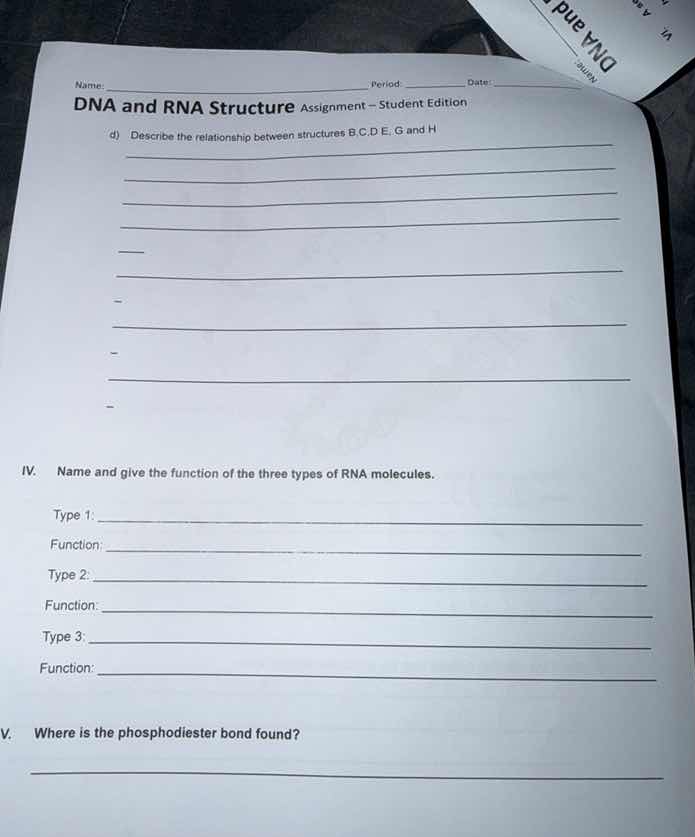
d) describe the relationship between structures b,c,d,e, g and h
_____________________________________________________________________
_____________________________________________________________________
_____________________________________________________________________
_____________________________________________________________________
_____________________________________________________________________
_____________________________________________________________________
_____________________________________________________________________
iv. name and give the function of the three types of rna molecules.
type 1: ___________________________________________________________
function: _________________________________________________________
type 2: ___________________________________________________________
function: _________________________________________________________
type 3: ___________________________________________________________
function: _________________________________________________________
v. where is the phosphodiester bond found?
_____________________________________________________________________
For part d: Without the visual of structures B, C, D, E, G, H, we assume standard nucleic acid components: B, C, D, E are nitrogenous bases (A, T/U, C, G), G is a pentose sugar (deoxyribose/ribose), H is a phosphate group. Bases pair (A-T/U, C-G) and attach to sugars; sugars link to phosphates to form the backbone, with base pairs forming the rungs of the nucleic acid helix.
For part IV: The three main RNA types have defined roles in protein synthesis.
- mRNA carries genetic code from DNA to ribosomes.
- tRNA delivers specific amino acids to ribosomes.
- rRNA forms ribosome structure, aids protein assembly.
For part V: Phosphodiester bonds link the 3' carbon of one sugar to the 5' carbon of the next in nucleic acid backbones.

Snap & solve any problem in the app
Get step-by-step solutions on Sovi AI
Photo-based solutions with guided steps
Explore more problems and detailed explanations
d) Assuming standard nucleic acid structures: Nitrogenous bases (B, C, D, E) form complementary base pairs (A-T/U, C-G). Each base attaches to a pentose sugar (G), and the sugars are connected to phosphate groups (H) to form the sugar-phosphate backbone of the DNA/RNA strand, with base pairs forming the internal rungs of the nucleic acid helix.
IV.
Type 1: Messenger RNA (mRNA)
Function: Carries genetic code from DNA to ribosomes
Type 2: Transfer RNA (tRNA)
Function: Transfers specific amino acids to ribosomes
Type 3: Ribosomal RNA (rRNA)
Function: Forms structural and catalytic part of ribosomes
V. The phosphodiester bond is found linking the 3' carbon of the pentose sugar (deoxyribose in DNA, ribose in RNA) of one nucleotide to the 5' carbon of the pentose sugar of the adjacent nucleotide, forming the sugar-phosphate backbone of DNA and RNA molecules.