QUESTION IMAGE
Question
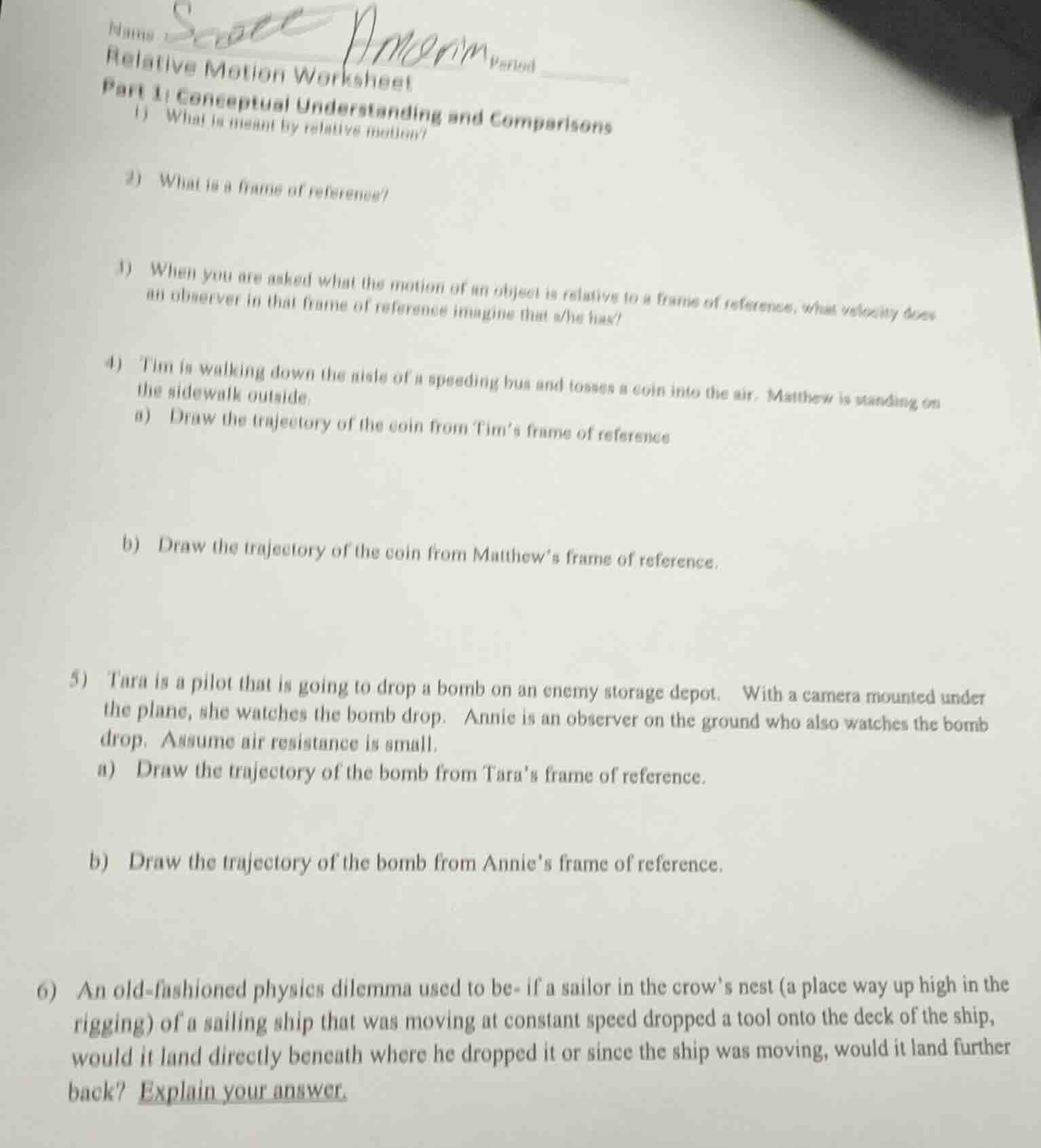
name _____ period _____relative motion worksheetpart 1: conceptual understanding and comparisons1) what is meant by relative motion?2) what is a frame of reference?3) when you are asked what the motion of an object is relative to a frame of reference, what velocity does an observer in that frame of reference imagine that s/he has?4) tim is walking down the aisle of a speeding bus and tosses a coin into the air. matthew is standing on the sidewalk outside.a) draw the trajectory of the coin from tims frame of referenceb) draw the trajectory of the coin from matthews frame of reference.5) tara is a pilot that is going to drop a bomb on an enemy storage depot. with a camera mounted under the plane, she watches the bomb drop. annie is an observer on the ground who also watches the bomb drop. assume air resistance is small.a) draw the trajectory of the bomb from taras frame of reference.b) draw the trajectory of the bomb from annies frame of reference.6) an old-fashioned physics dilemma used to be- if a sailor in the crows nest (a place way up high in the rigging) of a sailing ship that was moving at constant speed dropped a tool onto the deck of the ship, would it land directly beneath where he dropped it or since the ship was moving, would it land further back? explain your answer.
- Relative motion is the description of an object's movement as seen from the perspective of another moving or stationary object/frame of reference.
- A frame of reference is a set of coordinates (and usually a stationary or moving observer) used to define the position, velocity, and acceleration of objects.
- When analyzing motion relative to a frame, the observer in that frame assumes they are stationary, so their own velocity is 0.
4a) Tim is moving with the bus; from his frame, the coin only moves straight up and down vertically (no horizontal motion relative to him).
4b) Matthew is stationary on the sidewalk; the coin has the bus's horizontal velocity plus vertical motion, creating a parabola.
5a) Tara is moving with the plane; the bomb retains the plane's horizontal velocity relative to her, so it only falls straight down vertically.
5b) Annie is stationary on the ground; the bomb has the plane's horizontal velocity and vertical free fall, creating a curved parabolic path.
- The tool has the same constant horizontal velocity as the ship (from inertia) when dropped. There is no horizontal acceleration (assuming no air resistance), so it moves horizontally with the ship while falling, landing directly below the drop point.

Snap & solve any problem in the app
Get step-by-step solutions on Sovi AI
Photo-based solutions with guided steps
Explore more problems and detailed explanations
- Motion described relative to another object/frame.
- A coordinate system for measuring motion.
- 0 (zero) velocity.
4a) A straight vertical up/down line.
4b) A parabolic (curved) trajectory.
5a) A straight vertical downward line.
5b) A parabolic (curved) trajectory.
- It lands directly beneath the drop point.