QUESTION IMAGE
Question
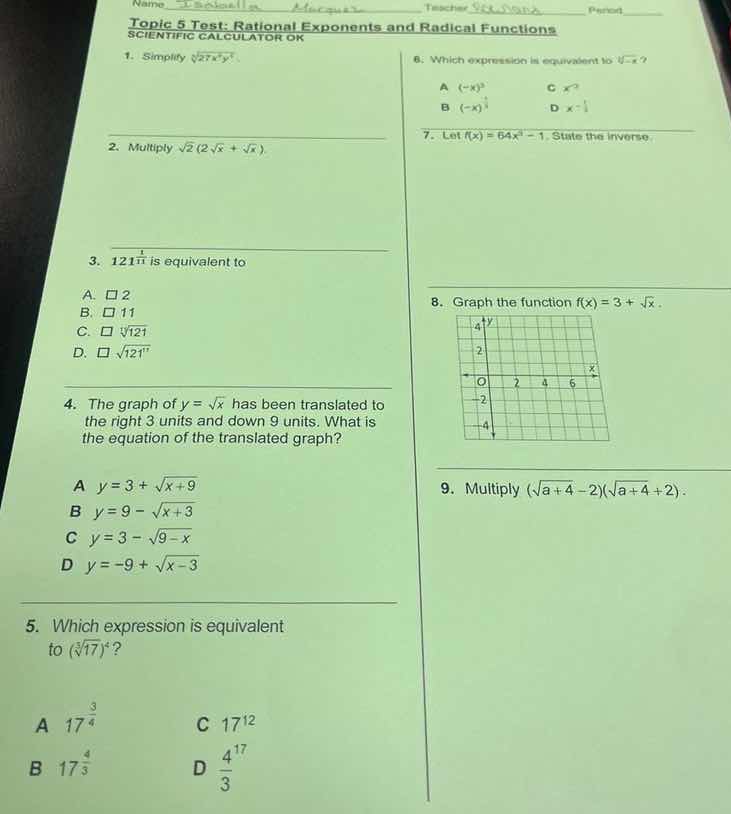
name __ teacher period __topic 5 test: rational exponents and radical functionsscientific calculator ok1. simplify $sqrt4{27x^{3}y^{9}}$.2. multiply $sqrt{2}(2sqrt{x}+sqrt{x})$.3. $121^{\frac{1}{11}}$ is equivalent toa. 2b. 11c. $sqrt11{121}$d. $sqrt{121^{11}}$4. the graph of $y = sqrt{x}$ has been translated to the right 3 units and down 9 units. what is the equation of the translated graph?a $y=3+sqrt{x+9}$b $y=9-sqrt{x+3}$c $y=3-sqrt{9-x}$d $y=-9+sqrt{x-3}$5. which expression is equivalent to $(sqrt3{17})^{4}$?a $17^{\frac{3}{4}}$c $17^{12}$b $17^{\frac{4}{3}}$d $\frac{4^{17}}{3}$6. which expression is equivalent to $6^{-x}$?a $(-x)^{6}$c $x^{-6}$b $(-x)^{-6}$d $x^{-6}$7. let $f(x)=64x^{6}-1$. state the inverse.8. graph the function $f(x)=3+sqrt{x}$.9. multiply $(sqrt{a+4}-2)(sqrt{a+4}+2)$.
Step1: Rewrite radical as exponent
$\sqrt[3]{27x^3y^9}=(27x^3y^9)^{\frac{1}{3}}$
Step2: Distribute exponent to each term
$=27^{\frac{1}{3}} \cdot (x^3)^{\frac{1}{3}} \cdot (y^9)^{\frac{1}{3}}$
Step3: Simplify each term
$=3 \cdot x^{3 \cdot \frac{1}{3}} \cdot y^{9 \cdot \frac{1}{3}} = 3xy^3$
Step1: Distribute $\sqrt{2}$ to each term
$\sqrt{2}(2\sqrt{x}+\sqrt{x}) = 2\sqrt{2}\sqrt{x} + \sqrt{2}\sqrt{x}$
Step2: Combine like terms
$=(2+1)\sqrt{2x}=3\sqrt{2x}$
Step1: Rewrite exponent as radical
$121^{\frac{1}{11}}=\sqrt[11]{121}$
Step2: Match to option
This matches option C.
Step1: Apply horizontal translation rule
Right 3 units: replace $x$ with $x-3$: $y=\sqrt{x-3}$
Step2: Apply vertical translation rule
Down 9 units: subtract 9: $y=\sqrt{x-3}-9=-9+\sqrt{x-3}$
Step3: Match to option
This matches option D.

Snap & solve any problem in the app
Get step-by-step solutions on Sovi AI
Photo-based solutions with guided steps
Explore more problems and detailed explanations
- $3xy^3$
- $3\sqrt{2x}$
- C. $\sqrt[11]{121}$
- D. $y=-9+\sqrt{x-3}$
- B. $17^{\frac{4}{3}}$
- A. $(-x)^{-\frac{3}{5}}$
- $f^{-1}(x)=\pm\frac{\sqrt[6]{x+1}}{2}$
- (Graph with key points (0,3), (1,4), (4,5), (9,6) and a smooth increasing curve starting at (0,3))
- $a$