QUESTION IMAGE
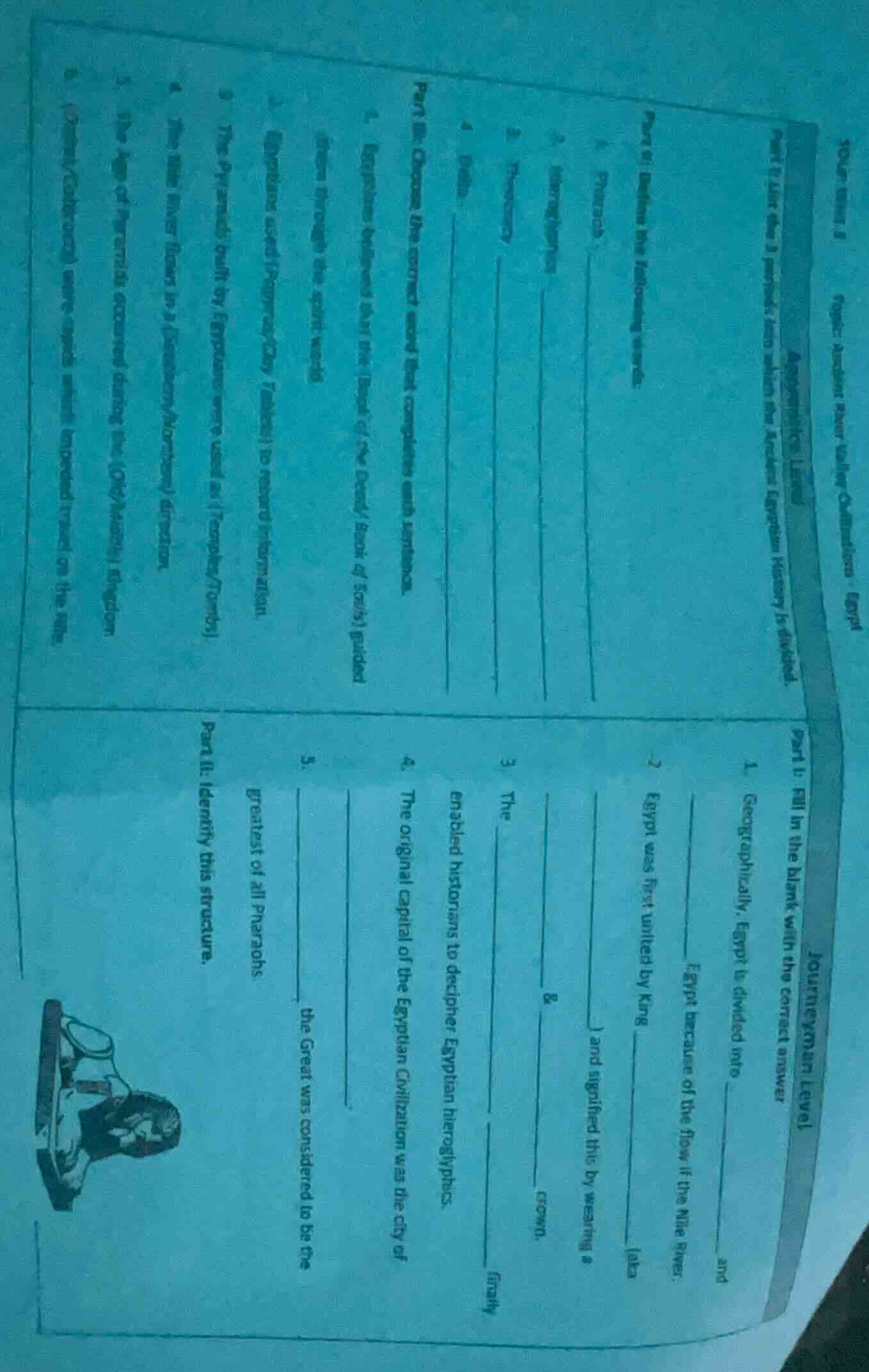
Question
your name
topic: ancient river valley civilizations - egypt
apprentice level
part i: list the 3 periods into which the ancient egyptian history is divided.
part ii: define the following words:
a. pharaoh
b. hieroglyphics
c. dynasty
d. mummy
part iii: choose the correct word that completes each sentence.
- egyptians believed that the (book of the dead / book of souls) guided them through the spirit world.
- egyptians used (papyrus / clay) to record information.
- the pyramids built by egyptians were used as (tombs / temples).
- the nile river flows in a (northeastern / southern) direction.
- the use of pyramids occurred during the (old / new) kingdom.
- (scribes / workers) were people who recorded in text on the nile.
journeywoman level
part i: fill in the blank with the correct answer
- geographically, egypt is divided into ____ and ____ egypt because of the flow if the nile river.
- egypt was first united by king ____ (aka __) and signified by wearing a __ & ____ crown.
- the ______ (finally) enabled historians to decipher egyptian hieroglyphics.
- the original capital of the egyptian civilization was the city of ______.
- ______ the great was considered to be the greatest of all pharaohs.
part ii: identify this structure.
image of a pyramid-like structure with a figure
To solve these questions about Ancient Egyptian history (subfield: History, under Social Science), we analyze each part:
Part I: Fill in the Blanks
- Geographically, Egypt is divided into \_\_\_\_ and \_\_\_\_ Egypt because of the flow of the Nile River.
- Egypt’s geography splits into Upper Egypt (southern, upstream) and Lower Egypt (northern, downstream) due to the Nile’s northward flow.
- Answer: Upper; Lower
- Egypt was first united by King \_\_\_\_.
- King Menes (or Narmer) is credited with unifying Upper and Lower Egypt around 3100 BCE.
- Answer: Menes (or Narmer)
- The \_\_\_\_ & \_\_\_\_ crown signified this [unification] by wearing a \_\_\_\_.
- The White Crown (Upper Egypt) and Red Crown (Lower Egypt) were combined into the Double Crown to symbolize unification.
- Answer: White; Red; Double Crown
- The \_\_\_\_ finally enabled historians to decipher Egyptian hieroglyphics.
- The Rosetta Stone, with text in hieroglyphics, demotic, and Greek, allowed scholars (e.g., Jean-François Champollion) to decode hieroglyphics.
- Answer: Rosetta Stone
- The original capital of the Egyptian Civilization was the city of \_\_\_.
- Memphis was the early capital of unified Egypt, established by Menes.
- Answer: Memphis
- \_\_\_\_ the Great was considered to be the greatest of all Pharaohs.
- Ramses II (Ramses the Great) is renowned for his military conquests, building projects, and long reign.
- Answer: Ramses
Part II: Identify this Structure
The image likely shows a Pharaoh’s bust (e.g., Tutankhamun, Ramses, or a sphinx/statue). If it’s a bust with a headdress, common examples include Tutankhamun’s mask or a sphinx. For a typical bust, the structure is a Pharaoh’s Statue/Bust (e.g., Tutankhamun’s funerary mask or a seated pharaoh statue).
Part III: Choose the Correct Word (Assuming Options for Each Sentence)
- Egyptians believed that the \_\_\_\_ (Book of the Dead / Book of Souls) guided them through the spirit world.
- The Book of the Dead contained spells/rituals for the afterlife.
- Answer: Book of the Dead
- Egyptians used \_\_\_\_ (papyrus / tablet) to record information.
- Papyrus (made from river reeds) was Egypt’s primary writing material.
- Answer: papyrus
- The Pyramids built by Egyptians were used as \_\_\_\_ (tombs / temples).
- Pyramids were tombs for pharaohs (e.g., Khufu’s Great Pyramid) to preserve their bodies for the afterlife.
- Answer: tombs
- The Nile River flows in a \_\_\_\_ (northern / southern) direction.
- The Nile flows northward from Uganda/Sudan to the Mediterranean.
- Answer: northern
- The use of pyramids occurred during the \_\_\_\_ (Old / New) Kingdom.
- Most major pyramids (e.g., Giza) were built in the Old Kingdom (2686–2181 BCE).
- Answer: Old
- Egyptian workers were paid \_\_\_\_ (food / money) which included rations on the site.
- Workers received food rations (grain, beer, etc.) as payment, not currency.
- Answer: food
Part IV: Define the Terms (Sample Definitions)
- Pharaoh: Egypt’s ruler, considered a god-king (e.g., Menes, Ramses).
- Hieroglyphics: Egyptian writing system with symbols/pictures (decoded via Rosetta Stone).
- Pyramid: Stone tomb for pharaohs (Old Kingdom), e.g., Great Pyramid of Giza.
- Nile: River vital to Egypt (irrigation, transportation, civilization).
Final Answers (Key Blanks)
- Upper; Lower
- Menes (Narmer)
- White; Red; Double Crown
- Rosetta Stone
- Memphis
- Ramses…

Snap & solve any problem in the app
Get step-by-step solutions on Sovi AI
Photo-based solutions with guided steps
Explore more problems and detailed explanations
To solve these questions about Ancient Egyptian history (subfield: History, under Social Science), we analyze each part:
Part I: Fill in the Blanks
- Geographically, Egypt is divided into \_\_\_\_ and \_\_\_\_ Egypt because of the flow of the Nile River.
- Egypt’s geography splits into Upper Egypt (southern, upstream) and Lower Egypt (northern, downstream) due to the Nile’s northward flow.
- Answer: Upper; Lower
- Egypt was first united by King \_\_\_\_.
- King Menes (or Narmer) is credited with unifying Upper and Lower Egypt around 3100 BCE.
- Answer: Menes (or Narmer)
- The \_\_\_\_ & \_\_\_\_ crown signified this [unification] by wearing a \_\_\_\_.
- The White Crown (Upper Egypt) and Red Crown (Lower Egypt) were combined into the Double Crown to symbolize unification.
- Answer: White; Red; Double Crown
- The \_\_\_\_ finally enabled historians to decipher Egyptian hieroglyphics.
- The Rosetta Stone, with text in hieroglyphics, demotic, and Greek, allowed scholars (e.g., Jean-François Champollion) to decode hieroglyphics.
- Answer: Rosetta Stone
- The original capital of the Egyptian Civilization was the city of \_\_\_.
- Memphis was the early capital of unified Egypt, established by Menes.
- Answer: Memphis
- \_\_\_\_ the Great was considered to be the greatest of all Pharaohs.
- Ramses II (Ramses the Great) is renowned for his military conquests, building projects, and long reign.
- Answer: Ramses
Part II: Identify this Structure
The image likely shows a Pharaoh’s bust (e.g., Tutankhamun, Ramses, or a sphinx/statue). If it’s a bust with a headdress, common examples include Tutankhamun’s mask or a sphinx. For a typical bust, the structure is a Pharaoh’s Statue/Bust (e.g., Tutankhamun’s funerary mask or a seated pharaoh statue).
Part III: Choose the Correct Word (Assuming Options for Each Sentence)
- Egyptians believed that the \_\_\_\_ (Book of the Dead / Book of Souls) guided them through the spirit world.
- The Book of the Dead contained spells/rituals for the afterlife.
- Answer: Book of the Dead
- Egyptians used \_\_\_\_ (papyrus / tablet) to record information.
- Papyrus (made from river reeds) was Egypt’s primary writing material.
- Answer: papyrus
- The Pyramids built by Egyptians were used as \_\_\_\_ (tombs / temples).
- Pyramids were tombs for pharaohs (e.g., Khufu’s Great Pyramid) to preserve their bodies for the afterlife.
- Answer: tombs
- The Nile River flows in a \_\_\_\_ (northern / southern) direction.
- The Nile flows northward from Uganda/Sudan to the Mediterranean.
- Answer: northern
- The use of pyramids occurred during the \_\_\_\_ (Old / New) Kingdom.
- Most major pyramids (e.g., Giza) were built in the Old Kingdom (2686–2181 BCE).
- Answer: Old
- Egyptian workers were paid \_\_\_\_ (food / money) which included rations on the site.
- Workers received food rations (grain, beer, etc.) as payment, not currency.
- Answer: food
Part IV: Define the Terms (Sample Definitions)
- Pharaoh: Egypt’s ruler, considered a god-king (e.g., Menes, Ramses).
- Hieroglyphics: Egyptian writing system with symbols/pictures (decoded via Rosetta Stone).
- Pyramid: Stone tomb for pharaohs (Old Kingdom), e.g., Great Pyramid of Giza.
- Nile: River vital to Egypt (irrigation, transportation, civilization).
Final Answers (Key Blanks)
- Upper; Lower
- Menes (Narmer)
- White; Red; Double Crown
- Rosetta Stone
- Memphis
- Ramses
(For Part II, specify the structure based on the image; e.g., "Tutankhamun’s Funerary Mask" or "Great Sphinx" if applicable.)