QUESTION IMAGE
Question
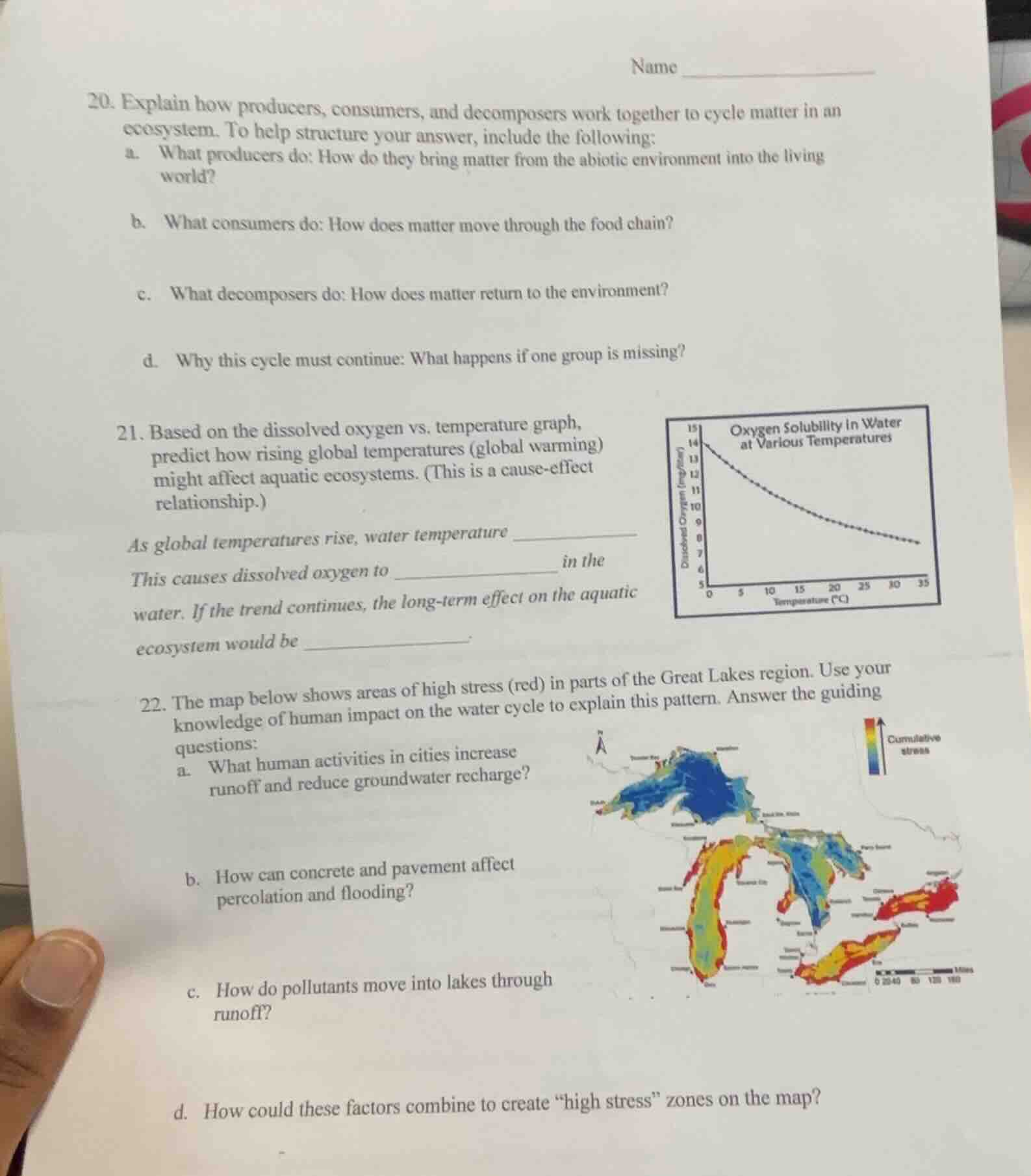
name20. explain how producers, consumers, and decomposers work together to cycle matter in an ecosystem. to help structure your answer, include the following:a. what producers do: how do they bring matter from the abiotic environment into the living world?b. what consumers do: how does matter move through the food chain?c. what decomposers do: how does matter return to the environment?d. why this cycle must continue: what happens if one group is missing?21. based on the dissolved oxygen vs. temperature graph, predict how rising global temperatures might affect aquatic ecosystems.as global temperatures rise, water temperature _____________this causes dissolved oxygen to ___________ in the water. if the trend continues, the long-term effect on the aquatic ecosystem would be _____________.22. the map below shows areas of high stress in parts of the great lakes region. use your knowledge of human impact on the water cycle to explain this pattern. answer the guiding questions:a. what human activities in cities increase runoff and reduce groundwater recharge?b. how can concrete and pavement affect percolation and flooding?c. how do pollutants move into lakes through runoff?d. how could these factors combine to create high stress zones on the map?
Question 20
a. Producers use photosynthesis to take in abiotic matter (like carbon dioxide, water, and nutrients) and convert it into organic matter that becomes part of their bodies, making it available to living organisms.
b. Consumers eat producers or other consumers, taking in the organic matter from those organisms. As they digest and use the matter for energy and growth, it moves up the food chain from lower to higher trophic levels.
c. Decomposers break down dead producers, consumers, and waste products. They break down organic matter into simple abiotic nutrients (like nitrogen, phosphorus, carbon) that are released back into soil, water, and air, making them available again for producers.
d. The cycle must continue because matter is finite and must be reused. If producers are missing, no new organic matter is created, so consumers and decomposers have no food source. If consumers are missing, producers may overpopulate and matter can't move to higher trophic levels, and decomposers receive less organic waste. If decomposers are missing, organic matter accumulates, and abiotic nutrients are not recycled, so producers can't make new organic matter, collapsing the ecosystem.
From the graph, dissolved oxygen in water has an inverse relationship with temperature. As temperature rises, dissolved oxygen levels drop. For aquatic ecosystems, lower dissolved oxygen means less oxygen available for aquatic organisms like fish, invertebrates, and plants that rely on it for respiration.
a. Urban activities like constructing buildings, roads, and parking lots replace natural vegetation and soil. Additionally, activities like clearing land for development reduce areas where water can infiltrate the ground.
b. Concrete and pavement are impermeable, so water cannot percolate through them into the groundwater. Instead, water runs off quickly, overwhelming drainage systems and increasing the risk of flooding.
c. Pollutants like fertilizers, pesticides, oil, and sewage collect on surfaces like roads and lawns. When it rains, runoff carries these pollutants directly into lakes, as there is no natural soil or vegetation to filter them out.
d. High-stress zones are in developed, populated areas. Increased runoff from impermeable surfaces floods areas, carries pollutants into lakes, and reduced groundwater recharge lowers water tables. This combination leads to water pollution, habitat destruction, and degraded water quality, creating the high-stress zones.

Snap & solve any problem in the app
Get step-by-step solutions on Sovi AI
Photo-based solutions with guided steps
Explore more problems and detailed explanations
a. Producers use photosynthesis to convert abiotic matter (CO₂, water, nutrients) into organic matter, introducing it to the living world.
b. Consumers eat other organisms, transferring organic matter through trophic levels of the food chain as they use it for energy and growth.
c. Decomposers break down dead organic material, releasing simple abiotic nutrients back into the non-living environment.
d. The cycle recycles finite matter. Missing producers: no new organic matter, ecosystem collapses. Missing consumers: unbalanced producer populations, blocked matter flow. Missing decomposers: trapped nutrients, producers can't replenish organic matter, ecosystem fails.
---