QUESTION IMAGE
Question
no additional details were added for this assignment.
surrendered. i tried hard to bring you into ambush, but
your last general understands indian fighting. the first
one was not so wise. when i saw that i could not beat
you by indian fighting, i determined to rush on you, and
fight you face to face. i fought hard. but your guns were
well aimed. the bullets flew like birds in the air, and
whizzed by our ears like the wind through the trees in the
winter. my warriors fell around me; it began to look
dismal. i saw my evil day at hand. the sun rose dim on
us in the morning, and at night it sunk in a dark cloud,
and looked like a ball of fire. that was the last sun that
shone on black hawk. his heart is dead, and no longer
beats quick in his bosom. he is now a prisoner to the
white men; they will do with him as they wish. but he can
stand torture, and is not afraid of death. he is no coward.
black hawk is an indian.
he has done nothing for which an indian ought to be
ashamed. he has fought for his countrymen, the squaws
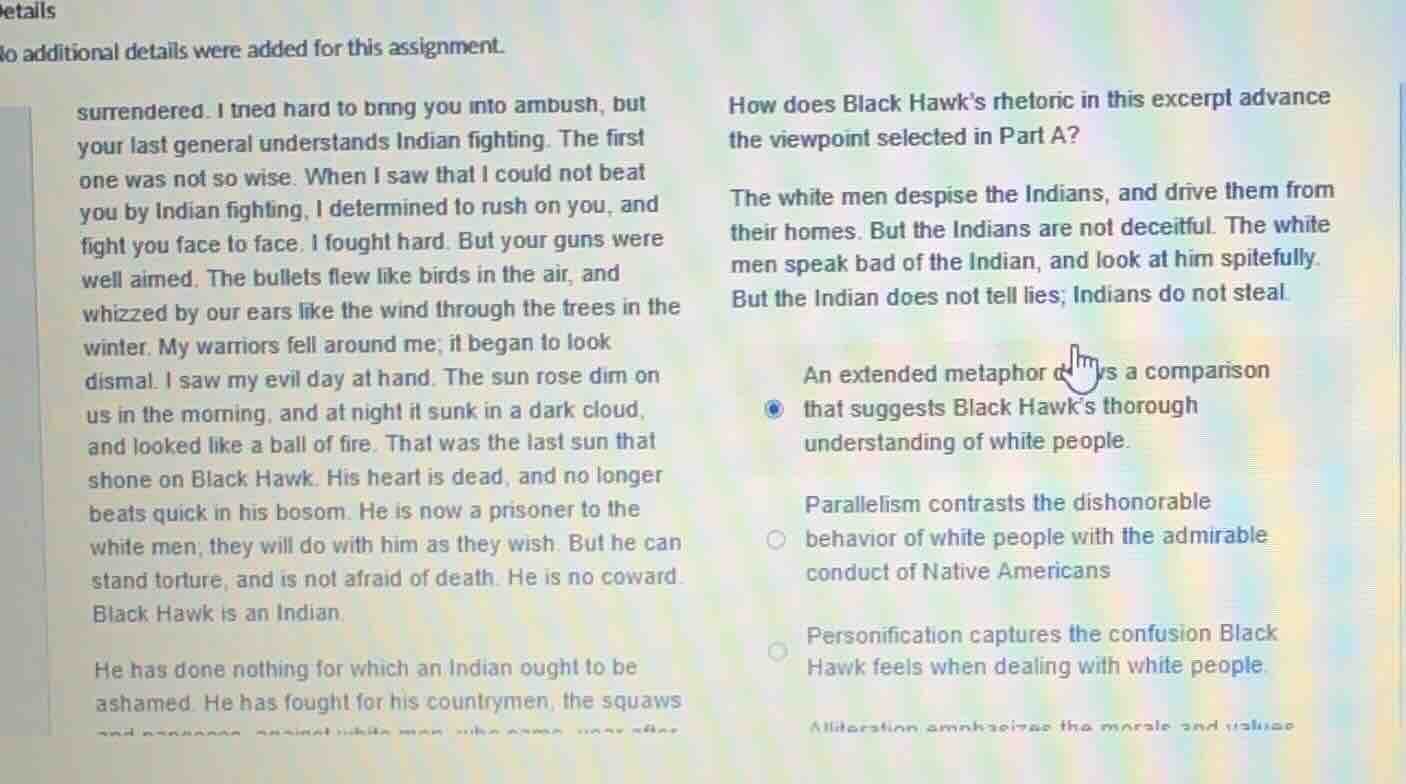
how does black hawk’s rhetoric in this excerpt advance
the viewpoint selected in part a?
the white men despise the indians, and drive them from
their homes. but the indians are not deceitful. the white
men speak bad of the indian, and look at him spitefully.
but the indian does not tell lies; indians do not steal.
an extended metaphor uses a comparison
that suggests black hawk’s thorough
understanding of white people.
parallelism contrasts the dishonorable
behavior of white people with the admirable
conduct of native americans
personification captures the confusion black
hawk feels when dealing with white people.
alliteration emphasizes the morale and resolve
The second excerpt uses parallel structure (repeating the contrast between white men's actions and Native Americans' traits: "The white men... But the Indians...") to highlight the dishonesty of white people against the integrity of Native Americans. This directly advances a viewpoint about the unfair treatment and moral differences between the groups. The other options are incorrect: the first option misidentifies the rhetorical device, the third option's personification is not present, and the fourth option's alliteration is not used for this purpose.

Snap & solve any problem in the app
Get step-by-step solutions on Sovi AI
Photo-based solutions with guided steps
Explore more problems and detailed explanations
B. Parallelism contrasts the dishonorable behavior of white people with the admirable conduct of Native Americans