QUESTION IMAGE
Question
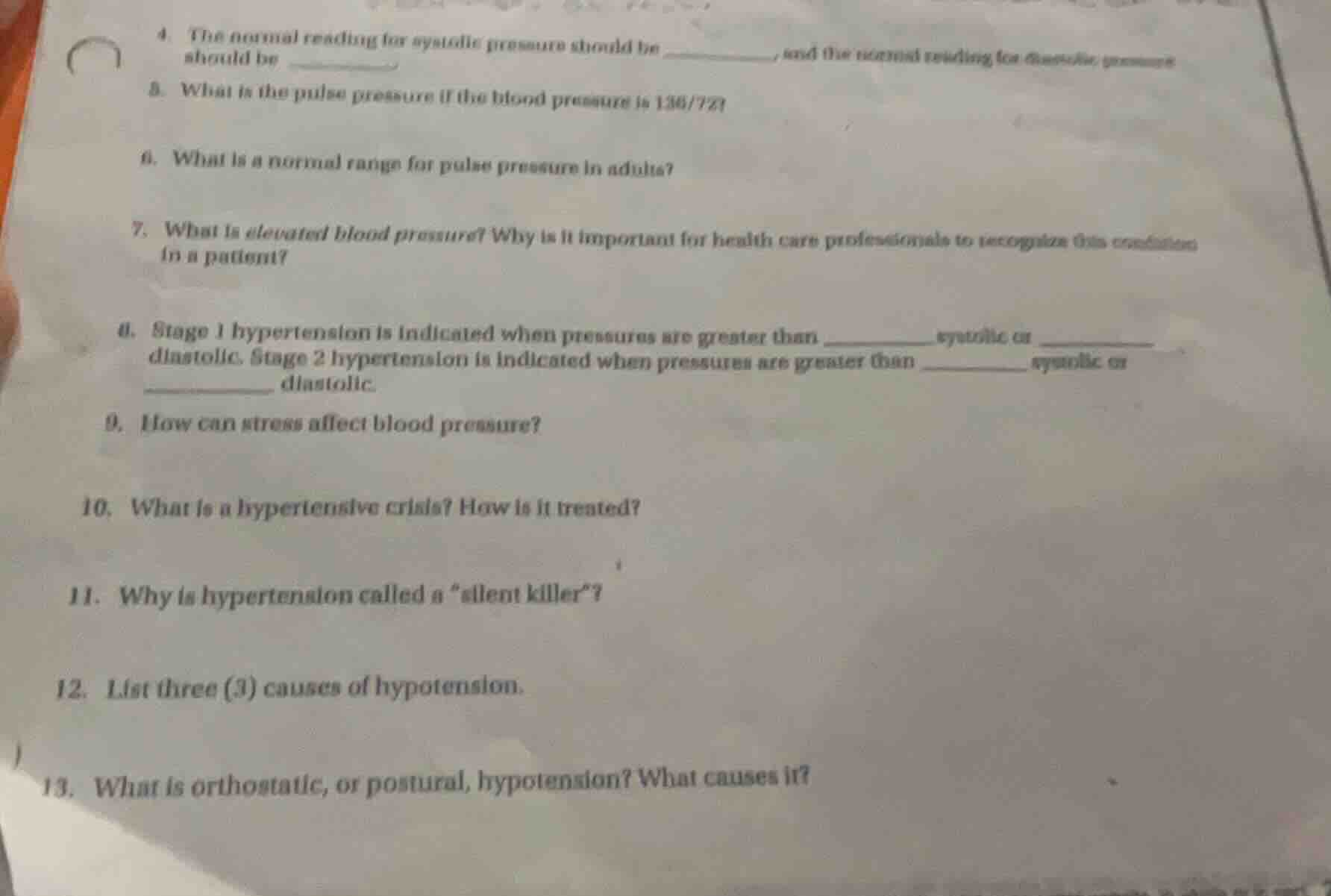
- the normal reading for systolic pressure should be ____, and the normal reading for diastolic pressure should be ____.
- what is the pulse pressure if the blood pressure is 136/72?
- what is a normal range for pulse pressure in adults?
- what is elevated blood pressure? why is it important for health care professionals to recognize this condition in a patient?
- stage 1 hypertension is indicated when pressures are greater than ____ systolic or __ diastolic. stage 2 hypertension is indicated when pressures are greater than __ systolic or ____ diastolic.
- how can stress affect blood pressure?
- what is a hypertensive crisis? how is it treated?
- why is hypertension called a \silent killer\?
- list three (3) causes of hypotension.
- what is orthostatic, or postural, hypotension? what causes it?
Brief Explanations
- For question 4: Standard clinical guidelines define normal blood pressure values.
- For question 5: Pulse pressure is calculated as systolic minus diastolic pressure.
- For question 6: This is a standard clinical reference range for adult pulse pressure.
- For question 7: Elevated blood pressure is a pre-hypertensive state, and early recognition prevents progression to hypertension and related complications.
- For question 8: Values are based on clinical hypertension staging guidelines from major health organizations.
- For question 9: Stress triggers hormonal responses that impact blood vessel and heart function.
- For question 10: Hypertensive crisis is a severe, life-threatening blood pressure spike, with established emergency treatment protocols.
- For question 11: The nickname comes from the lack of obvious symptoms until severe organ damage occurs.
- For question 12: These are common, clinically recognized causes of low blood pressure.
- For question 13: This is a specific type of hypotension linked to postural changes, with defined physiological causes.

Snap & solve any problem in the app
Get step-by-step solutions on Sovi AI
Photo-based solutions with guided steps
Explore more problems and detailed explanations
- The normal reading for systolic pressure should be less than 120 mmHg, and the normal reading for diastolic pressure should be less than 80 mmHg
- 64 mmHg
- 40 mmHg to 60 mmHg
- Elevated blood pressure is defined as a systolic reading of 120-129 mmHg and a diastolic reading less than 80 mmHg. It is important for healthcare professionals to recognize it because it is a pre-hypertensive state that can progress to full hypertension; early intervention (lifestyle changes, monitoring) can prevent the development of chronic high blood pressure, heart disease, stroke, and kidney damage.
- Stage 1 hypertension is indicated when pressures are greater than 130 mmHg systolic or 80 mmHg diastolic. Stage 2 hypertension is indicated when pressures are greater than 140 mmHg systolic or 90 mmHg diastolic.
- Stress triggers the release of hormones like adrenaline and cortisol, which cause blood vessels to narrow and the heart to beat faster. This temporarily increases blood pressure. Chronic, long-term stress can lead to sustained high blood pressure as the body remains in this heightened state over time.
- A hypertensive crisis is a sudden, severe spike in blood pressure (typically systolic >180 mmHg or diastolic >120 mmHg) that can damage organs like the brain, heart, kidneys, or eyes. It is treated with immediate intravenous (IV) blood pressure medications (such as labetalol or nitroprusside) in a hospital setting to safely lower blood pressure gradually, along with monitoring and treatment for any resulting organ damage.
- Hypertension is called a "silent killer" because it usually has no obvious, noticeable symptoms in its early stages. Many people do not know they have high blood pressure until it causes serious, life-threatening complications like heart attack, stroke, kidney failure, or heart failure.
- - Dehydration (loss of fluids and electrolytes)
- Heart conditions (such as heart failure or bradycardia)
- Severe blood loss (from injury, internal bleeding, or surgery)
- Orthostatic (postural) hypotension is a sudden drop in blood pressure that occurs when a person stands up from a sitting or lying down position, leading to symptoms like dizziness, lightheadedness, or fainting. It is caused by a delayed or insufficient response from the nervous system to constrict blood vessels and increase heart rate when standing, which can be due to aging, dehydration, certain medications (like diuretics or blood pressure drugs), or nervous system disorders.