QUESTION IMAGE
Question
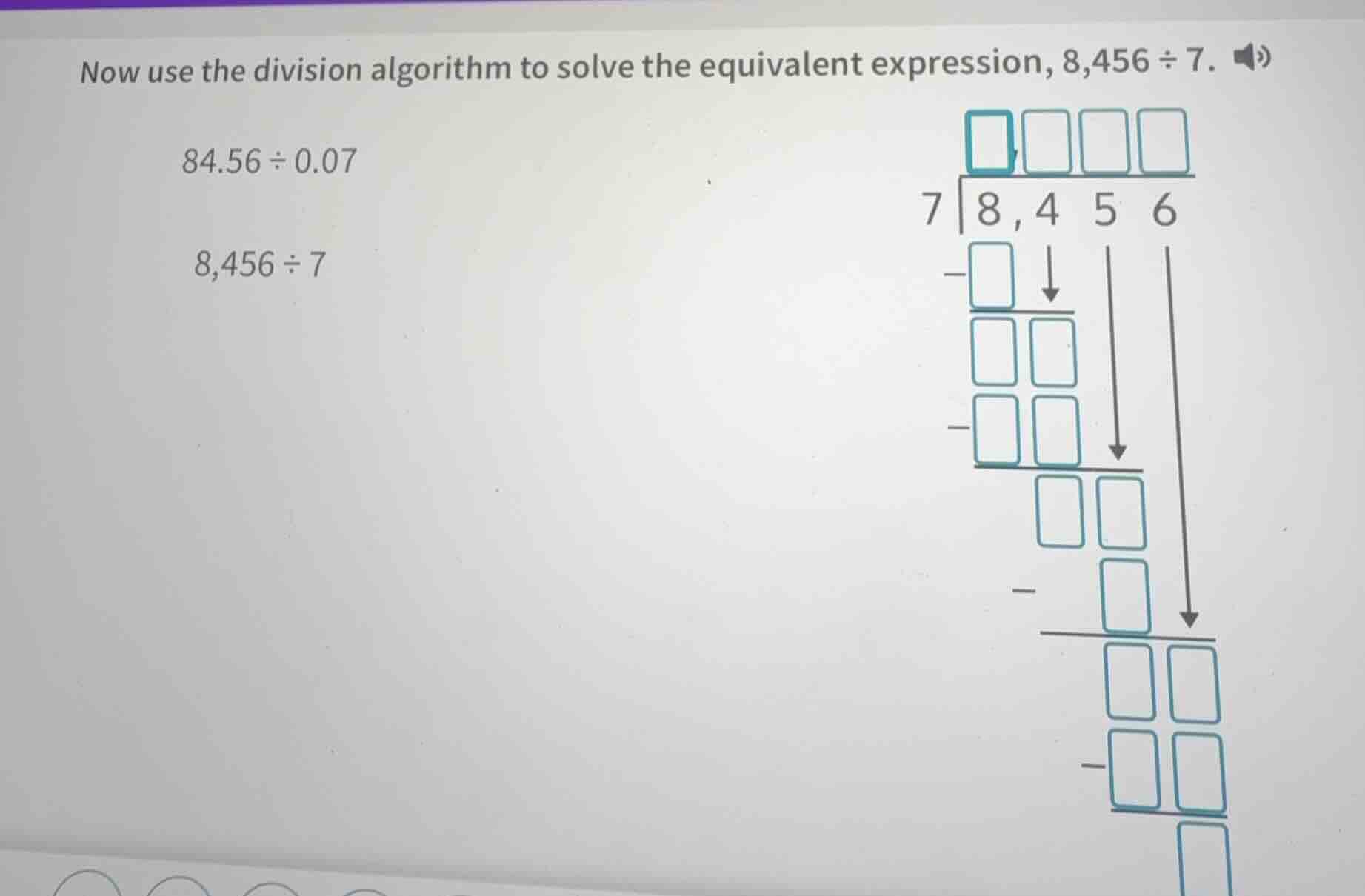
now use the division algorithm to solve the equivalent expression, 8,456 ÷ 7. 84.56 ÷ 0.07 8,456 ÷ 7
Step1: Divide thousands place
Divide 8 (thousands place) by 7. \( 8 \div 7 = 1 \) with remainder 1. Write 1 above thousands place. Subtract \( 7 \times 1 = 7 \) from 8, get 1.
Step2: Bring down 4
Bring down 4 (hundreds place) to make 14. \( 14 \div 7 = 2 \). Write 2 above hundreds place. Subtract \( 7 \times 2 = 14 \) from 14, get 0.
Step3: Bring down 5
Bring down 5 (tens place) to make 5. \( 5 \div 7 = 0 \) (quotient 0, write above tens place). Bring down 6 (units place) to make 56.
Step4: Divide 56 by 7
\( 56 \div 7 = 8 \). Write 8 above units place. Subtract \( 7 \times 8 = 56 \) from 56, get 0.
Filling the long - division boxes:
- Top quotient: 1 (thousands), 2 (hundreds), 0 (tens), 8 (units) → 1208.
- First subtraction: 7 (under 8).
- After first subtraction: 1 (below 8 - 7), then bring down 4 to make 14.
- Second subtraction: 14 (under 14).
- After second subtraction: 0 (below 14 - 14), bring down 5 to make 5, then bring down 6 to make 56.
- Third subtraction: 0 (but since we had 5, we write 0 above tens place, then when we have 56, \( 7\times8 = 56 \), so subtraction is 56 under 56).
- Final remainder: 0.

Snap & solve any problem in the app
Get step-by-step solutions on Sovi AI
Photo-based solutions with guided steps
Explore more problems and detailed explanations
The result of \( 8456\div7 \) (and also \( 84.56\div0.07 \)) is \( 1208 \). And the long - division boxes are filled as follows:
- Quotient: \( 1\), \( 2\), \( 0\), \( 8 \)
- First subtraction: \( 7 \)
- After first subtraction: \( 1 \) (then with 4 becomes 14)
- Second subtraction: \( 14 \)
- After second subtraction: \( 0 \) (then with 5 becomes 5, then with 6 becomes 56)
- Third subtraction: \( 56 \)
- Final remainder: \( 0 \)