QUESTION IMAGE
Question
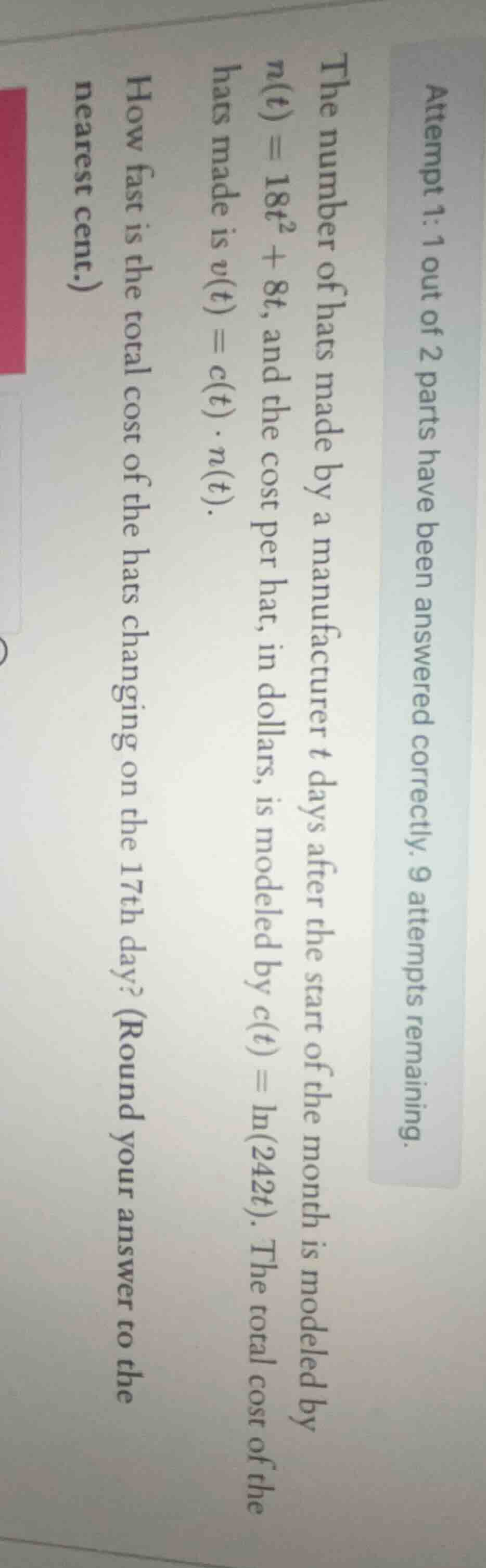
the number of hats made by a manufacturer ( t ) days after the start of the month is modeled by ( n(t) = 18t^2 + 8t ), and the cost per hat, in dollars, is modeled by ( c(t) = ln(242t) ). the total cost of the hats made is ( v(t) = c(t) cdot n(t) ). how fast is the total cost of the hats changing on the 17th day? (round your answer to the nearest cent.)
Step1: Find the derivative of \( v(t) \) using the product rule
The product rule states that if \( v(t) = c(t) \cdot n(t) \), then \( v'(t) = c'(t) \cdot n(t) + c(t) \cdot n'(t) \). First, find \( n'(t) \) and \( c'(t) \).
Given \( n(t) = 18t^2 + 8t \), so \( n'(t) = 36t + 8 \) (using the power rule: \( \frac{d}{dt}(t^n) = nt^{n - 1} \)).
Given \( c(t) = \ln(242t) \), we can rewrite \( \ln(242t) = \ln(242) + \ln(t) \), so \( c'(t) = \frac{1}{t} \) (since the derivative of \( \ln(t) \) is \( \frac{1}{t} \) and the derivative of a constant \( \ln(242) \) is 0).
Step2: Substitute \( t = 17 \) into the derivative formula
Now, substitute \( t = 17 \) into \( c(t) \), \( n(t) \), \( c'(t) \), and \( n'(t) \):
- \( n(17) = 18(17)^2 + 8(17) = 18(289) + 136 = 5202 + 136 = 5338 \)
- \( c(17) = \ln(242 \times 17) = \ln(4114) \approx 8.321 \) (using a calculator to find the natural logarithm)
- \( c'(17) = \frac{1}{17} \approx 0.0588 \)
- \( n'(17) = 36(17) + 8 = 612 + 8 = 620 \)
Now, use the product rule:
\( v'(17) = c'(17) \cdot n(17) + c(17) \cdot n'(17) \)
Substitute the values:
\( v'(17) = \frac{1}{17} \times 5338 + \ln(4114) \times 620 \)
Calculate each term:
First term: \( \frac{5338}{17} = 314 \)
Second term: \( \ln(4114) \times 620 \approx 8.321 \times 620 \approx 5159.02 \)
Now, add the two terms:
\( v'(17) \approx 314 + 5159.02 = 5473.02 \)

Snap & solve any problem in the app
Get step-by-step solutions on Sovi AI
Photo-based solutions with guided steps
Explore more problems and detailed explanations
The total cost of the hats is changing at a rate of approximately \(\$5473.02\) per day on the 17th day.