QUESTION IMAGE
Question
object c:
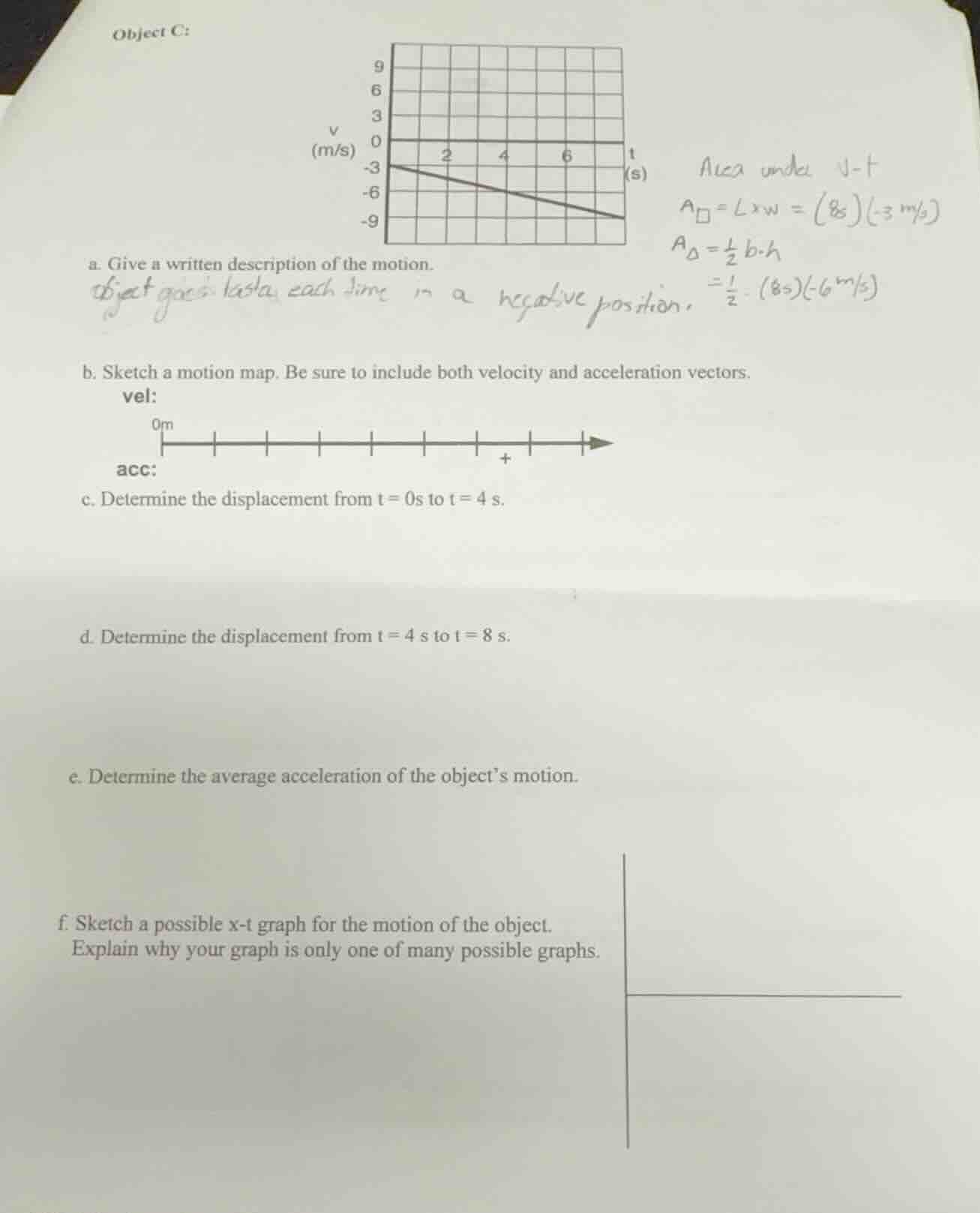
a. give a written description of the motion.
b. sketch a motion map. be sure to include both velocity and acceleration vectors.
vel:
acc:
c. determine the displacement from t = 0s to t = 4 s.
d. determine the displacement from t = 4 s to t = 8 s.
e. determine the average acceleration of the object’s motion.
f. sketch a possible x-t graph for the motion of the object.
explain why your graph is only one of many possible graphs.
Part a: Written Description of Motion
The velocity - time (v - t) graph shows that the object starts with an initial velocity of \(v_0=- 3\space m/s\) (negative sign indicates motion in the negative direction) at \(t = 0\space s\). The velocity is decreasing linearly (since the v - t graph is a straight line with negative slope), which means the object is accelerating in the negative direction (decelerating in the positive direction or accelerating negatively). So the object is moving in the negative direction and speeding up (because acceleration and velocity are in the same direction, both negative) as time progresses.
Step 1: Recall the formula for displacement from a \(v - t\) graph
The displacement of an object from a velocity - time graph is given by the area under the \(v - t\) curve between the two time instants. For a linear \(v - t\) graph (a straight line), the area under the curve is the area of a trapezoid (or a triangle in some cases, here it's a trapezoid with bases \(v_0\) and \(v_4\) and height \(\Delta t\)). The formula for the area of a trapezoid is \(A=\frac{1}{2}(b_1 + b_2)h\), where \(b_1\) and \(b_2\) are the lengths of the two parallel sides and \(h\) is the distance between them. In the context of \(v - t\) graph, \(b_1=v(0)\), \(b_2 = v(4)\) and \(h=\Delta t=t_2 - t_1\)
First, we need to find \(v(4)\). The slope of the \(v - t\) graph is constant (since it's a straight line). The slope \(m=\frac{\Delta v}{\Delta t}\). From \(t = 0\) to \(t = 8\), \(v(0)=-3\space m/s\) and \(v(8)=-9\space m/s\). So the slope \(m=\frac{-9-(-3)}{8 - 0}=\frac{-6}{8}=- 0.75\space m/s^2\)
At \(t = 4\space s\), \(v(4)=v(0)+m\times(4 - 0)=-3+(-0.75)\times4=-3 - 3=-6\space m/s\)
Step 2: Calculate the area (displacement)
The time interval \(\Delta t=4 - 0 = 4\space s\). The two velocities at \(t = 0\) and \(t = 4\) are \(v_0=-3\space m/s\) and \(v_4=-6\space m/s\)
Using the formula for the area of a trapezoid \(A=\frac{1}{2}(v_0 + v_4)\times\Delta t\)
Substitute \(v_0=-3\space m/s\), \(v_4=-6\space m/s\) and \(\Delta t = 4\space s\) into the formula:
\(A=\frac{1}{2}(-3+(-6))\times4=\frac{1}{2}(-9)\times4=- 18\space m\)
Step 1: Recall the formula for displacement from \(v - t\) graph
Again, displacement is the area under the \(v - t\) curve. From \(t = 4\) to \(t = 8\), the \(v - t\) graph is a straight line. We can use the formula for the area of a trapezoid (or a triangle, here it's a trapezoid with bases \(v(4)\) and \(v(8)\) and height \(\Delta t\))
We know \(v(4)=-6\space m/s\) and \(v(8)=-9\space m/s\), \(\Delta t=8 - 4 = 4\space s\)
Step 2: Calculate the area (displacement)
Using the trapezoid area formula \(A=\frac{1}{2}(b_1 + b_2)h\), where \(b_1 = v(4)=-6\space m/s\), \(b_2=v(8)=-9\space m/s\) and \(h = 4\space s\)
\(A=\frac{1}{2}(-6+(-9))\times4=\frac{1}{2}(-15)\times4=-30\space m\)

Snap & solve any problem in the app
Get step-by-step solutions on Sovi AI
Photo-based solutions with guided steps
Explore more problems and detailed explanations
The object starts with an initial velocity of \(-3\space m/s\) (moving in the negative direction) at \(t = 0\space s\). It has a constant negative acceleration (since the \(v - t\) graph is a straight line with negative slope), so it is moving in the negative direction and speeding up as time increases.