QUESTION IMAGE
Question
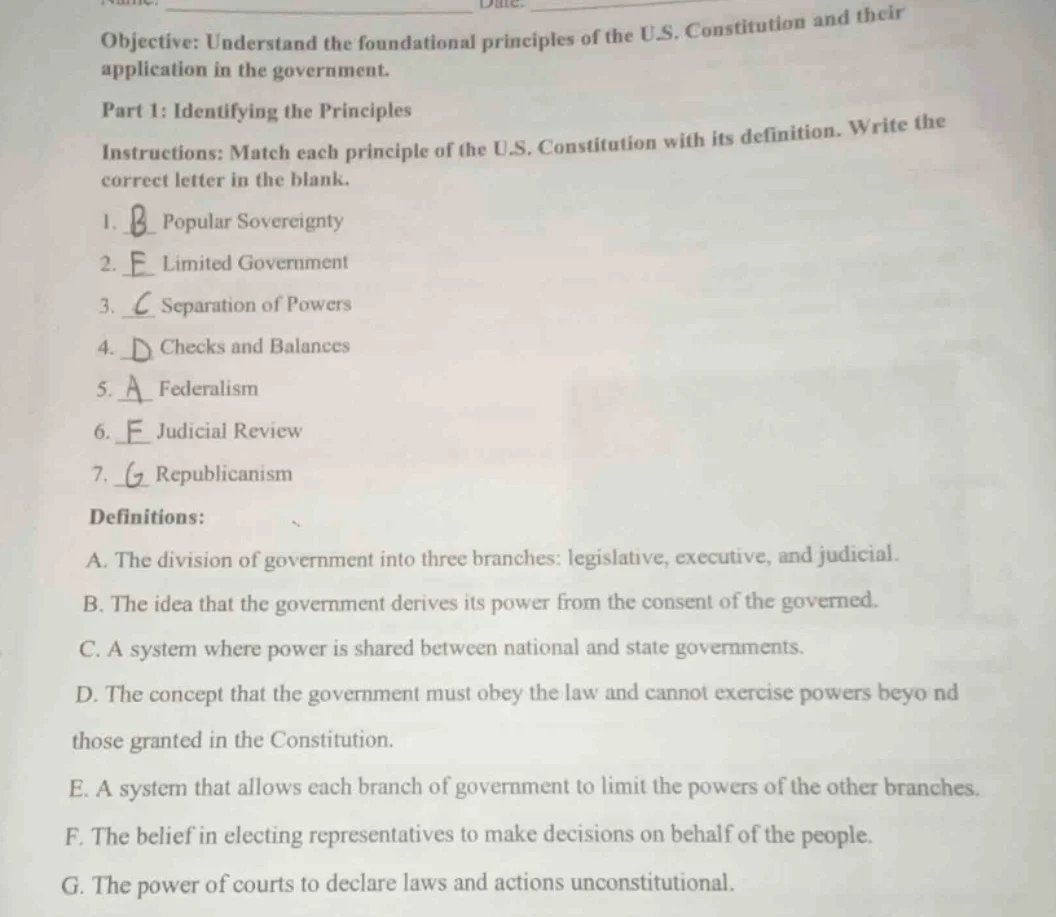
objective: understand the foundational principles of the u.s. constitution and their application in the government. part 1: identifying the principles instructions: match each principle of the u.s. constitution with its definition. write the correct letter in the blank. 1. popular sovereignty 2. limited government 3. separation of powers 4. checks and balances 5. federalism 6. judicial review 7. republicanism definitions: a. the division of government into three branches: legislative, executive, and judicial. b. the idea that the government derives its power from the consent of the governed. c. a system where power is shared between national and state governments. d. the concept that the government must obey the law and cannot exercise powers beyond those granted in the constitution. e. a system that allows each branch of government to limit the powers of the other branches. f. the belief in electing representatives to make decisions on behalf of the people. g. the power of courts to declare laws and actions unconstitutional.
- Popular Sovereignty: The definition B says the government gets power from the consent of the governed, which matches Popular Sovereignty. So 1 - B.
- Limited Government: Definition D states the government must obey the law and can't exceed constitutional powers, so 2 - D (Note: There was a typo in the original with 2 and 6 both marked F, but based on definitions, Limited Government is D).
- Separation of Powers: Definition A is about dividing government into three branches, so 3 - A.
- Checks and Balances: Definition E is about each branch limiting others' powers, so 4 - E.
- Federalism: Definition C is about sharing power between national and state governments, so 5 - C.
- Judicial Review: Definition G is about courts declaring laws/actions unconstitutional, so 6 - G.
- Republicanism: Definition F is about electing representatives, so 7 - F.

Snap & solve any problem in the app
Get step-by-step solutions on Sovi AI
Photo-based solutions with guided steps
Explore more problems and detailed explanations
- B. The idea that the government derives its power from the consent of the governed.
- D. The concept that the government must obey the law and cannot exercise powers beyond those granted in the Constitution.
- A. The division of government into three branches: legislative, executive, and judicial.
- E. A system that allows each branch of government to limit the powers of the other branches.
- C. A system where power is shared between national and state governments.
- G. The power of courts to declare laws and actions unconstitutional.
- F. The belief in electing representatives to make decisions on behalf of the people.