QUESTION IMAGE
Question
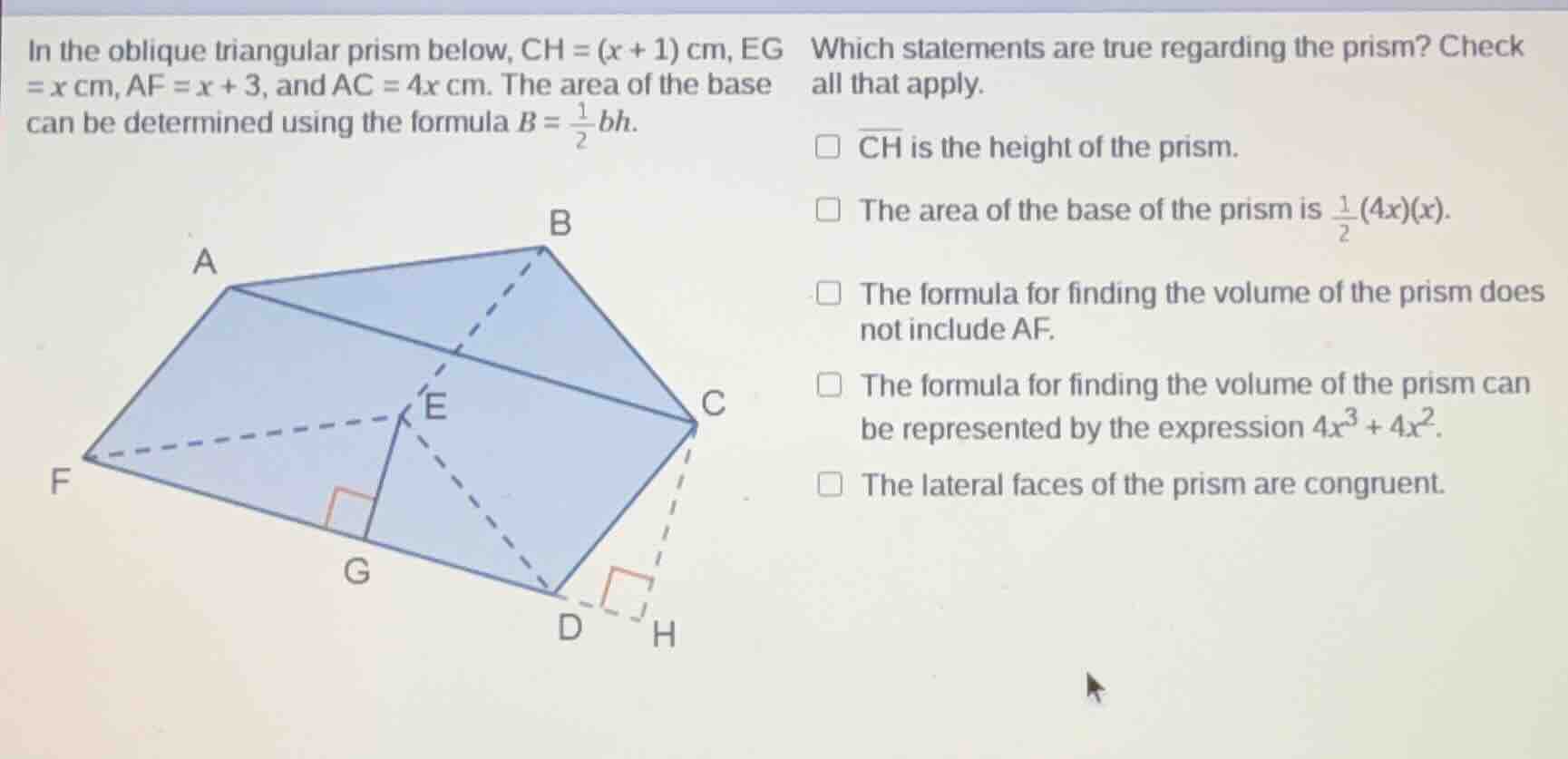
in the oblique triangular prism below, ch = (x + 1) cm, eg = x cm, af = x + 3, and ac = 4x cm. the area of the base can be determined using the formula ( b = \frac{1}{2}bh ). which statements are true regarding the prism? check all that apply.
(square) (overline{ch}) is the height of the prism.
(square) the area of the base of the prism is (\frac{1}{2}(4x)(x)).
(square) the formula for finding the volume of the prism does not include af.
(square) the formula for finding the volume of the prism can be represented by the expression (4x^3 + 4x^2).
(square) the lateral faces of the prism are congruent.
Step1: Analyze prism height
In an oblique prism, the height is the perpendicular distance between the two bases. $\overline{CH}$ is perpendicular to the base face (marked with a right angle), so it is the height.
Step2: Calculate base area
The base is a triangle with base $AC=4x$ and height $EG=x$. Using $B=\frac{1}{2}bh$, substitute values:
$B=\frac{1}{2}(4x)(x)$
Step3: Check volume formula components
Volume of a prism is $V = B \times h_{prism}$. Here, $h_{prism}=CH=x+1$, $B=\frac{1}{2}(4x)(x)=2x^2$. $AF$ is a lateral edge, not used in volume calculation.
Step4: Compute volume expression
Substitute $B$ and $h_{prism}$ into volume formula:
$V = 2x^2 \times (x+1) = 2x^3 + 2x^2$
Step5: Analyze lateral faces
In an oblique prism, lateral faces are parallelograms with different side lengths/angles, so they are not congruent.

Snap & solve any problem in the app
Get step-by-step solutions on Sovi AI
Photo-based solutions with guided steps
Explore more problems and detailed explanations
- $\overline{CH}$ is the height of the prism.
- The area of the base of the prism is $\frac{1}{2}(4x)(x)$.
- The formula for finding the volume of the prism does not include AF.