QUESTION IMAGE
Question
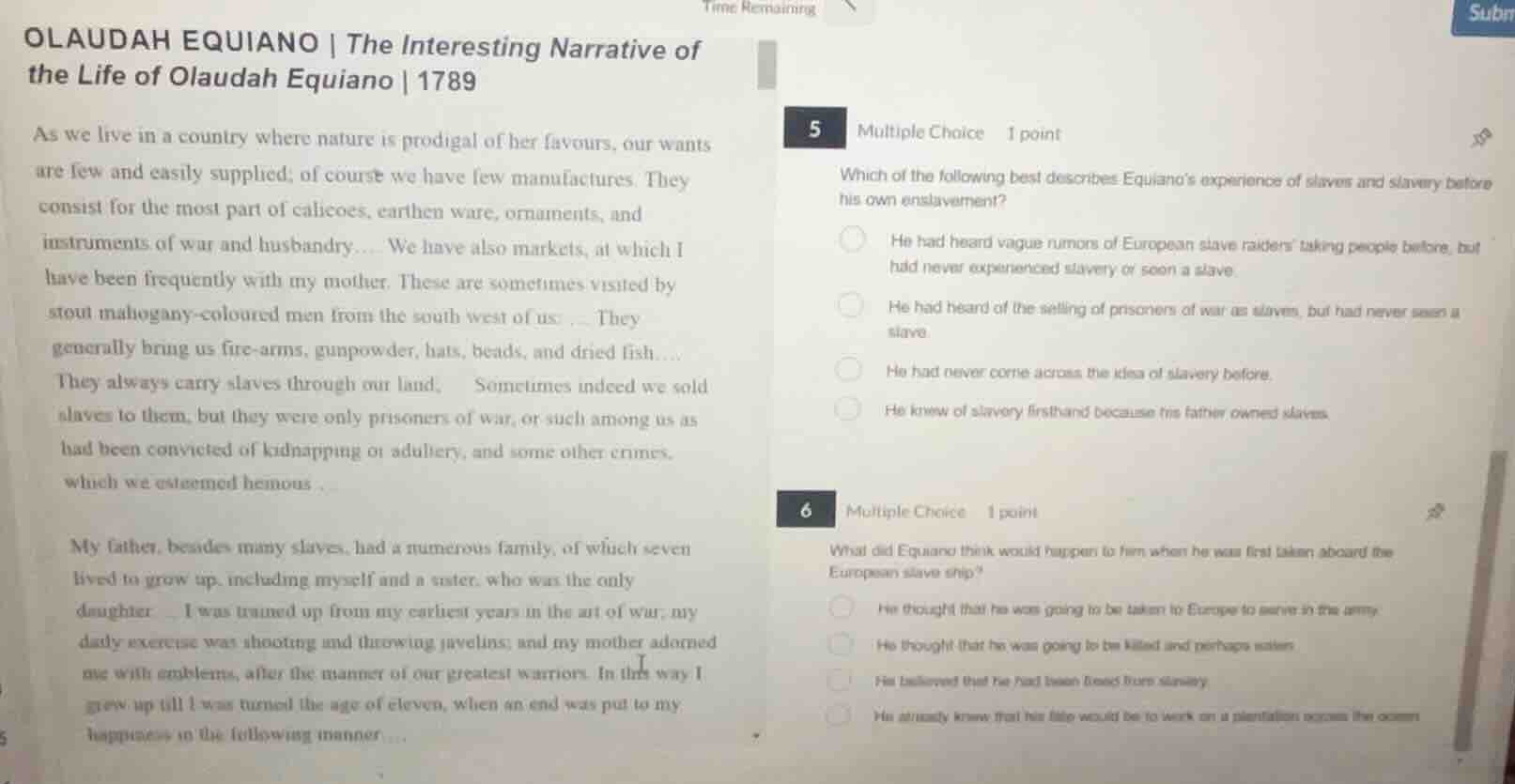
olaudan equiano | the interesting narrative of the life of olaudah equiano | 1789 as we live in a country where nature is prodigal of her favours, our wants are few and easily supplied; of course we have few manufactures. they consist for the most part of calicoes, earthen ware, ornaments, and instruments of war and husbandry... we have also markets, at which i have been frequently with my mother. these are sometimes visited by stout mahogany - coloured men from the south west of us... they generally bring us fire - arms, gunpowder, hats, beads, and dried fish... they always carry slaves through our land, sometimes indeed we sold slaves to them, but they were only prisoners of war, or such among us as had been convicted of kidnapping or adultery, and some other crimes, which we esteemed heinous. my father, besides many slaves, had a numerous family, of which seven lived to grow up, including myself and a sister, who was the only daughter i was trained up from my earliest years in the art of war; my daily exercise was shooting and throwing javelins; and my mother adorned me with emblems, after the manner of our greatest warriors. in this way i grew up till i was turned the age of eleven, when an end was put to my happiness in the following manner... 5 multiple choice 1 point which of the following best describes equianos experience of slaves and slavery before his own enslavement? he had heard vague rumors of european slave raiders taking people before, but had never experienced slavery or seen a slave. he had heard of the selling of prisoners of war as slaves, but had never seen a slave. he had never come across the idea of slavery before. he knew of slavery firsthand because his father owned slaves. 6 multiple choice 1 point what did equiano think would happen to him when he was first taken aboard the european slave ship? he thought that he was going to be taken to europe to serve in the army. he thought that he was going to be killed and perhaps eaten. he believed that he had been saved from slavery. he already knew that his fate would be to work on a plantation across the ocean
Question 5
To solve this, we analyze each option against the text. The text says "Sometimes indeed we sold slaves to them, but they were only prisoners of war...", so Equiano knew of selling prisoners of war as slaves, and the option "He had heard of the selling of prisoners of war as slaves, but had never seen a slave" is incorrect? Wait, no—wait, the text also says "They always carry slaves through our land" and his father had many slaves? Wait, no, the text: "My father, besides many slaves..." Wait, no, the question is about before his own enslavement. Wait, the options:
- Option 1: Vague rumors of European raiders, but never saw a slave? The text says they saw men from southwest bringing goods and carrying slaves through their land, and they sold prisoners of war as slaves. So maybe not.
- Option 2: He had heard of selling prisoners of war as slaves, but never seen a slave? Wait, the text says "Sometimes indeed we sold slaves to them, but they were only prisoners of war...", and "They always carry slaves through our land"—so he had seen slaves? No, maybe not. Wait, the correct option: Let's recheck. The text: "We have also markets... These are sometimes visited by stout mahogany - coloured men... They generally bring us... They always carry slaves through our land... Sometimes indeed we sold slaves to them, but they were only prisoners of war...". And "My father, besides many slaves...". Wait, the question is "his experience of slaves and slavery before his own enslavement". So:
- Option 3: He had never come across the idea of slavery before. No, his father had slaves, so he knew of slavery.
- Option 4: He knew of slavery firsthand because his father owned slaves. Yes! Because "My father, besides many slaves, had a numerous family...". So before his own enslavement, his father owned slaves, so he knew slavery firsthand. Wait, but the options: "He knew of slavery firsthand because his father owned slaves." Let's check the options again.
The options are:
- He had heard vague rumors of European slave raiders’ taking people before, but had never experienced slavery or seen a slave.
- He had heard of the selling of prisoners of war as slaves, but had never seen a slave.
- He had never come across the idea of slavery before.
- He knew of slavery firsthand because his father owned slaves.
The text says "My father, besides many slaves, had a numerous family...", so before his own enslavement, his father owned slaves, so he knew slavery firsthand. So option 4 is correct? Wait, but the question is "before his own enslavement"—his father had slaves, so he experienced slavery (knew it) because his father owned slaves. So the correct option is D (assuming D is "He knew of slavery firsthand because his father owned slaves").
Wait, maybe I misread. Let's confirm: The text: "My father, besides many slaves, had a numerous family, of which seven lived to grow up, including myself and a sister...". So before he was enslaved, his father had slaves, so he knew slavery firsthand. So the correct option is the fourth one: "He knew of slavery firsthand because his father owned slaves."
To solve this, we analyze Equiano's thoughts when first taken aboard the European slave ship. The context of being kidnapped and taken to a strange ship with unfamiliar people (Europeans) would likely make him fear for his life. Let's analyze the options:
- Option 1: Thought he was going to Europe to serve in the army. There's no indication of this in the text or typical slave - ship experiences.
- Option 2: Thought he was going to be killed and perhaps eaten. This is a common fear among enslaved people who were unfamiliar with European intentions, as the conditions on the ship and the unknown nature of the Europeans could lead to such a fear.
- Option 3: Believed he had been saved from slavery. This is unlikely as he was kidnapped and taken against his will.
- Option 4: Already knew his fate was to work on a plantation. He would not have had this knowledge as a young boy from his home region, unfamiliar with the full scope of the trans - Atlantic slave trade.

Snap & solve any problem in the app
Get step-by-step solutions on Sovi AI
Photo-based solutions with guided steps
Explore more problems and detailed explanations
D. He knew of slavery firsthand because his father owned slaves