QUESTION IMAGE
Question
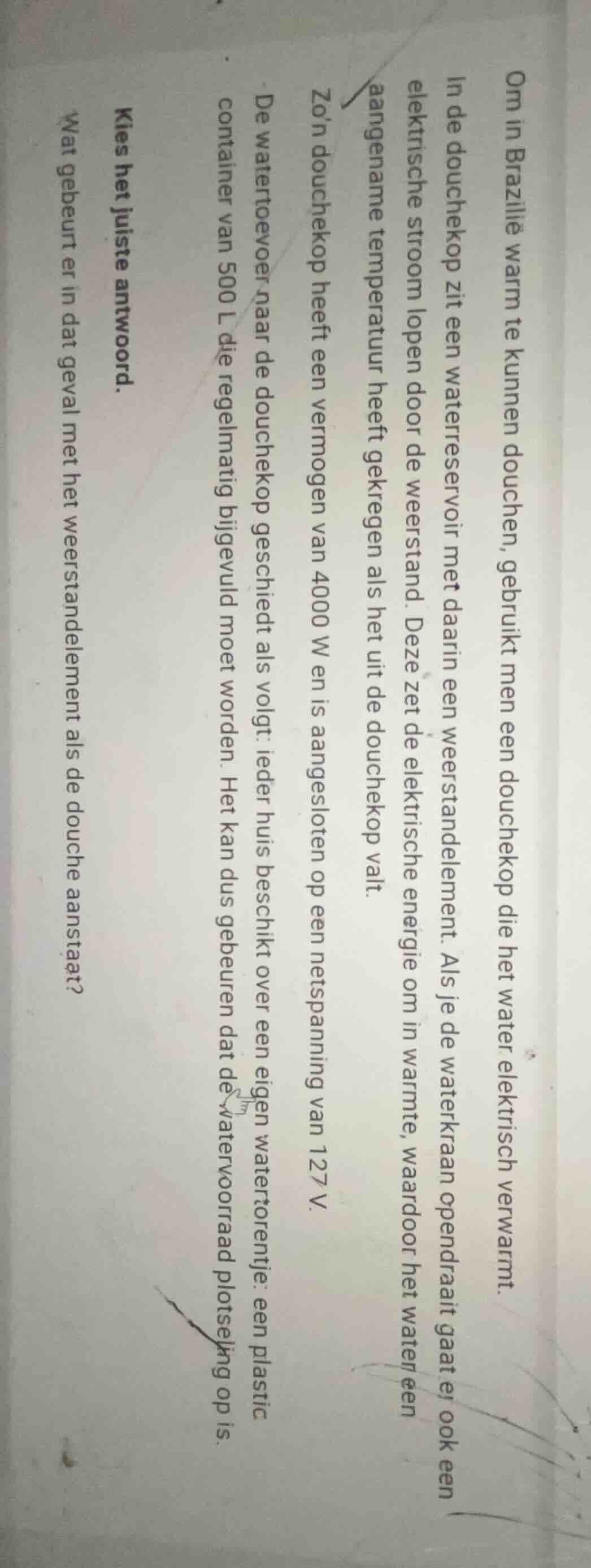
om in brazilië warm te kunnen douchen, gebruikt men een douchekop die het water elektrisch verwarmt.
in de douchekop zit een waterreservoir met daarin een weerstanelement. als je de waterkraan opendraait gaat er ook een elektrische stroom lopen door de weerstand. deze zet de elektrische energie om in warmte, waardoor het water een aangename temperatuur heeft gekregen als het uit de douchekop valt.
zo’n douchekop heeft een vermogen van 4000 w en is aangesloten op een netspanning van 127 v.
- de watertoevoer naar de douchekop geschiedt als volgt: ieder huis beschikt over een eigen watertorentje: een plastic container van 500 l die regelmatig bijgevuld moet worden. het kan dus gebeuren dat de watervoorraad plotseling op is.
kies het juiste antwoord.
wat gebeurt er in dat geval met het weerstanelement als de douche aanstaat?
Step 1: Analyze the Problem
The problem is about a showerhead with a heating element. When the water supply suddenly stops, the heating element is still on. We need to determine what happens to the heating element. First, recall the relationship between power, voltage, and resistance (\(P = \frac{V^2}{R}\)) and the effect of water on the heating element (water acts as a heat sink, removing heat).
Step 2: Consider the Role of Water
Normally, water flowing through the heating element absorbs the heat generated by the resistance (due to \(I^2R\) losses, where \(I\) is current and \(R\) is resistance). The power dissipated in the resistor is converted to heat, and the water carries this heat away, preventing the element from overheating.
Step 3: Situation When Water Stops
If the water supply stops (no water flow), the heat generated by the resistance element has no medium (water) to absorb and carry away the heat. The power input (\(P = 4000\space W\)) is still being converted to heat, but there's no cooling mechanism (water flow) anymore.
Step 4: Effect on the Heating Element
Without water to remove the heat, the temperature of the heating element will rise rapidly. The heat will accumulate in the element, causing its temperature to exceed its safe operating limit. This can lead to the heating element overheating, potentially melting, burning out (breaking the circuit due to excessive temperature damaging the resistor), or even causing a fire hazard.

Snap & solve any problem in the app
Get step-by-step solutions on Sovi AI
Photo-based solutions with guided steps
Explore more problems and detailed explanations
When the water supply suddenly stops while the shower is on, the heating element will overheat. Since there is no water to absorb the heat generated by the resistance (from the electrical power conversion to heat), the heat will accumulate in the element. This can cause the heating element to reach a very high temperature, potentially leading to it burning out (failing due to excessive temperature), melting, or creating a fire risk.