QUESTION IMAGE
Question
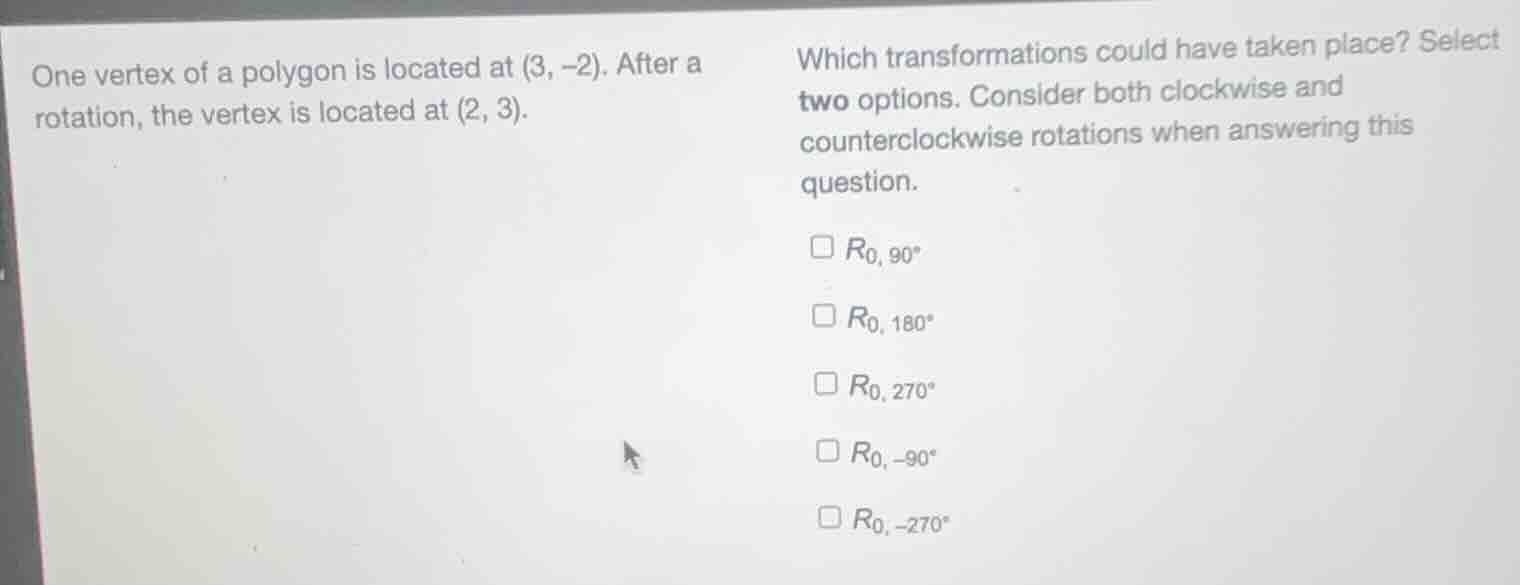
one vertex of a polygon is located at (3, -2). after a rotation, the vertex is located at (2, 3). which transformations could have taken place? select two options. consider both clockwise and counterclockwise rotations when answering this question. \\(\square r_{0, 90^{\circ}}\\) \\(\square r_{0, 180^{\circ}}\\) \\(\square r_{0, 270^{\circ}}\\) \\(\square r_{0, -90^{\circ}}\\) \\(\square r_{0, -270^{\circ}}\\)
Step1: Recall rotation rules
The rotation rules about the origin \(O\) are:
- \(90^\circ\) counterclockwise (\(R_{0,90^\circ}\)): \((x,y)\to(-y,x)\)
- \(180^\circ\) rotation (\(R_{0,180^\circ}\)): \((x,y)\to(-x,-y)\)
- \(270^\circ\) counterclockwise (\(R_{0,270^\circ}\)) or \(90^\circ\) clockwise (\(R_{0,- 90^\circ}\)): \((x,y)\to(y,-x)\)
- \(90^\circ\) clockwise (\(R_{0,-90^\circ}\)) is same as \(270^\circ\) counterclockwise and \(270^\circ\) clockwise (\(R_{0, - 270^\circ}\)) is same as \(90^\circ\) counterclockwise.
Step2: Test the point \((3,-2)\) with each rule
- For \(R_{0,90^\circ}\): \((x,y)=(3,-2)\to(-y,x)=(2,3)\)
- For \(R_{0,180^\circ}\): \((x,y)=(3,-2)\to(-x,-y)=(-3,2)
eq(2,3)\)
- For \(R_{0,270^\circ}\): \((x,y)=(3,-2)\to(y,-x)=(-2,-3)
eq(2,3)\)
- For \(R_{0,-90^\circ}\) (which is \(270^\circ\) counterclockwise): Wait, no, \(R_{0,-90^\circ}\) is \(90^\circ\) clockwise, the rule is \((x,y)\to(y,-x)\)? Wait no, correction: \(90^\circ\) clockwise (\(R_{0,-90^\circ}\)): \((x,y)\to(y,-x)\)? No, actually the correct rule for \(90^\circ\) clockwise is \((x,y)\to(y, - x)\)? Wait no, let's re - derive. A \(90^\circ\) clockwise rotation about the origin: the angle of the vector \(\vec{v}=(x,y)\) with the x - axis is \(\theta=\arctan(\frac{y}{x})\). After a \(90^\circ\) clockwise rotation, the new angle is \(\theta - 90^\circ\). Using rotation matrix \(
=
\), so \(
=
\). Wait, but when we did \(R_{0,90^\circ}\) (counterclockwise) we had \(
\) no, wait the correct rotation matrix for \(90^\circ\) counterclockwise is \(
\), so \((x,y)\to(-y,x)\). For \(90^\circ\) clockwise ( \(R_{0,-90^\circ}\)) the rotation matrix is \(
\), so \((x,y)\to(y,-x)\). But we saw that \(R_{0,90^\circ}\) gives \((2,3)\). Now, \(R_{0,-270^\circ}\) is equivalent to \(90^\circ\) counterclockwise (since \(- 270^\circ+360^\circ = 90^\circ\)), so applying \(R_{0,-270^\circ}\) to \((3,-2)\): \((x,y)\to(-y,x)=(2,3)\) (because \(R_{0,-270^\circ}\) is same as \(R_{0,90^\circ}\) as \(- 270^\circ+360^\circ = 90^\circ\))

Snap & solve any problem in the app
Get step-by-step solutions on Sovi AI
Photo-based solutions with guided steps
Explore more problems and detailed explanations
\(R_{0,90^\circ}\), \(R_{0,-270^\circ}\)