QUESTION IMAGE
Question
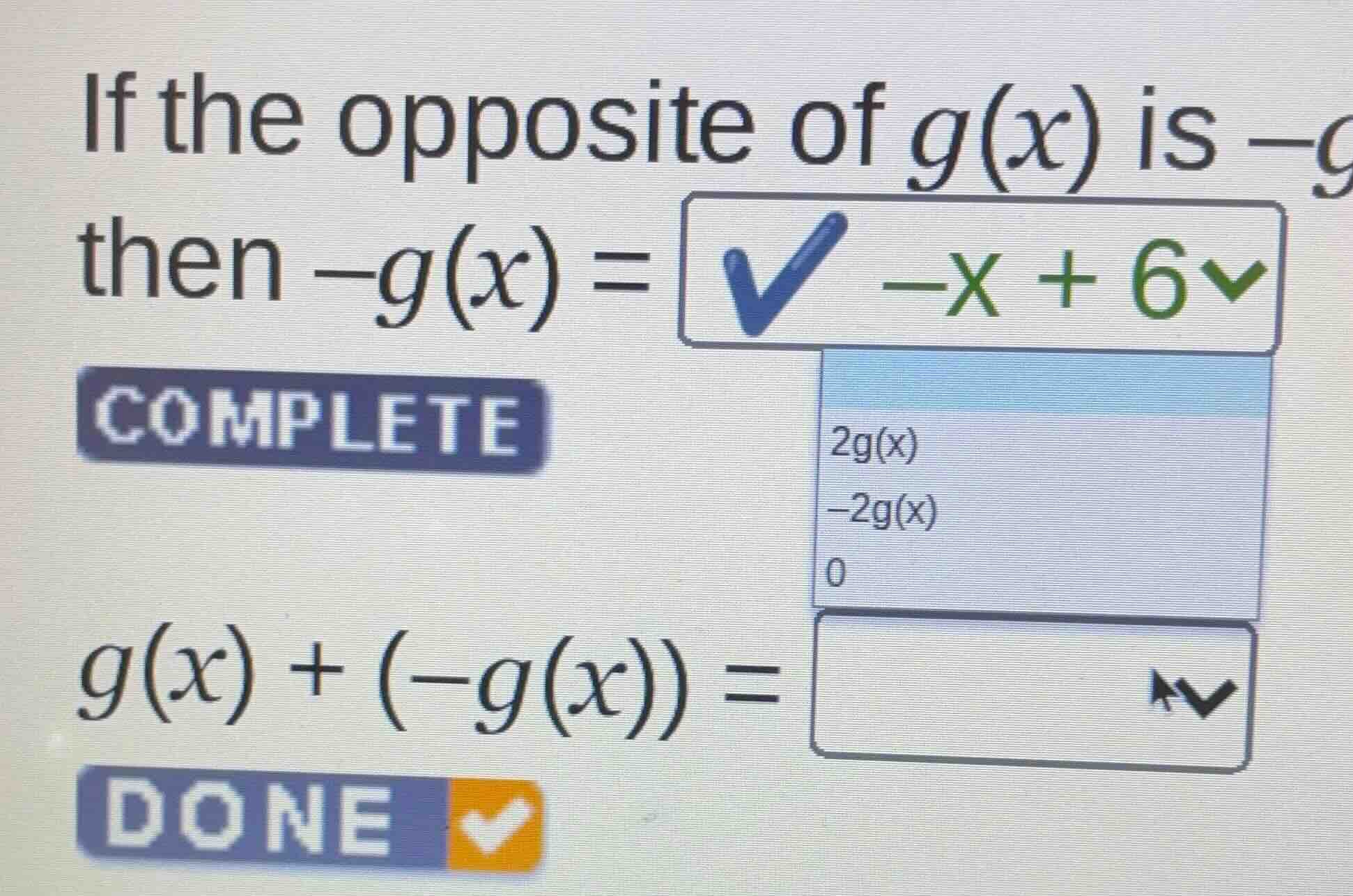
if the opposite of $g(x)$ is $-g$ then $-g(x) = quad -x + 6$ $complete$ $g(x)+(-g(x))=$ $done$ options: $2g(x)$, $-2g(x)$, $0$
Step1: Recall the property of opposite functions
The opposite of a function \( g(x) \) is \( -g(x) \), and by the definition of additive inverses, for any function \( g(x) \), \( g(x)+(-g(x)) \) should equal the zero function (or 0, since adding a function and its opposite cancels them out).
Step2: Apply the additive inverse property
Mathematically, if we let \( y = g(x) \), then \( y+(-y)=0 \). So substituting back \( y = g(x) \), we get \( g(x)+(-g(x)) = 0 \). Looking at the options, the value 0 is one of the choices (the option with 0).

Snap & solve any problem in the app
Get step-by-step solutions on Sovi AI
Photo-based solutions with guided steps
Explore more problems and detailed explanations
0 (or the option labeled "0" from the dropdown, which corresponds to the additive inverse sum being zero)