QUESTION IMAGE
Question
ordering rock layers:
- start at the bottom and start working your way up - the bottom has the oldest layers
- if there is anything cutting through these layers (intrusion, fault, etc) stop counting the horizontal layers and work on that fault or intrusion
- when you reach a point where a disturbance stops at a rock layer, that disturbance falls next in order.
- they layer on top is always the youngest
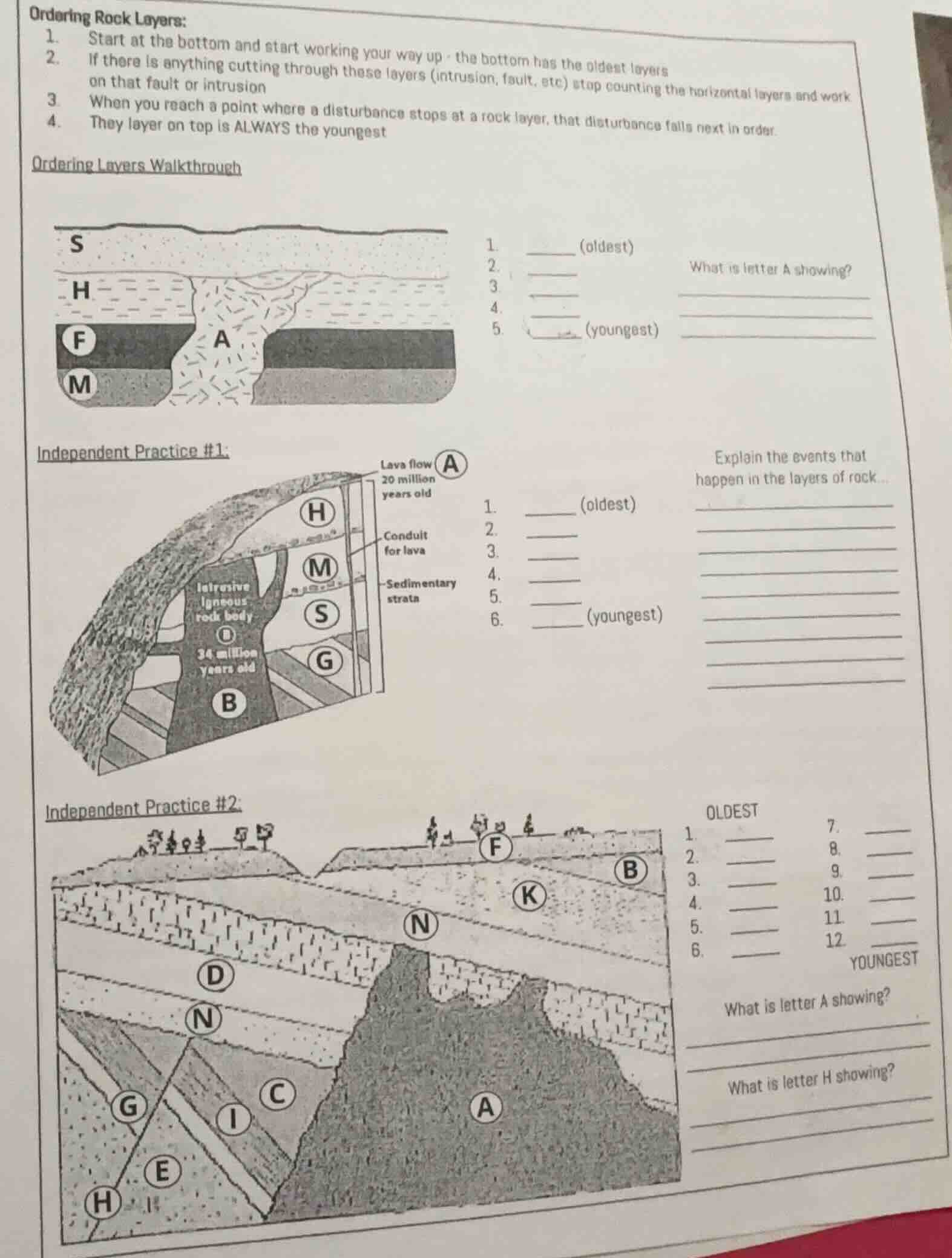
ordering layers walkthrough
- ______ (oldest)
- ______
- ______
- ______
- ______ (youngest)
what is letter a showing?
____________________
____________________
independent practice #1:
- ______ (oldest)
- ______
- ______
- ______
- ______
- ______ (youngest)
explain the events that happen in the layers of rock...
____________________
____________________
____________________
____________________
____________________
independent practice #2:
- ______
- ______
- ______
- ______
- ______
- ______
- ______
- ______
- ______
- ______
- ______
- ______
what is letter a showing?
____________________
____________________
what is letter h showing?
____________________
____________________
Ordering Layers Walkthrough
Step1: Identify oldest layer (bottom)
Oldest layer = M (bottommost)
Step2: Next layer above M
Next layer = F
Step3: Identify intrusion cutting M/F
Intrusion A cuts M/F, so A is younger than M/F, older than H
Step4: Layer above intrusion
Layer above A = H
Step5: Identify youngest layer (top)
Youngest layer = S (topmost)
Step6: Identify feature A
A cuts existing layers, so it's an intrusion.
Step1: Identify oldest sedimentary layer
Oldest layer = G (bottommost sedimentary)
Step2: Next layer above G
Next layer = S
Step3: Next layer above S
Next layer = M
Step4: Next layer above M
Next layer = H
Step5: Identify intrusion age
Intrusion B (36 million years) is younger than G/S/M/H, older than A
Step6: Identify youngest feature (lava flow)
Youngest feature = A (20 million years, topmost)
Step7: Explain rock layer events
List events from oldest to youngest.
Step1: Identify oldest layer (bottom)
Oldest layer = H (bottommost)
Step2: Next layer above H
Next layer = E
Step3: Next layer above E
Next layer = G
Step4: Next layer above G
Next layer = I
Step5: Next layer above I
Next layer = C
Step6: Identify intrusion cutting lower layers
Intrusion A cuts H/E/G/I/C, so A is younger than these layers
Step7: Layer formed after intrusion erosion
Layer N forms on eroded surface of A/lower layers
Step8: Next layer above N
Next layer = D
Step9: Next layer above D
Next layer = N (upper bed)
Step10: Next layer above upper N
Next layer = K
Step11: Next layer above K
Next layer = B
Step12: Identify youngest layer (top)
Youngest layer = F (topmost)
Step13: Identify features A and H
A cuts layers, H is a tilted bed.

Snap & solve any problem in the app
Get step-by-step solutions on Sovi AI
Photo-based solutions with guided steps
Explore more problems and detailed explanations
- M (oldest)
- F
- A
- H
- S (youngest)
What is letter A showing? An igneous intrusion (it cuts through the older rock layers M and F, forming after them).
---