QUESTION IMAGE
Question
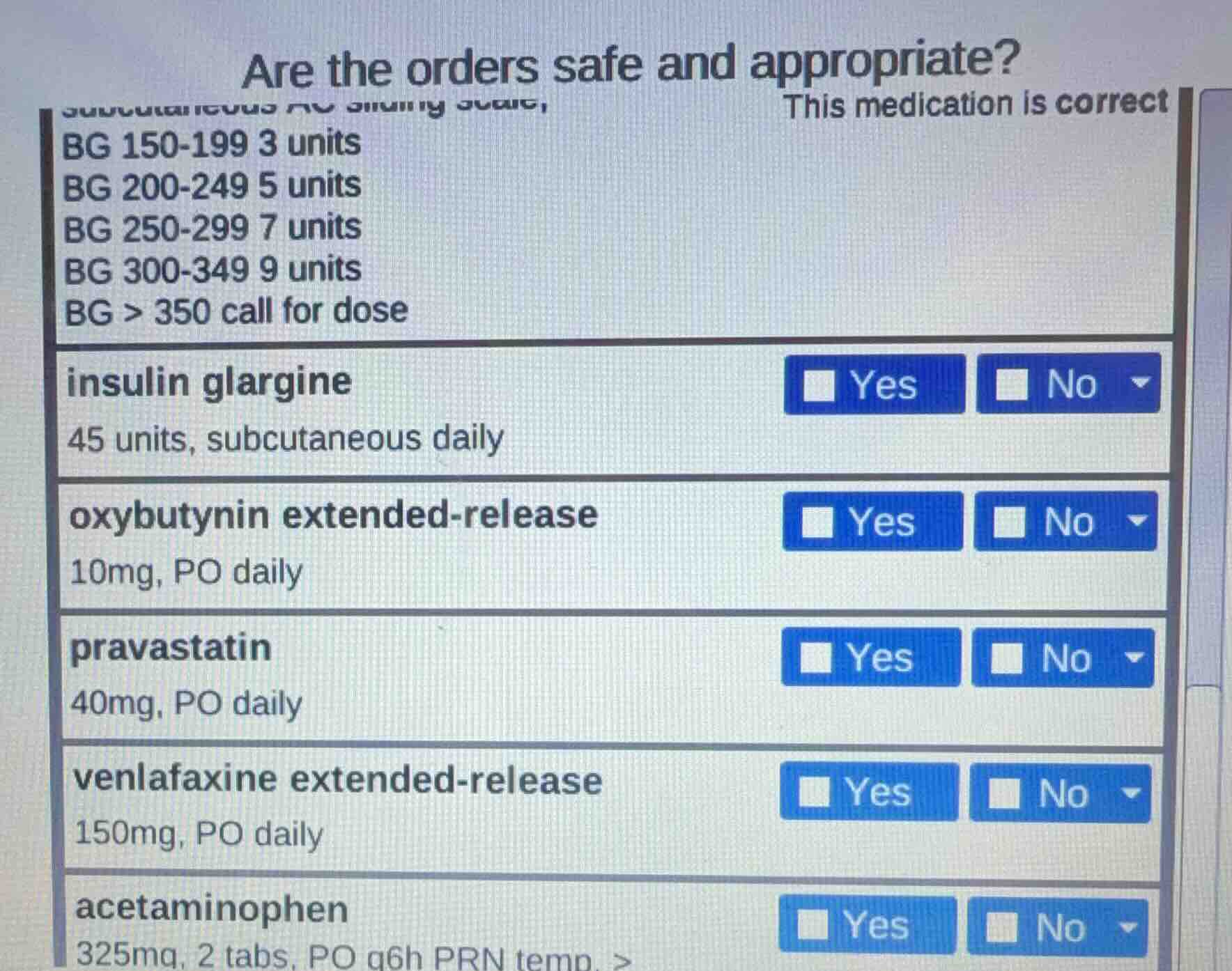
are the orders safe and appropriate? this medication is correct bg 150 - 199 3 units bg 200 - 249 5 units bg 250 - 299 7 units bg 300 - 349 9 units bg > 350 call for dose insulin glargine 45 units, subcutaneous daily oxybutynin extended - release 10mg, po daily pravastatin 40mg, po daily venlafaxine extended - release 150mg, po daily acetaminophen 325mg, 2 tabs, po q6h prn temp. >
To determine if the orders are safe and appropriate, we analyze each medication:
Insulin Glargine
- Purpose: Long - acting insulin, typically dosed based on individual needs (e.g., blood glucose control). A 45 - unit daily subcutaneous dose is within a reasonable range for many patients (especially those with diabetes requiring significant insulin, though context like the patient’s BG trends matters). Assuming the patient’s needs align, this can be appropriate. So mark Yes.
Oxybutynin Extended - Release
- Indication: For overactive bladder, etc. A 10mg PO daily dose is a standard starting/maintenance dose for extended - release oxybutynin. So mark Yes.
Pravastatin
- Indication: Cholesterol management. 40mg PO daily is a common therapeutic dose for pravastatin (used to lower LDL, etc.). So mark Yes.
Venlafaxine Extended - Release
- Indication: Depression, anxiety. 150mg PO daily is a typical therapeutic dose for venlafaxine extended - release (within the range for major depressive disorder, generalized anxiety disorder treatment). So mark Yes.
Acetaminophen
- Indication: Pain/fever. 325mg per tab, 2 tabs (650mg) PO q6h PRN (as needed for temp > [likely 100.4°F or similar]) is safe (acetaminophen max daily dose is often 3000 - 4000mg, so 650mg q6h is within limits, and “PRN temp >” is appropriate for fever management). So mark Yes.
Final Answers (for each “Yes/No” checkbox):
- Insulin glargine: $\boldsymbol{\text{Yes}}$
- Oxybutynin extended - release: $\boldsymbol{\text{Yes}}$
- Pravastatin: $\boldsymbol{\text{Yes}}$
- Venlafaxine extended - release: $\boldsymbol{\text{Yes}}$
- Acetaminophen: $\boldsymbol{\text{Yes}}$
(Note: If there were specific patient - specific contraindications not provided, this is based on general prescribing norms.)

Snap & solve any problem in the app
Get step-by-step solutions on Sovi AI
Photo-based solutions with guided steps
Explore more problems and detailed explanations
To determine if the orders are safe and appropriate, we analyze each medication:
Insulin Glargine
- Purpose: Long - acting insulin, typically dosed based on individual needs (e.g., blood glucose control). A 45 - unit daily subcutaneous dose is within a reasonable range for many patients (especially those with diabetes requiring significant insulin, though context like the patient’s BG trends matters). Assuming the patient’s needs align, this can be appropriate. So mark Yes.
Oxybutynin Extended - Release
- Indication: For overactive bladder, etc. A 10mg PO daily dose is a standard starting/maintenance dose for extended - release oxybutynin. So mark Yes.
Pravastatin
- Indication: Cholesterol management. 40mg PO daily is a common therapeutic dose for pravastatin (used to lower LDL, etc.). So mark Yes.
Venlafaxine Extended - Release
- Indication: Depression, anxiety. 150mg PO daily is a typical therapeutic dose for venlafaxine extended - release (within the range for major depressive disorder, generalized anxiety disorder treatment). So mark Yes.
Acetaminophen
- Indication: Pain/fever. 325mg per tab, 2 tabs (650mg) PO q6h PRN (as needed for temp > [likely 100.4°F or similar]) is safe (acetaminophen max daily dose is often 3000 - 4000mg, so 650mg q6h is within limits, and “PRN temp >” is appropriate for fever management). So mark Yes.
Final Answers (for each “Yes/No” checkbox):
- Insulin glargine: $\boldsymbol{\text{Yes}}$
- Oxybutynin extended - release: $\boldsymbol{\text{Yes}}$
- Pravastatin: $\boldsymbol{\text{Yes}}$
- Venlafaxine extended - release: $\boldsymbol{\text{Yes}}$
- Acetaminophen: $\boldsymbol{\text{Yes}}$
(Note: If there were specific patient - specific contraindications not provided, this is based on general prescribing norms.)