QUESTION IMAGE
Question
overall rate
concentration of a reactant not involved in the rds will significantly increase the
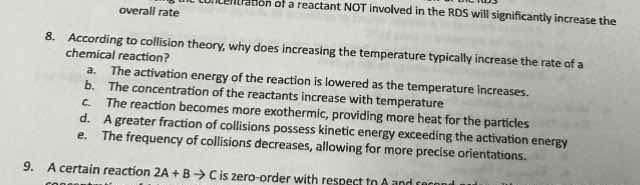
- according to collision theory, why does increasing the temperature typically increase the rate of a
chemical reaction?
a. the activation energy of the reaction is lowered as the temperature increases.
b. the concentration of the reactants increase with temperature
c. the reaction becomes exothermic, providing more heat for the particles
d. a greater fraction of collisions possess kinetic energy exceeding the activation energy
e. the frequency of collisions decreases, allowing for more precise orientations.
- a certain reaction 2a + b → c is zero - order with respect to a and second
Question 8
To solve this, we analyze each option based on collision theory:
- Option a: Catalysts lower activation energy, not temperature. So a is wrong.
- Option b: Temperature doesn't directly increase reactant concentration (unless volume changes, but collision theory focuses on energy and collision frequency/energy). So b is wrong.
- Option c: Temperature increase doesn't make a reaction exothermic (exothermic is about enthalpy change, not temperature effect on rate). So c is wrong.
- Option d: Collision theory states that for a reaction to occur, collisions must have enough energy (≥ activation energy) and correct orientation. Increasing temperature increases kinetic energy of particles, so more collisions have energy above activation energy. This matches.
- Option e: Increasing temperature increases collision frequency (particles move faster), so e is wrong.

Snap & solve any problem in the app
Get step-by-step solutions on Sovi AI
Photo-based solutions with guided steps
Explore more problems and detailed explanations
d. A greater fraction of collisions possess kinetic energy exceeding the activation energy