QUESTION IMAGE
Question
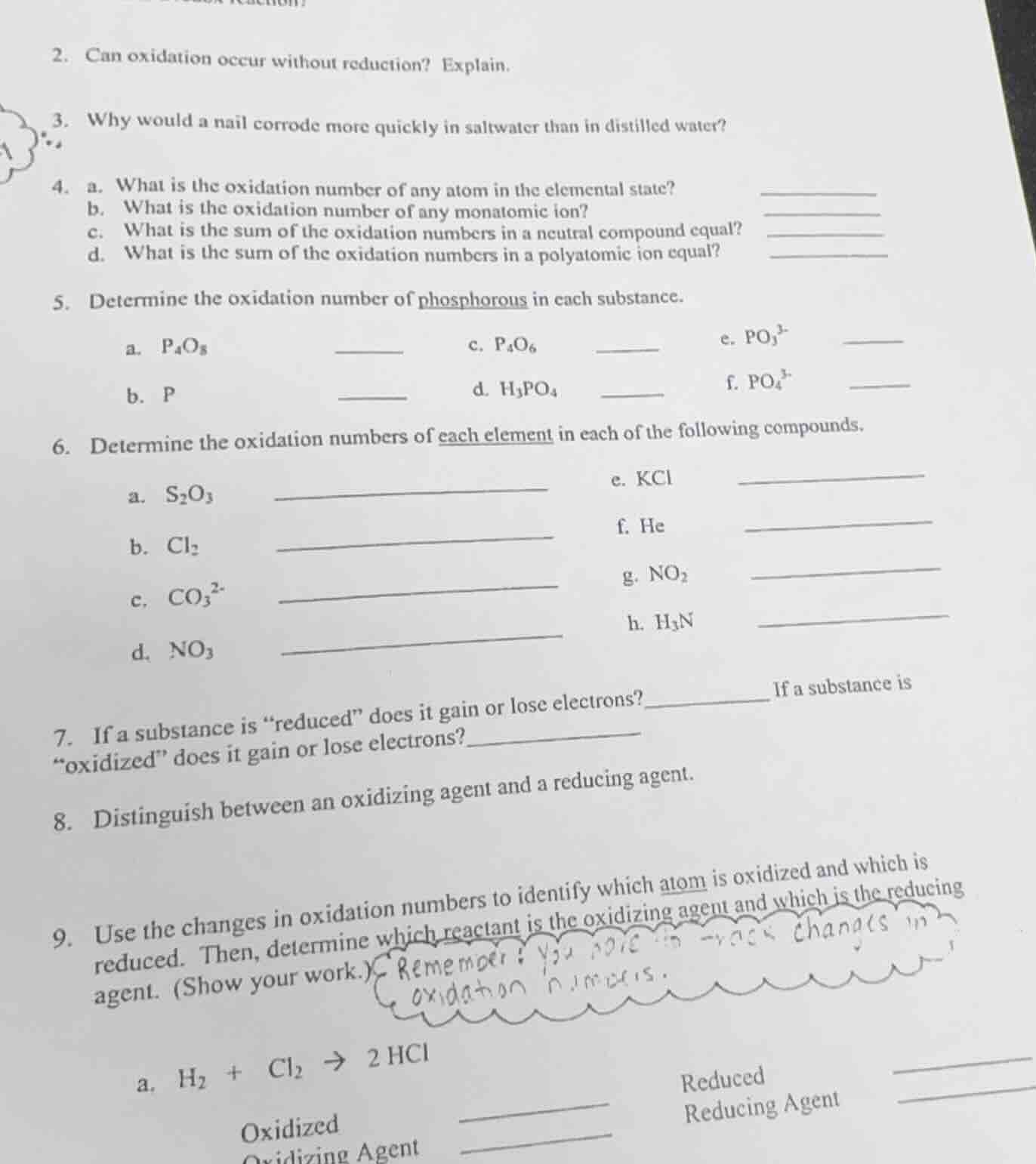
- can oxidation occur without reduction? explain.
- why would a nail corrode more quickly in saltwater than in distilled water?
- a. what is the oxidation number of any atom in the elemental state?
b. what is the oxidation number of any monatomic ion?
c. what is the sum of the oxidation numbers in a neutral compound equal?
d. what is the sum of the oxidation numbers in a polyatomic ion equal?
- determine the oxidation number of phosphorous in each substance.
a. p₄o₈
b. p
c. p₄o₆
d. h₃po₄
e. po₃³⁻
f. po₄³⁻
- determine the oxidation numbers of each element in each of the following compounds.
a. s₂o₃
b. cl₂
c. co₃²⁻
d. no₃
e. kcl
f. he
g. no₂
h. h₃n
- if a substance is
educed\ does it gain or lose electrons? ____ if a substance is \oxidized\ does it gain or lose electrons? ____
- distinguish between an oxidizing agent and a reducing agent.
- use the changes in oxidation numbers to identify which atom is oxidized and which is reduced. then, determine which reactant is the oxidizing agent and which is the reducing agent. (show your work.)
a. h₂ + cl₂ → 2 hcl
oxidized ______
reduced ______
oxidizing agent ______
reducing agent ______
Question 2: Can oxidation occur without reduction? Explain.
Oxidation - reduction (redox) reactions involve the transfer of electrons. Oxidation is the loss of electrons, and reduction is the gain of electrons. In any redox reaction, when one species loses electrons (oxidized), another must gain those electrons (reduced). So, oxidation and reduction are complementary processes and cannot occur independently.
Corrosion of a nail (usually iron) is an electrochemical process (rusting, a redox reaction). Saltwater contains dissolved ions (like \( \text{Na}^+ \) and \( \text{Cl}^- \)), which increase the electrical conductivity of the water. This allows the electrochemical reactions (oxidation of \( \text{Fe} \) and reduction of \( \text{O}_2 \)) involved in corrosion to proceed more rapidly compared to distilled water, which has very low conductivity due to the absence of significant ions.
By definition, the oxidation number of an atom in its elemental state (e.g., \( \text{O}_2 \), \( \text{Fe} \), \( \text{Ne} \)) is 0. This is because in the elemental form, the atom has no net loss or gain of electrons relative to its neutral state.

Snap & solve any problem in the app
Get step-by-step solutions on Sovi AI
Photo-based solutions with guided steps
Explore more problems and detailed explanations
No, oxidation cannot occur without reduction. Oxidation is the loss of electrons, and reduction is the gain of electrons. In a redox reaction, electrons lost by one species (during oxidation) must be gained by another species (during reduction), so they occur simultaneously.