QUESTION IMAGE
Question
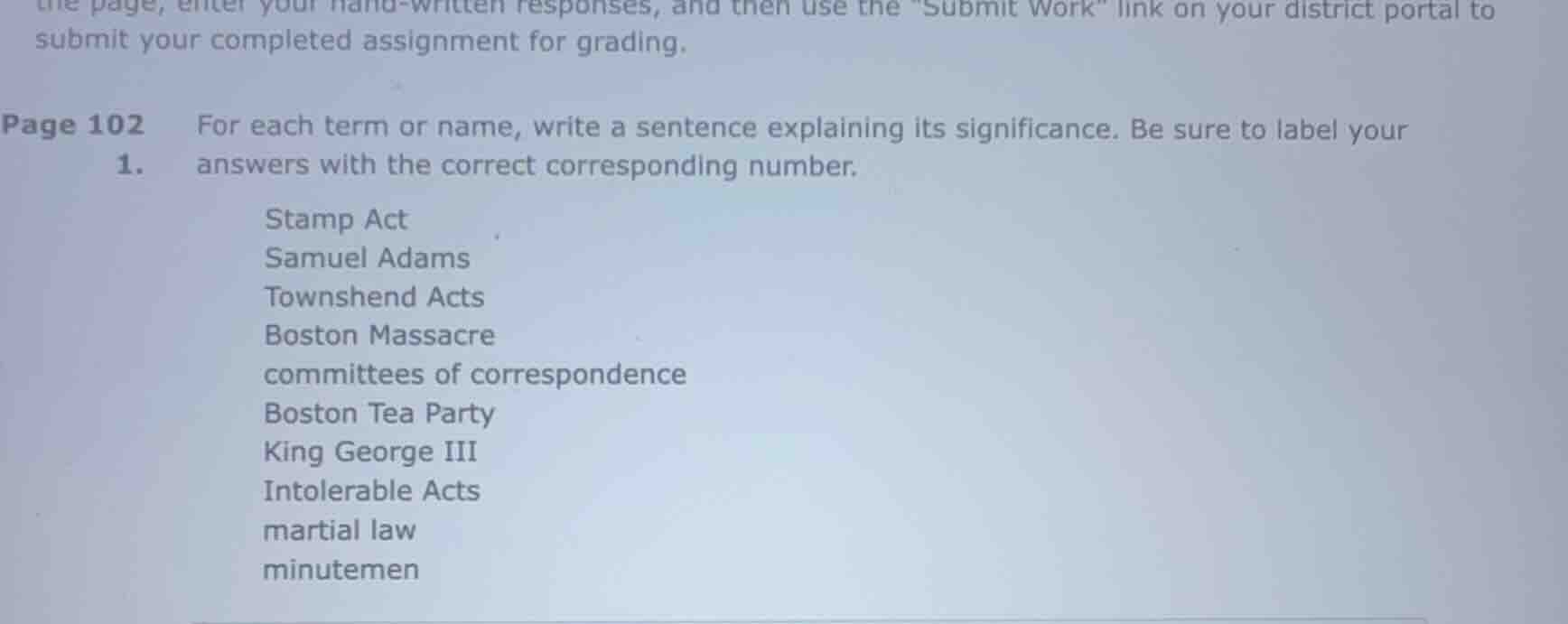
page 102 1. for each term or name, write a sentence explaining its significance. be sure to label your answers with the correct corresponding number. stamp act samuel adams townshend acts boston massacre committees of correspondence boston tea party king george iii intolerable acts martial law minutemen
Brief Explanations
- Stamp Act: A 1765 British tax on paper goods in the colonies that sparked widespread protest, uniting colonists against "taxation without representation" and laying groundwork for revolutionary sentiment.
- Samuel Adams: A key American revolutionary organizer who led protests against British policies, co-founded groups like the Sons of Liberty, and helped galvanize support for independence.
- Townshend Acts: 1767 British laws taxing imported goods (tea, paper, glass) in the colonies; the resulting boycotts and tensions further eroded relations between Britain and the colonies.
- Boston Massacre: A 1770 clash between British soldiers and Boston colonists that left five colonists dead; it was used as propaganda by revolutionaries to turn public opinion against British rule.
- committees of correspondence: Colonial groups established to share information and coordinate resistance against British policies, uniting colonial efforts across different regions.
- Boston Tea Party: A 1773 protest where colonists dumped British tea into Boston Harbor to oppose the Tea Act; it prompted harsh British retaliation that pushed the colonies closer to revolution.
- King George III: The British monarch during the American Revolution whose strict policies toward the colonies (including punitive acts after the Boston Tea Party) fueled colonial demands for independence.
- Intolerable Acts: Harsh 1774 British laws punishing Massachusetts for the Boston Tea Party; they unified the colonies, leading to the first Continental Congress and increased revolutionary momentum.
- martial law: Rule by military authority instead of civilian government; Britain threatened and implemented elements of it in the colonies, escalating fears of oppressive British control.
- minutemen: Colonial militia members trained to respond to British threats at a minute's notice; they played a critical role in the early battles of the American Revolution (Lexington and Concord).

Snap & solve any problem in the app
Get step-by-step solutions on Sovi AI
Photo-based solutions with guided steps
Explore more problems and detailed explanations
- Stamp Act: A 1765 British tax on colonial paper goods that fueled early revolutionary anger by enforcing "taxation without representation."
- Samuel Adams: A foundational American revolutionary who organized protests, co-led the Sons of Liberty, and rallied colonists toward independence.
- Townshend Acts: 1767 British taxes on imported colonial goods that led to widespread boycotts and deepened anti-British sentiment.
- Boston Massacre: A 1770 violent clash between British soldiers and colonists that was used as revolutionary propaganda to turn public opinion against Britain.
- committees of correspondence: Colonial networks that shared news of British policies, uniting resistance efforts across different colonies.
- Boston Tea Party: A 1773 colonial protest against British tea taxes that triggered harsh retaliatory laws pushing the colonies toward revolution.
- King George III: The British king whose uncompromising policies toward the colonies were a central catalyst for the American demand for independence.
- Intolerable Acts: 1774 punitive British laws against Massachusetts that unified the colonies and led to the first Continental Congress.
- martial law: Military rule imposed by Britain in parts of the colonies, stoking fears of oppressive foreign control and supporting revolutionary causes.
- minutemen: Colonial militia forces trained to deploy instantly, who fought in the opening battles of the American Revolution at Lexington and Concord.