QUESTION IMAGE
Question
this is a 2 - page document!
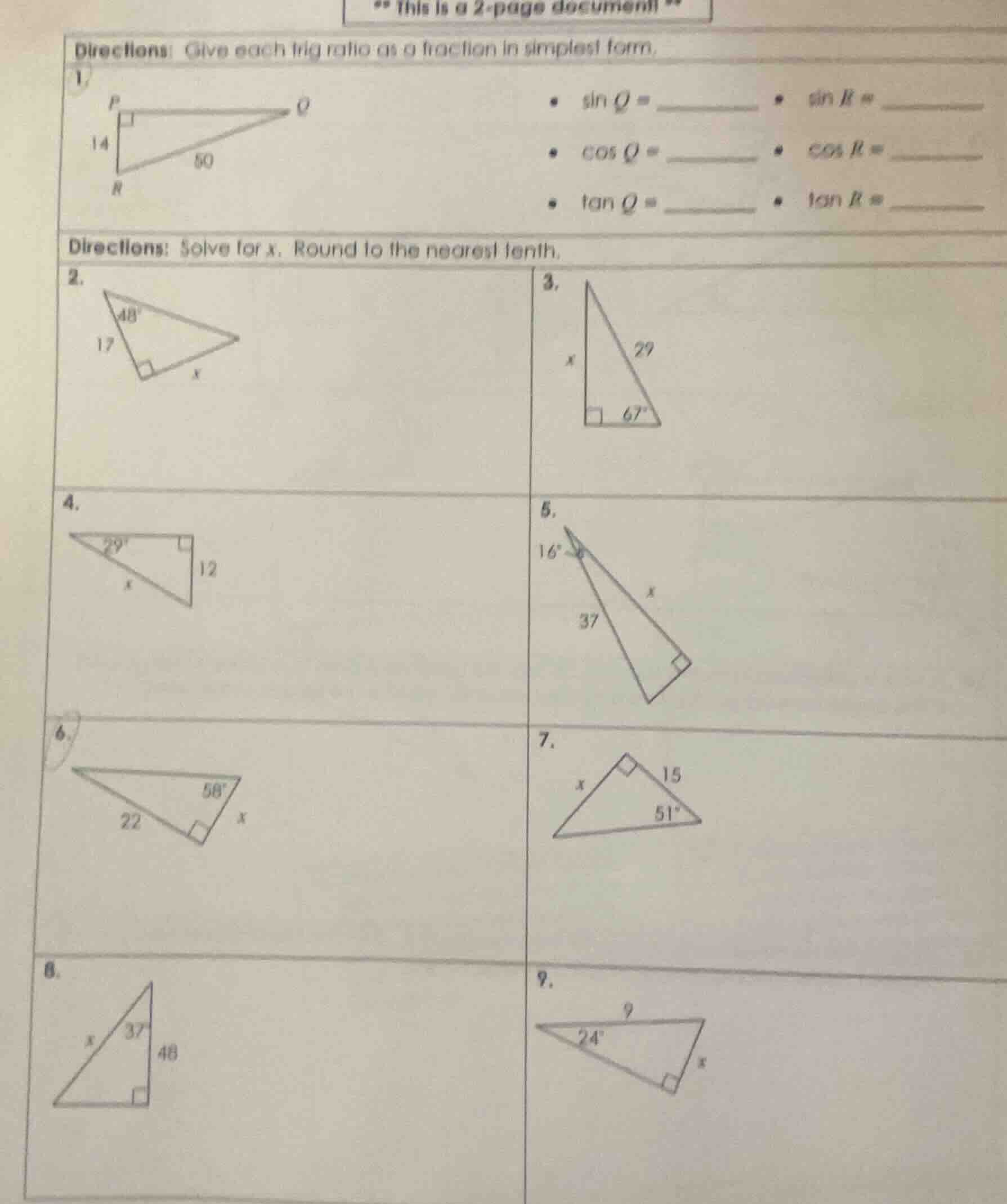
directions: give each trig ratio as a fraction in simplest form.
1.
- $sin q =$ ____ - $sin r =$ ____
- $cos q =$ ____ - $cos r =$ ____
- $\tan q =$ ____ - $\tan r =$ ____
directions: solve for $x$. round to the nearest tenth.
2.
3.
4.
5.
6.
7.
8.
9.
Problem 1: Trig Ratios for Triangle \( PRQ \) (Right - angled at \( P \))
First, we need to find the length of \( PQ \) using the Pythagorean theorem. In a right - triangle \( a^{2}+b^{2}=c^{2} \), where \( c \) is the hypotenuse and \( a,b \) are the legs. Here, \( PR = 14 \), \( RQ=50 \), so \( PQ=\sqrt{RQ^{2}-PR^{2}}=\sqrt{50^{2}-14^{2}}=\sqrt{2500 - 196}=\sqrt{2304}=48 \)
For \( \sin Q \):
In a right - triangle, \( \sin\theta=\frac{\text{opposite}}{\text{hypotenuse}} \). For \( \angle Q \), the opposite side is \( PR = 14 \) and the hypotenuse is \( RQ = 50 \). So \( \sin Q=\frac{14}{50}=\frac{7}{25} \)
For \( \sin R \):
For \( \angle R \), the opposite side is \( PQ = 48 \) and the hypotenuse is \( RQ = 50 \). So \( \sin R=\frac{48}{50}=\frac{24}{25} \)
For \( \cos Q \):
\( \cos\theta=\frac{\text{adjacent}}{\text{hypotenuse}} \). For \( \angle Q \), the adjacent side is \( PQ = 48 \) and the hypotenuse is \( RQ = 50 \). So \( \cos Q=\frac{48}{50}=\frac{24}{25} \)
For \( \cos R \):
For \( \angle R \), the adjacent side is \( PR = 14 \) and the hypotenuse is \( RQ = 50 \). So \( \cos R=\frac{14}{50}=\frac{7}{25} \)
For \( \tan Q \):
\( \tan\theta=\frac{\text{opposite}}{\text{adjacent}} \). For \( \angle Q \), the opposite side is \( PR = 14 \) and the adjacent side is \( PQ = 48 \). So \( \tan Q=\frac{14}{48}=\frac{7}{24} \)
For \( \tan R \):
For \( \angle R \), the opposite side is \( PQ = 48 \) and the adjacent side is \( PR = 14 \). So \( \tan R=\frac{48}{14}=\frac{24}{7} \)
Problem 2: Solve for \( x \) (Right - angled triangle, angle \( 48^{\circ} \), leg \( = 17 \))
We know that \( \tan\theta=\frac{\text{opposite}}{\text{adjacent}} \). Here, \( \theta = 48^{\circ} \), adjacent side \( = 17 \), and opposite side \( = x \). So \( \tan48^{\circ}=\frac{x}{17} \), then \( x = 17\times\tan48^{\circ}\approx17\times1.1106\approx18.9 \)
Problem 3: Solve for \( x \) (Right - angled triangle, hypotenuse \( = 29 \), angle \( 67^{\circ} \))
We know that \( \cos\theta=\frac{\text{adjacent}}{\text{hypotenuse}} \). For \( \theta = 67^{\circ} \), the adjacent side to \( \theta \) is \( x \) and the hypotenuse is \( 29 \). So \( \cos67^{\circ}=\frac{x}{29} \), then \( x = 29\times\cos67^{\circ}\approx29\times0.3907\approx11.3 \)
Problem 4: Solve for \( x \) (Right - angled triangle, leg \( = 12 \), angle \( 29^{\circ} \))
We know that \( \sin\theta=\frac{\text{opposite}}{\text{hypotenuse}} \). Here, \( \theta = 29^{\circ} \), opposite side \( = 12 \), and hypotenuse \( = x \). So \( \sin29^{\circ}=\frac{12}{x} \), then \( x=\frac{12}{\sin29^{\circ}}\approx\frac{12}{0.4848}\approx24.7 \)
Problem 5: Solve for \( x \) (Two right - angled triangles, angle \( 16^{\circ} \), one leg \( = 37 \))
We know that \( \cos\theta=\frac{\text{adjacent}}{\text{hypotenuse}} \). For the smaller triangle, if we consider the angle \( 16^{\circ} \), adjacent side \( = 37 \), and for the larger triangle, adjacent side \( = x \). Since the two triangles are similar (same angle \( 16^{\circ} \) and right - angled), we can also use the cosine formula. \( \cos16^{\circ}=\frac{37}{x} \), then \( x=\frac{37}{\cos16^{\circ}}\approx\frac{37}{0.9613}\approx38.5 \)
Problem 6: Solve for \( x \) (Right - angled triangle, hypotenuse \( = 22 \), angle \( 58^{\circ} \))
We know that \( \sin\theta=\frac{\text{opposite}}{\text{hypotenuse}} \). For \( \theta = 58^{\circ} \), the opposite side is \( x \) and the hypotenuse is \( 22 \). So \( \sin58^{\circ}=\frac{x}{22} \), then \( x = 22\times\sin58^{\circ}\approx22\time…

Snap & solve any problem in the app
Get step-by-step solutions on Sovi AI
Photo-based solutions with guided steps
Explore more problems and detailed explanations
Problem 1: Trig Ratios for Triangle \( PRQ \) (Right - angled at \( P \))
First, we need to find the length of \( PQ \) using the Pythagorean theorem. In a right - triangle \( a^{2}+b^{2}=c^{2} \), where \( c \) is the hypotenuse and \( a,b \) are the legs. Here, \( PR = 14 \), \( RQ=50 \), so \( PQ=\sqrt{RQ^{2}-PR^{2}}=\sqrt{50^{2}-14^{2}}=\sqrt{2500 - 196}=\sqrt{2304}=48 \)
For \( \sin Q \):
In a right - triangle, \( \sin\theta=\frac{\text{opposite}}{\text{hypotenuse}} \). For \( \angle Q \), the opposite side is \( PR = 14 \) and the hypotenuse is \( RQ = 50 \). So \( \sin Q=\frac{14}{50}=\frac{7}{25} \)
For \( \sin R \):
For \( \angle R \), the opposite side is \( PQ = 48 \) and the hypotenuse is \( RQ = 50 \). So \( \sin R=\frac{48}{50}=\frac{24}{25} \)
For \( \cos Q \):
\( \cos\theta=\frac{\text{adjacent}}{\text{hypotenuse}} \). For \( \angle Q \), the adjacent side is \( PQ = 48 \) and the hypotenuse is \( RQ = 50 \). So \( \cos Q=\frac{48}{50}=\frac{24}{25} \)
For \( \cos R \):
For \( \angle R \), the adjacent side is \( PR = 14 \) and the hypotenuse is \( RQ = 50 \). So \( \cos R=\frac{14}{50}=\frac{7}{25} \)
For \( \tan Q \):
\( \tan\theta=\frac{\text{opposite}}{\text{adjacent}} \). For \( \angle Q \), the opposite side is \( PR = 14 \) and the adjacent side is \( PQ = 48 \). So \( \tan Q=\frac{14}{48}=\frac{7}{24} \)
For \( \tan R \):
For \( \angle R \), the opposite side is \( PQ = 48 \) and the adjacent side is \( PR = 14 \). So \( \tan R=\frac{48}{14}=\frac{24}{7} \)
Problem 2: Solve for \( x \) (Right - angled triangle, angle \( 48^{\circ} \), leg \( = 17 \))
We know that \( \tan\theta=\frac{\text{opposite}}{\text{adjacent}} \). Here, \( \theta = 48^{\circ} \), adjacent side \( = 17 \), and opposite side \( = x \). So \( \tan48^{\circ}=\frac{x}{17} \), then \( x = 17\times\tan48^{\circ}\approx17\times1.1106\approx18.9 \)
Problem 3: Solve for \( x \) (Right - angled triangle, hypotenuse \( = 29 \), angle \( 67^{\circ} \))
We know that \( \cos\theta=\frac{\text{adjacent}}{\text{hypotenuse}} \). For \( \theta = 67^{\circ} \), the adjacent side to \( \theta \) is \( x \) and the hypotenuse is \( 29 \). So \( \cos67^{\circ}=\frac{x}{29} \), then \( x = 29\times\cos67^{\circ}\approx29\times0.3907\approx11.3 \)
Problem 4: Solve for \( x \) (Right - angled triangle, leg \( = 12 \), angle \( 29^{\circ} \))
We know that \( \sin\theta=\frac{\text{opposite}}{\text{hypotenuse}} \). Here, \( \theta = 29^{\circ} \), opposite side \( = 12 \), and hypotenuse \( = x \). So \( \sin29^{\circ}=\frac{12}{x} \), then \( x=\frac{12}{\sin29^{\circ}}\approx\frac{12}{0.4848}\approx24.7 \)
Problem 5: Solve for \( x \) (Two right - angled triangles, angle \( 16^{\circ} \), one leg \( = 37 \))
We know that \( \cos\theta=\frac{\text{adjacent}}{\text{hypotenuse}} \). For the smaller triangle, if we consider the angle \( 16^{\circ} \), adjacent side \( = 37 \), and for the larger triangle, adjacent side \( = x \). Since the two triangles are similar (same angle \( 16^{\circ} \) and right - angled), we can also use the cosine formula. \( \cos16^{\circ}=\frac{37}{x} \), then \( x=\frac{37}{\cos16^{\circ}}\approx\frac{37}{0.9613}\approx38.5 \)
Problem 6: Solve for \( x \) (Right - angled triangle, hypotenuse \( = 22 \), angle \( 58^{\circ} \))
We know that \( \sin\theta=\frac{\text{opposite}}{\text{hypotenuse}} \). For \( \theta = 58^{\circ} \), the opposite side is \( x \) and the hypotenuse is \( 22 \). So \( \sin58^{\circ}=\frac{x}{22} \), then \( x = 22\times\sin58^{\circ}\approx22\times0.8480\approx18.7 \)
Problem 7: Solve for \( x \) (Right - angled triangle, leg \( = 15 \), angle \( 51^{\circ} \))
We know that \( \tan\theta=\frac{\text{opposite}}{\text{adjacent}} \). For \( \theta = 51^{\circ} \), the opposite side is \( x \) and the adjacent side is \( 15 \). So \( \tan51^{\circ}=\frac{x}{15} \), then \( x = 15\times\tan51^{\circ}\approx15\times1.2349\approx18.5 \)
Problem 8: Solve for \( x \) (Right - angled triangle, leg \( = 48 \), angle \( 37^{\circ} \))
We know that \( \cos\theta=\frac{\text{adjacent}}{\text{hypotenuse}} \). For \( \theta = 37^{\circ} \), the adjacent side is \( 48 \) and the hypotenuse is \( x \). So \( \cos37^{\circ}=\frac{48}{x} \), then \( x=\frac{48}{\cos37^{\circ}}\approx\frac{48}{0.7986}\approx60.1 \)
Problem 9: Solve for \( x \) (Right - angled triangle, leg \( = 9 \), angle \( 24^{\circ} \))
We know that \( \tan\theta=\frac{\text{opposite}}{\text{adjacent}} \). For \( \theta = 24^{\circ} \), the opposite side is \( x \) and the adjacent side is \( 9 \). So \( \tan24^{\circ}=\frac{x}{9} \), then \( x = 9\times\tan24^{\circ}\approx9\times0.4452\approx4.0 \)
Final Answers:
- \( \sin Q=\frac{7}{25} \), \( \sin R=\frac{24}{25} \), \( \cos Q=\frac{24}{25} \), \( \cos R=\frac{7}{25} \), \( \tan Q=\frac{7}{24} \), \( \tan R=\frac{24}{7} \)
- \( x\approx18.9 \)
- \( x\approx11.3 \)
- \( x\approx24.7 \)
- \( x\approx38.5 \)
- \( x\approx18.7 \)
- \( x\approx18.5 \)
- \( x\approx60.1 \)
- \( x\approx4.0 \)