QUESTION IMAGE
Question
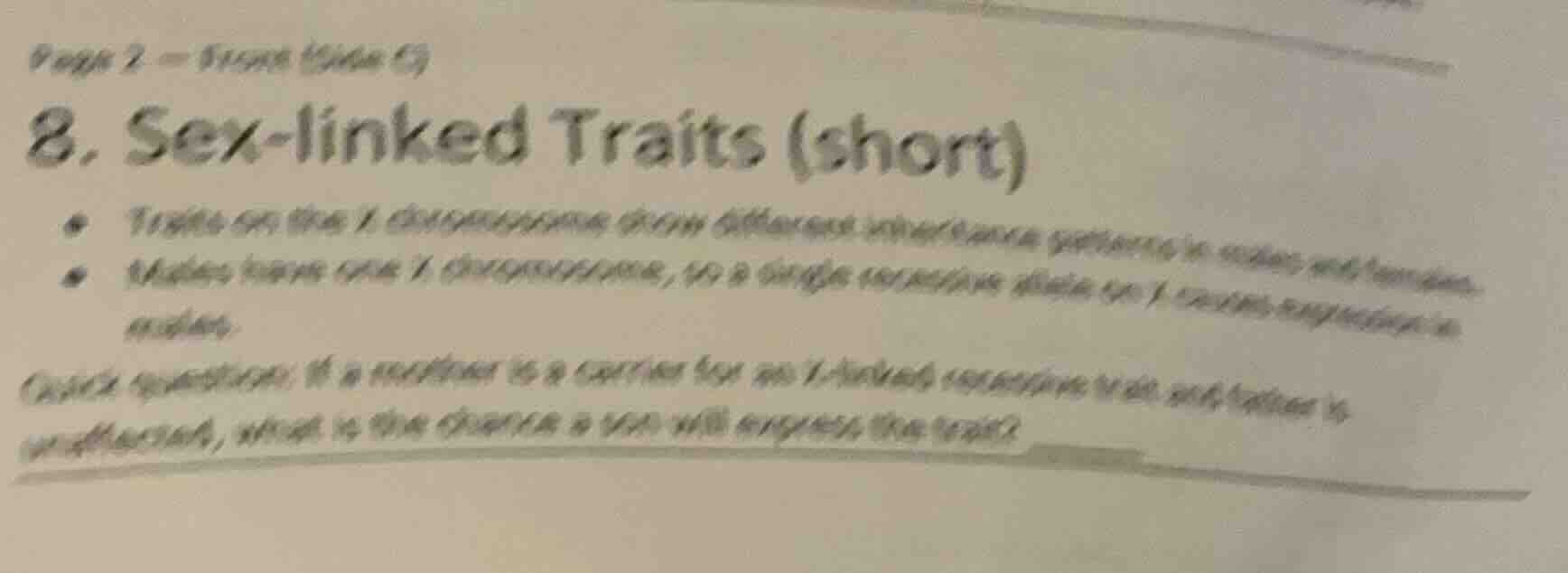
page 2 - front (side 6)
- sex - linked traits (short)
- traits on the x chromosome show different inheritance patterns in males and females.
- males have one x chromosome, so a single recessive allele on x causes expression in males.
quick question: if a mother is a carrier for an x - linked recessive trait and father is unaffected, what is the chance a son will express the trait?
Step1: Understand sex - linked inheritance
For X - linked recessive traits, let's denote the normal allele as \(X^A\) and the recessive allele as \(X^a\). The mother is a carrier, so her genotype is \(X^A X^a\). The father is unaffected, so his genotype is \(X^A Y\) (since males have one X and one Y chromosome, and he is unaffected, his X has the dominant allele).
Step2: Determine possible gametes
The mother (\(X^A X^a\)) can produce two types of gametes: \(X^A\) and \(X^a\), each with a probability of \(\frac{1}{2}\). The father (\(X^A Y\)) can produce two types of gametes: \(X^A\) and \(Y\), each with a probability of \(\frac{1}{2}\).
Step3: Analyze the inheritance for a son
A son inherits the Y chromosome from his father and an X chromosome from his mother. So, the possible genotypes for a son are:
- If he gets \(X^A\) from his mother and \(Y\) from his father, his genotype is \(X^A Y\) (unaffected).
- If he gets \(X^a\) from his mother and \(Y\) from his father, his genotype is \(X^a Y\) (affected, since he has only one X chromosome and the recessive allele is on it).
The probability of getting \(X^a\) from the mother (which is needed for the son to be affected) is \(\frac{1}{2}\), and the probability of getting \(Y\) from the father is \(\frac{1}{2}\). But for a son, the inheritance of the Y from the father is certain in terms of determining the sex (since to be a son, he must get the Y from the father). So, the probability that a son will inherit the recessive allele from the mother (and thus express the X - linked recessive trait) is the probability that the mother passes on the \(X^a\) allele, which is \(\frac{1}{2}\).

Snap & solve any problem in the app
Get step-by-step solutions on Sovi AI
Photo-based solutions with guided steps
Explore more problems and detailed explanations
\(\frac{1}{2}\) (or 50%)