QUESTION IMAGE
Question
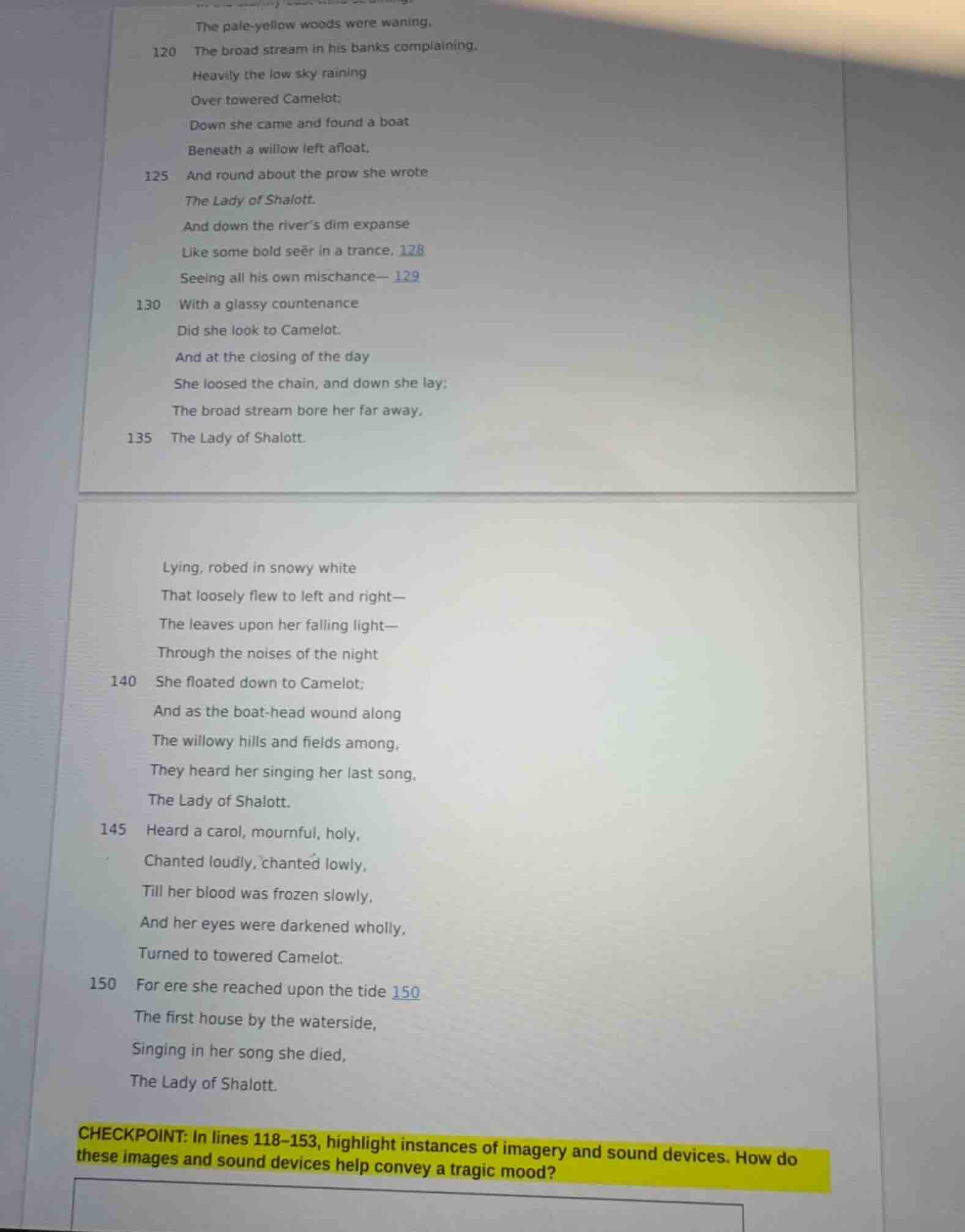
the pale - yellow woods were waning.
120 the broad stream in his banks complaining,
heavily the low sky raining
over towered camelot;
down she came and found a boat
beneath a willow left afloat;
125 and round about the prow she wrote
the lady of shalott.
and down the river’s dim expanse
like some bold seer in a trance, 128
seeing all his own mischance— 129
130 with a glassy countenance
did she look to camelot.
and at the closing of the day
she loosed the chain, and down she lay;
the broad stream bore her far away,
135 the lady of shalott.
lying, robed in snowy white
that loosely flew to left and right—
the leaves upon her falling light—
through the noises of the night
140 she floated down to camelot;
and as the boat - head wound along
the willowy hills and fields among,
they heard her singing her last song,
the lady of shalott.
145 heard a carol, mournful, holy,
chanted loudly, chanted lowly,
till her blood was frozen slowly,
and her eyes were darkened wholly,
turned to towered camelot.
150 for ere she reached upon the tide 150
the first house by the waterside,
singing in her song she died,
the lady of shalott.
checkpoint: in lines 118 - 153, highlight instances of imagery and sound devices. how do these images and sound devices help convey a tragic mood?
Imagery Instances:
- Visual Imagery: “The pale - yellow woods were waning”, “Heavily the low sky raining / Over towered Camelot”, “Lying, robed in snowy white / That loosely flew to left and right— / The leaves upon her falling light—” create mental pictures of the landscape, the Lady’s appearance, and the falling leaves. These images of a fading wood, a rainy sky, and the Lady in white with leaves falling on her evoke a sense of decay, gloom, and fragility, contributing to the tragic mood.
- Tactile Imagery: “That loosely flew to left and right” (the robe) gives a sense of the light, flowing texture of the Lady’s robe, adding to the delicate and vulnerable image of her, enhancing the tragedy as she is on her final journey.
- Kinesthetic Imagery: “Down she came and found a boat / Beneath a willow left afloat”, “She loosed the chain, and down she lay; / The broad stream bore her far away”, “She floated down to Camelot” show the Lady’s movements and the stream’s motion. The passive movement of the Lady (being borne by the stream) and her final actions (loosing the chain, lying down) suggest a loss of control and a march towards death, creating a tragic atmosphere.
Sound Devices Instances:
- Repetition: The phrase “The Lady of Shalott” is repeated (lines 125, 135, 145, 153). This repetition acts as a refrain, emphasizing the Lady’s identity and her tragic fate. It creates a mournful, almost dirge - like quality, reinforcing the tragic mood.
- Alliteration: “Heavily the low sky raining” (alliteration of “l” in “low” and “sky”, and “h” in “heavily” and “raining” to some extent), “willow left afloat” (alliteration of “w”), “leaves upon her falling light” (alliteration of “l”), “boat - head wound along” (alliteration of “w”), “mournful, holy” (alliteration of “h”), “chanted loudly, chanted lowly” (alliteration of “c” and “l”). Alliteration creates a rhythmic, musical quality but also can emphasize the somber or delicate nature of the scenes, like the “low sky raining” adding to the gloom, and the repeated “chanted” in “chanted loudly, chanted lowly” emphasizing the mournful carol, all contributing to the tragic mood.
- Consonance: In “The broad stream in his banks complaining” (consonance of “b” in “broad”, “banks”), “She loosed the chain, and down she lay” (consonance of “l” in “loosed”, “lay”). Consonance adds to the musicality but also can create a sense of tension or a somber tone, fitting the tragic theme.
How They Convey Tragic Mood:
The imagery of decay (waning woods), gloom (rainy sky), and the Lady’s vulnerable state (in white, passive movement) combined with the sound devices like the mournful refrain of “The Lady of Shalott”, the somber alliteration and consonance, all work together. The imagery paints a picture of a dying world and a dying woman, while the sound devices create a mournful, repetitive, and somber auditory landscape. Together, they immerse the reader in a world of loss, fragility, and death, effectively conveying the tragic mood of the Lady’s final moments.

Snap & solve any problem in the app
Get step-by-step solutions on Sovi AI
Photo-based solutions with guided steps
Explore more problems and detailed explanations
Imagery:
- Visual: “The pale - yellow woods were waning”, “Heavily the low sky raining / Over towered Camelot”, “Lying, robed in snowy white...The leaves upon her falling light—”
- Tactile: “That loosely flew to left and right”
- Kinesthetic: “Down she came...Beneath a willow left afloat”, “She loosed the chain...The broad stream bore her far away”
Sound Devices:
- Repetition: “The Lady of Shalott” (lines 125, 135, 145, 153)
- Alliteration: “Heavily the low sky raining”, “willow left afloat”, “leaves upon her falling light”, “boat - head wound along”, “mournful, holy”, “chanted loudly, chanted lowly”
- Consonance: “The broad stream in his banks complaining”, “She loosed the chain, and down she lay”
Contribution to Tragic Mood:
Imagery of decay, gloom, and the Lady’s vulnerability, plus somber/repetitive sound devices, create a sense of loss, fragility, and death, conveying the tragic mood of the Lady’s fate.