QUESTION IMAGE
Question
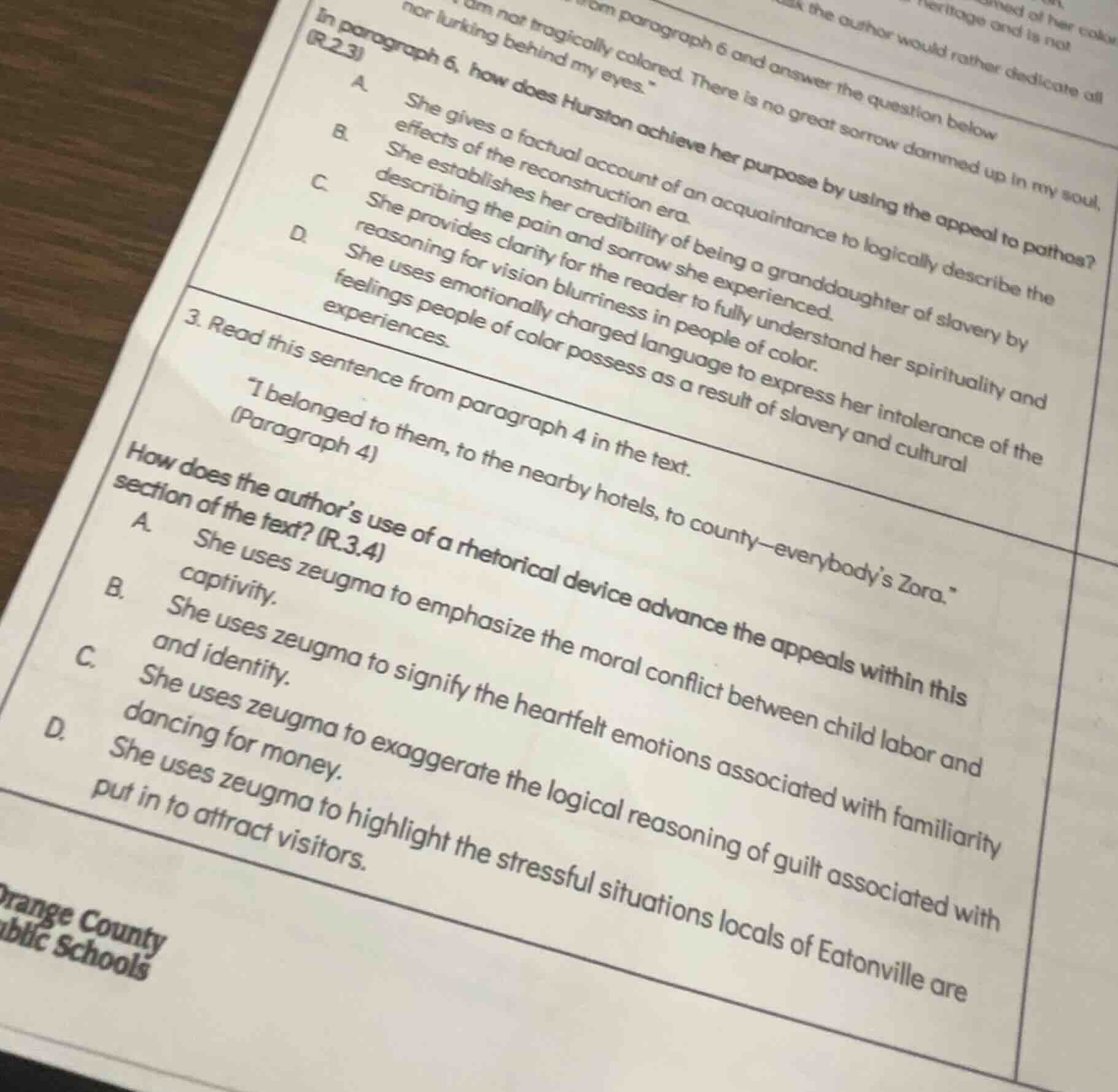
from paragraph 6 and answer the question below
i am not tragically colored. there is no great sorrow dammed up in my soul,
nor lurking behind my eyes.
in paragraph 6, how does hurston achieve her purpose by using the appeal to pathos? (r.2.3)
a. she gives a factual account of an acquaintance to logically describe the effects of the reconstruction era.
b. she establishes her credibility of being a granddaughter of slavery by describing the pain and sorrow she experienced.
c. she provides clarity for the reader to fully understand her spirituality and reasoning for vision blurriness in people of color.
d. she uses emotionally charged language to express her intolerance of the feelings people of color possess as a result of slavery and cultural experiences.
- read this sentence from paragraph 4 in the text.
“i belonged to them, to the nearby hotels, to county—everybodys zora.” (paragraph 4)
how does the authors use of a rhetorical device advance the appeals within this section of the text? (r.3.4)
a. she uses zeugma to emphasize the moral conflict between child labor and captivity.
b. she uses zeugma to signify the heartfelt emotions associated with familiarity and identity.
c. she uses zeugma to exaggerate the logical reasoning of guilt associated with dancing for money.
d. she uses zeugma to highlight the stressful situations locals of eatonville are put in to attract visitors.
For the first question: Pathos is an appeal to emotion. Option B describes detailing personal pain and sorrow, which directly evokes emotional responses from the reader, fitting the definition of pathos.
For the second question: The sentence "I belonged to them, to the nearby hotels, to county—everybody's Zora" uses zeugma (a single verb applying to multiple objects) to show the speaker's sense of belonging and connection to her community, which ties to familiarity and her identity. Option C matches this.

Snap & solve any problem in the app
Get step-by-step solutions on Sovi AI
Photo-based solutions with guided steps
Explore more problems and detailed explanations
First question: B. She establishes her credibility of being a granddaughter of slavery by describing the pain and sorrow she experienced.
Second question: C. She uses zeugma to exaggerate the logical reasoning of guilt associated with dancing for money.