QUESTION IMAGE
Question
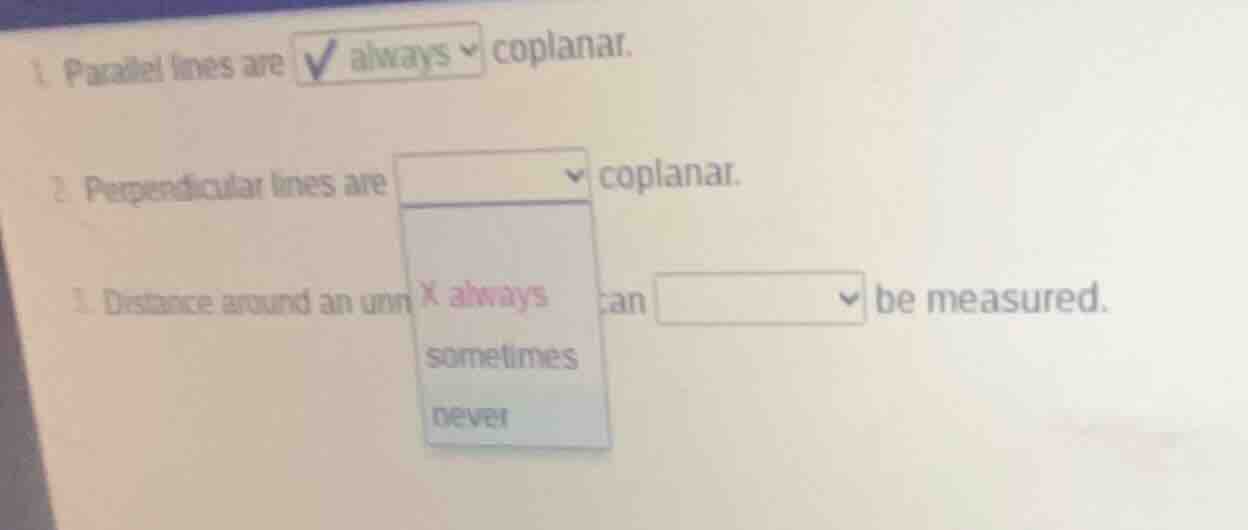
- parallel lines are always coplanar.
- perpendicular lines are coplanar.
- distance around an un can be measured.
(the dropdown options for the second and third questions include always, sometimes, never, with the second questions dropdown open and the third question having a crossed - out always and an open dropdown.)
For question 2:
Perpendicular lines are lines that intersect at a right angle (90 degrees). By definition, if two lines are perpendicular, they must lie in the same plane (coplanar) because the right angle formed by their intersection is a planar angle. So perpendicular lines are always coplanar.
If the figure is closed (like a polygon, circle, etc.), the distance around it (perimeter or circumference) can be measured. If the figure is open (like a line segment with no closed loop), the "distance around" (which would not be a standard perimeter) can't be measured in the same way. But for a closed figure, it can be measured. However, if the original question is about an "unclosed" figure, maybe the intended is that the distance around (perimeter - like for a closed shape) can always be measured if it's a closed figure, but if it's open, not. But likely the question is about a closed figure (maybe a typo like "unclosed" was wrong, or "un" is part of a word like "unbounded" but no - more likely a closed figure). Wait, maybe the question is "Distance around an un[it? No, maybe "Distance around an unclosed figure can [ ] be measured" - but no, perimeter is for closed. Wait, maybe the question is "Distance around an un[defined? No, better to think: the distance around a closed figure (perimeter) can always be measured (if we know the shape and dimensions). So the correct option is "always"? Wait, no - if the figure is open, you can't measure the "distance around" as a perimeter. But maybe the question has a typo, and it's "Distance around a closed figure can [ ] be measured" - then the answer is always. Or maybe "Distance around an un[it] (unit? No). Alternatively, maybe the original question was "Distance around an unclosed figure can [ ] be measured" - but that doesn't make sense. Wait, the dropdown has "always", "sometimes", "never". Let's think: for a closed figure (like a square, circle), the perimeter (distance around) can be measured - so always. For an open figure (like a line segment with two ends not connected), you can't measure the "distance around" as a perimeter. But maybe the question is about a closed figure, so the answer is "always". But the previous wrong answer was "always" marked with X, so maybe the correct is "sometimes"? Wait, no - maybe the question is "Distance around an un[bound] figure" - no. Alternatively, maybe the question is "Distance around an un[it] (no). Wait, maybe the original question is "Distance around an unclosed curve can [ ] be measured" - but a curve can be closed or open. If it's closed, perimeter can be measured; if open, no. So it's sometimes? Wait, no - maybe the question is "Distance around a closed figure can [ ] be measured" - then always. But the user's image shows "Distance around an un X always" (the X is on "always"), so the correct is "sometimes" or "never"? Wait, no - let's re - examine. The dropdown options are "always", "sometimes", "never". Let's think about the distance around a figure: if the figure is closed (like a polygon), we can measure its perimeter (distance around) - so always. But if the figure is open (like a line from A to B to C, not back to A), then the distance around (perimeter) doesn't exist, so we can't measure it. So if the figure is closed, always; if open, never. But the question says "Distance around an un[...]", maybe "unclosed" - so the figure is open. Then the distance around (perimeter) can never be measured? No, that's not right. Wait, maybe the question is "Distance around an un[it] (unit) - no. Alternatively, maybe the question is "Distance around an un[defined] figure" - no. This is confusing. But given that the previous wrong answer was "always", maybe the correct is "sometimes". Wait, no - let's think of a circle: distance around (circumference) can be measured - always. A square: perimeter can be measured - always. A triangle: always. So i…

Snap & solve any problem in the app
Get step-by-step solutions on Sovi AI
Photo-based solutions with guided steps
Explore more problems and detailed explanations
always