QUESTION IMAGE
Question
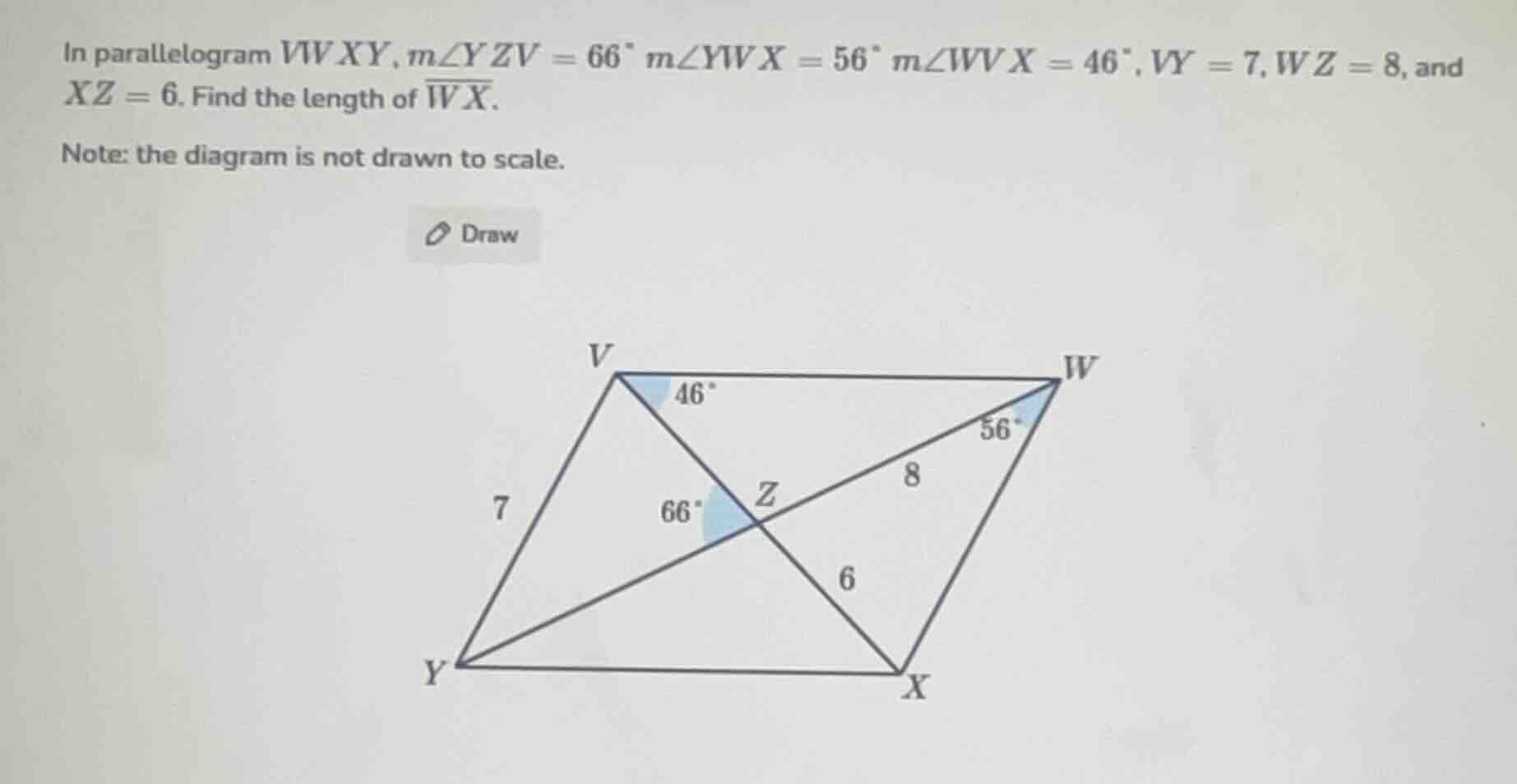
in parallelogram vwxy, ( mangle yzv = 66^circ ), ( mangle ywx = 56^circ ), ( mangle wvx = 46^circ ), ( vy = 7 ), ( wz = 8 ), and ( xz = 6 ). find the length of ( overline{wx} ). note: the diagram is not drawn to scale.
Step1: Identify triangle for Law of Sines
In parallelogram \(VWXY\), we look at \(\triangle VYW\) and \(\triangle WXV\)? Wait, no, let's check the angles and sides. Wait, actually, let's consider \(\triangle VZW\) or \(\triangle YWX\)? Wait, no, let's use the Law of Sines in \(\triangle VYW\)? Wait, no, let's see: we have \(VY = 7\), \(WZ = 8\), \(XZ = 6\), so \(VZ = XZ = 6\) (diagonals of parallelogram bisect each other? Wait, no, in a parallelogram, diagonals bisect each other, so \(VZ = XZ\) and \(WZ = YZ\)? Wait, no, the diagonals are \(VX\) and \(WY\). So \(VZ = XZ = 6\), \(WZ = YZ = 8\). Wait, so \(VZ = 6\), \(WZ = 8\), \(VY = 7\). Wait, maybe we can use the Law of Sines in \(\triangle VYW\)? Wait, no, let's check the angles. Wait, \(\angle YZV = 66^\circ\), which is vertical to \(\angle WZX\), so \(\angle WZX = 66^\circ\). But maybe we can use the Law of Sines in \(\triangle VYW\)? Wait, no, let's look at \(\triangle VYW\): we have \(VY = 7\), \(WZ = 8\) (so \(YZ = 8\) since diagonals bisect), \(VZ = 6\) (so \(XZ = 6\)). Wait, maybe \(\triangle VYW\) and \(\triangle WXV\)? No, wait, let's use the Law of Sines in \(\triangle VYW\) or \(\triangle WXY\)? Wait, the problem is to find \(WX\). Let's consider \(\triangle WXY\)? No, maybe \(\triangle VYW\): Wait, no, let's check the angles. Wait, \(\angle YWV = 56^\circ\), \(\angle WVX = 46^\circ\), and \(\angle YZV = 66^\circ\) (which is \(\angle YZV = 66^\circ\), so \(\angle VZW = 180 - 66 = 114^\circ\)? Wait, no, vertical angles: \(\angle YZV\) and \(\angle WZX\) are vertical, so they are equal, \(66^\circ\). Wait, maybe we can use the Law of Sines in \(\triangle VZW\) or \(\triangle YWX\). Wait, let's list the knowns:
In \(\triangle VYW\): Wait, \(VY = 7\), \(YZ = 8\) (since diagonals bisect, \(WZ = YZ = 8\)), \(VZ = 6\) (since \(XZ = 6\), diagonals bisect, so \(VZ = XZ = 6\)). Wait, no, diagonals in a parallelogram bisect each other, so \(VZ = XZ\) and \(WZ = YZ\). So \(VZ = 6\), \(WZ = 8\), so \(VX = VZ + XZ = 12\), \(WY = WZ + YZ = 16\). But maybe we can use the Law of Sines in \(\triangle VYW\) where we have sides \(VY = 7\), \(YZ = 8\), \(VZ = 6\)? No, wait, let's use the Law of Sines in \(\triangle VYW\) with angle \(\angle YWV = 56^\circ\), \(\angle WVY = 46^\circ\), so the third angle is \(180 - 56 - 46 = 78^\circ\)? Wait, no, \(\angle YWV = 56^\circ\), \(\angle WVX = 46^\circ\), so \(\angle VWX = 56 + 46 = 102^\circ\)? No, that's not right. Wait, maybe I made a mistake. Wait, the problem is in parallelogram \(VWXY\), so \(VW \parallel XY\) and \(VX \parallel WY\)? No, sides: \(VW \parallel XY\) and \(VX \parallel WY\)? Wait, no, in a parallelogram, opposite sides are parallel: \(VW \parallel XY\) and \(VX \parallel WY\)? No, \(VW \parallel XY\) and \(VY \parallel WX\). Ah! Yes, in parallelogram \(VWXY\), \(VY \parallel WX\) and \(VW \parallel XY\). So \(VY = WX\)? Wait, no, opposite sides are equal: \(VY = WX\) and \(VW = XY\). Wait, that's a key property of parallelograms: opposite sides are equal in length. So if \(VY = 7\), then \(WX = VY = 7\)? Wait, that can't be, because the angles are given. Wait, no, maybe the labeling is different. Wait, the parallelogram is \(VWXY\), so the vertices are \(V\), \(W\), \(X\), \(Y\) in order, so sides: \(VW\), \(WX\), \(XY\), \(YV\). So \(VW \parallel XY\) and \(WX \parallel YV\). Therefore, \(WX = YV\). Since \(YV = 7\), then \(WX = 7\). Wait, that's a property of parallelograms: opposite sides are equal. So regardless of the angles, if \(VY\) is a side, then \(WX\) (opposite side) is equal to \(VY\). So that's the key.
St…

Snap & solve any problem in the app
Get step-by-step solutions on Sovi AI
Photo-based solutions with guided steps
Explore more problems and detailed explanations
\(7\)