QUESTION IMAGE
Question
part a
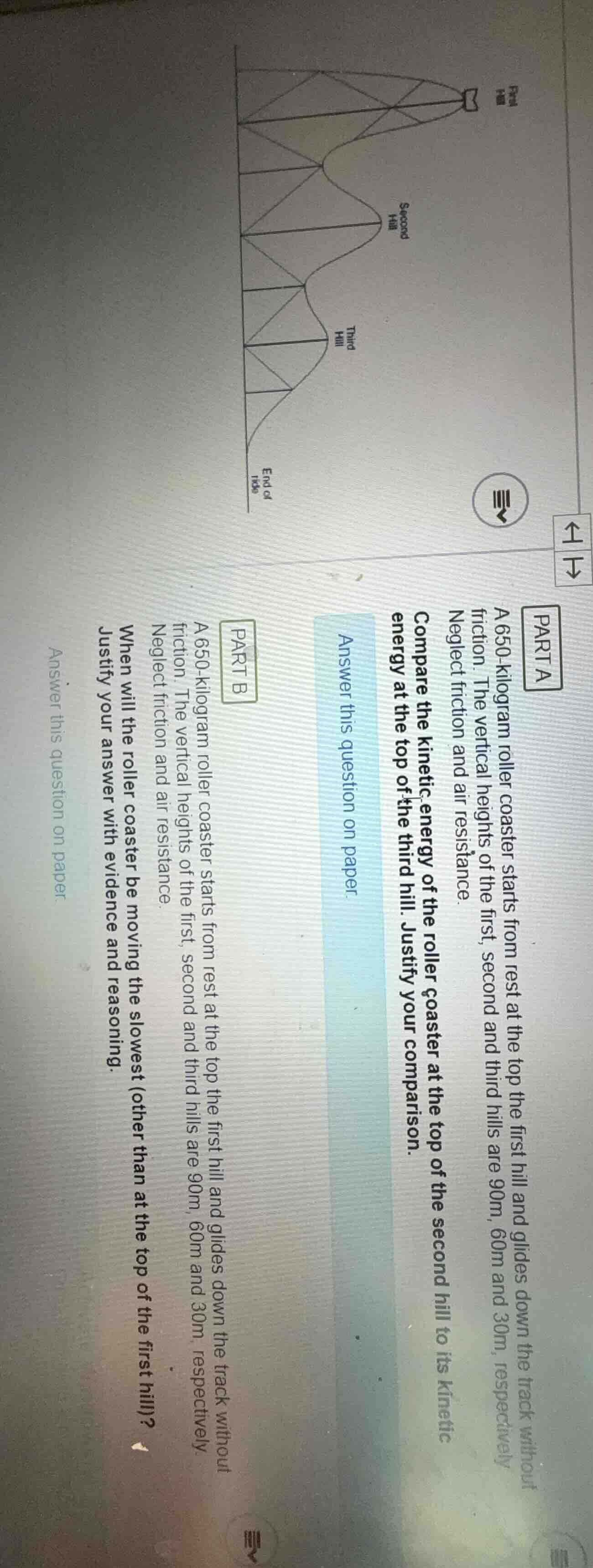
a 650-kilogram roller coaster starts from rest at the top the first hill and glides down the track without friction. the vertical heights of the first, second and third hills are 90m, 60m and 30m, respectively
neglect friction and air resistance.
compare the kinetic energy of the roller coaster at the top of the second hill to its kinetic energy at the top of the third hill. justify your comparison.
answer this question on paper.
part b
a 650-kilogram roller coaster starts from rest at the top the first hill and glides down the track without friction. the vertical heights of the first, second and third hills are 90m, 60m and 30m, respectively.
neglect friction and air resistance.
when will the roller coaster be moving the slowest (other than at the top of the first hill)?
justify your answer with evidence and reasoning.
answer this question on paper.
Step1: Define energy conservation law
Since friction/air resistance are neglected, mechanical energy is conserved: $PE_i + KE_i = PE_f + KE_f$. The coaster starts from rest, so $KE_i=0$, so $PE_i = PE_f + KE_f$, or $KE_f = PE_i - PE_f$.
Gravitational potential energy: $PE = mgh$.
Step2: Calculate KE at top of 2nd hill
First hill height $h_1=90m$, second hill $h_2=60m$.
$KE_2 = mg(h_1 - h_2) = mg(90-60) = 30mg$
Step3: Calculate KE at top of 3rd hill
Third hill height $h_3=30m$.
$KE_3 = mg(h_1 - h_3) = mg(90-30) = 60mg$
Step4: Compare the two kinetic energies
Compare $KE_2$ and $KE_3$: $30mg < 60mg$, so $KE_2 < KE_3$.
Step5: Find slowest speed (Part B)
Kinetic energy is $KE=\frac{1}{2}mv^2$, so speed $v=\sqrt{\frac{2KE}{m}}$. Lower KE means lower speed. The highest remaining PE (after first hill) is at the top of the second hill, so KE is lowest there, meaning speed is slowest.

Snap & solve any problem in the app
Get step-by-step solutions on Sovi AI
Photo-based solutions with guided steps
Explore more problems and detailed explanations
Part A:
The kinetic energy of the roller coaster at the top of the second hill is less than its kinetic energy at the top of the third hill. By conservation of mechanical energy (no friction/air resistance), the kinetic energy at the top of each hill equals the loss in gravitational potential energy from the first hill. The second hill is taller than the third, so less potential energy is converted to kinetic energy, resulting in lower kinetic energy at the top of the second hill.
Part B:
The roller coaster will be moving the slowest at the top of the second hill (other than the start at the first hill). Kinetic energy is directly related to speed ($KE=\frac{1}{2}mv^2$), and at the top of the second hill, the coaster has the highest remaining gravitational potential energy (and thus the lowest kinetic energy) of all points after the first hill, so its speed is the slowest there.