QUESTION IMAGE
Question
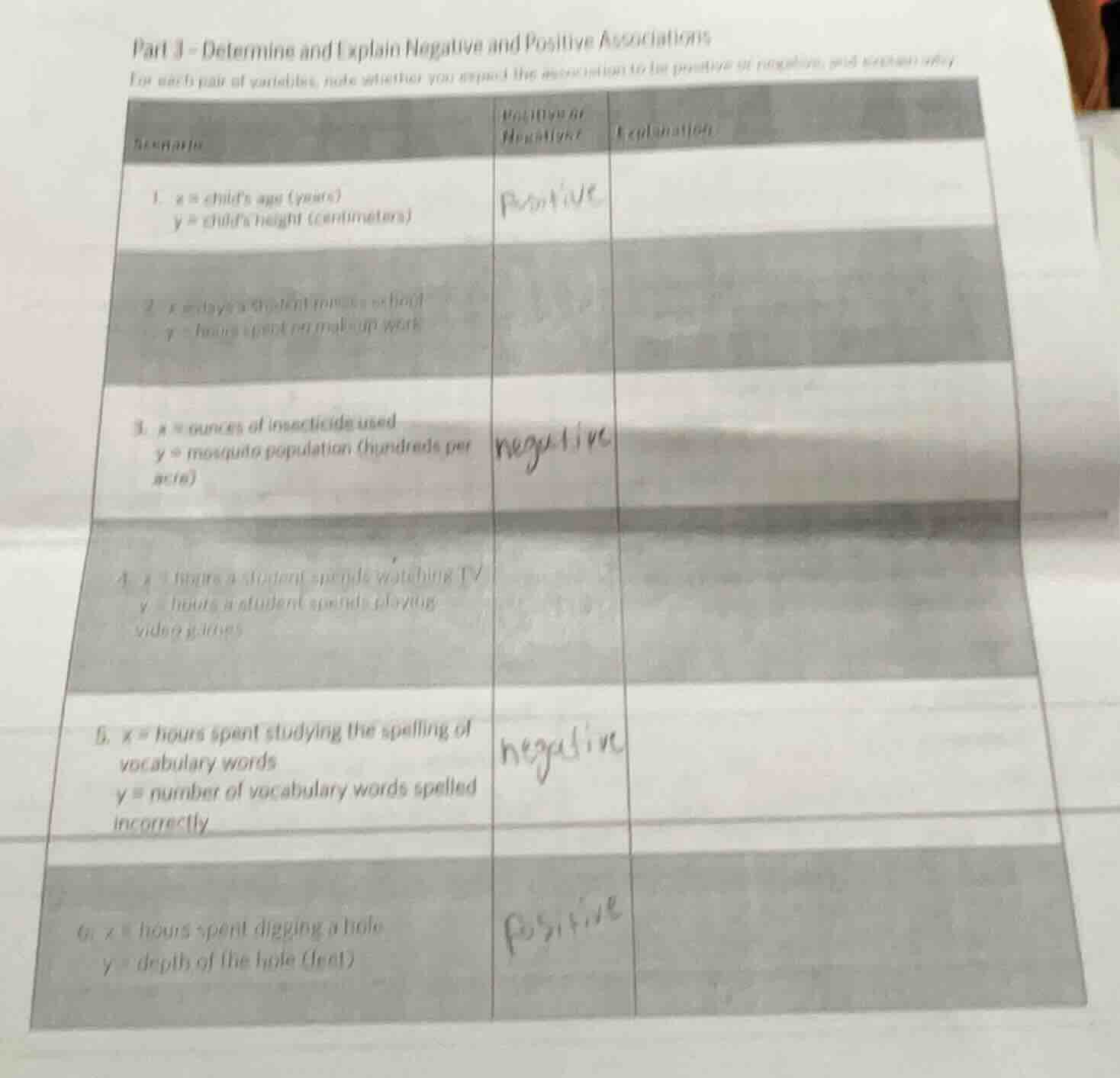
part 3 - determine and explain negative and positive associations
for each pair of variables, note whether you expect the association to be positive or negative, and explain why
| scenario | positive or negative? | explanation |
|---|---|---|
| 2. ( x = ) distance student travels to school <br> ( y = ) time spent traveling to school | ||
| 3. ( x = ) ounces of insecticide used <br> ( y = ) mosquito population (hundreds per acre) | negative (handwritten) | |
| 4. ( x = ) hours a student spends watching tv <br> ( y = ) hours a student spends playing video games | ||
| 5. ( x = ) hours spent studying the spelling of vocabulary words <br> ( y = ) number of vocabulary words spelled incorrectly | negative (handwritten) | |
| 6. ( x = ) hours spent digging a hole <br> ( y = ) depth of the hole (feet) | positive (handwritten) |
Response
To solve this, we analyze each variable pair for positive/negative association:
1. \( x \) = child’s age (years), \( y \) = child’s height (centimeters)
- Association: Positive
- Explanation: As a child’s age increases, their height typically increases (positive relationship).
2. \( x \) = distance from home to school, \( y \) = time spent to get to work
- Association: Positive
- Explanation: Greater distance from home to school (or work) usually means more time spent commuting (positive relationship).
3. \( x \) = ounces of insecticide used, \( y \) = mosquito population (hundreds per acre)
- Association: Negative
- Explanation: More insecticide kills more mosquitoes, so as \( x \) (insecticide) increases, \( y \) (mosquitoes) decreases (negative relationship).
4. \( x \) = hours a student spends watching TV, \( y \) = hours a student spends playing video games
- Association: Positive
- Explanation: Students who spend more time on TV often spend more time on other screen - based activities like video games (positive relationship).
5. \( x \) = hours spent studying spelling of vocabulary words, \( y \) = number of vocabulary words spelled incorrectly
- Association: Negative
- Explanation: More study time reduces spelling mistakes, so as \( x \) (study time) increases, \( y \) (incorrect spellings) decreases (negative relationship).
6. \( x \) = hours spent digging a hole, \( y \) = depth of the hole (feet)
- Association: Positive
- Explanation: More time spent digging usually results in a deeper hole, so as \( x \) (time) increases, \( y \) (depth) increases (positive relationship).
Final Answers (for each row’s “Explanation” column):
- As age increases, height increases.
- Greater distance means more commute time.
- More insecticide reduces mosquitoes.
- More TV time links to more video game time.
- More study time reduces misspelled words.
- More digging time increases hole depth.

Snap & solve any problem in the app
Get step-by-step solutions on Sovi AI
Photo-based solutions with guided steps
Explore more problems and detailed explanations
To solve this, we analyze each variable pair for positive/negative association:
1. \( x \) = child’s age (years), \( y \) = child’s height (centimeters)
- Association: Positive
- Explanation: As a child’s age increases, their height typically increases (positive relationship).
2. \( x \) = distance from home to school, \( y \) = time spent to get to work
- Association: Positive
- Explanation: Greater distance from home to school (or work) usually means more time spent commuting (positive relationship).
3. \( x \) = ounces of insecticide used, \( y \) = mosquito population (hundreds per acre)
- Association: Negative
- Explanation: More insecticide kills more mosquitoes, so as \( x \) (insecticide) increases, \( y \) (mosquitoes) decreases (negative relationship).
4. \( x \) = hours a student spends watching TV, \( y \) = hours a student spends playing video games
- Association: Positive
- Explanation: Students who spend more time on TV often spend more time on other screen - based activities like video games (positive relationship).
5. \( x \) = hours spent studying spelling of vocabulary words, \( y \) = number of vocabulary words spelled incorrectly
- Association: Negative
- Explanation: More study time reduces spelling mistakes, so as \( x \) (study time) increases, \( y \) (incorrect spellings) decreases (negative relationship).
6. \( x \) = hours spent digging a hole, \( y \) = depth of the hole (feet)
- Association: Positive
- Explanation: More time spent digging usually results in a deeper hole, so as \( x \) (time) increases, \( y \) (depth) increases (positive relationship).
Final Answers (for each row’s “Explanation” column):
- As age increases, height increases.
- Greater distance means more commute time.
- More insecticide reduces mosquitoes.
- More TV time links to more video game time.
- More study time reduces misspelled words.
- More digging time increases hole depth.