QUESTION IMAGE
Question
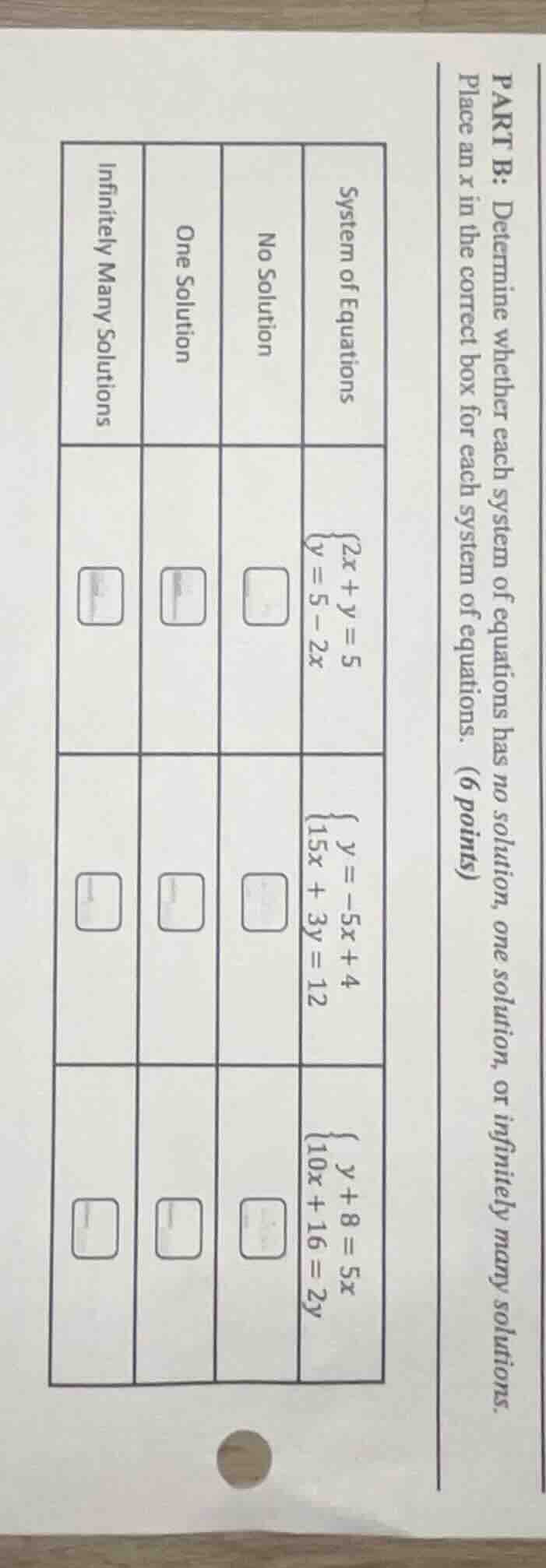
part b: determine whether each system of equations has no solution, one solution, or infinitely many solutions. place an x in the correct box for each system of equations. (6 points)
| system of equations | no solution | one solution | infinitely many solutions |
|---|
| \\(\
\\) | \\(\square\\) | \\(\square\\) | \\(\square\\) |
| \\(\
\\) | \\(\square\\) | \\(\square\\) | \\(\square\\) |
| \\(\
\\) | \\(\square\\) | \\(\square\\) | \\(\square\\) |
Step1: Analyze first system
Substitute $y=5-2x$ into $2x+y=5$:
$2x + (5-2x) = 5$
$2x + 5 - 2x = 5$
$5=5$
This is always true, so the equations are identical.
Step2: Analyze second system
Substitute $y=-5x+4$ into $15x+3y=12$:
$15x + 3(-5x+4) = 12$
$15x -15x +12 = 12$
$12=12$
This is always true, so the equations are identical.
Step3: Analyze third system
Rewrite $y+8=5x$ as $y=5x-8$. Substitute into $10x+16=2y$:
$10x+16=2(5x-8)$
$10x+16=10x-16$
$16=-16$
This is never true, so lines are parallel.

Snap & solve any problem in the app
Get step-by-step solutions on Sovi AI
Photo-based solutions with guided steps
Explore more problems and detailed explanations
- For
: Mark $\boldsymbol{x}$ in the "Infinitely Many Solutions" box
- For
: Mark $\boldsymbol{x}$ in the "Infinitely Many Solutions" box
- For
: Mark $\boldsymbol{x}$ in the "No Solution" box