QUESTION IMAGE
Question
part 2: dna structure & replication
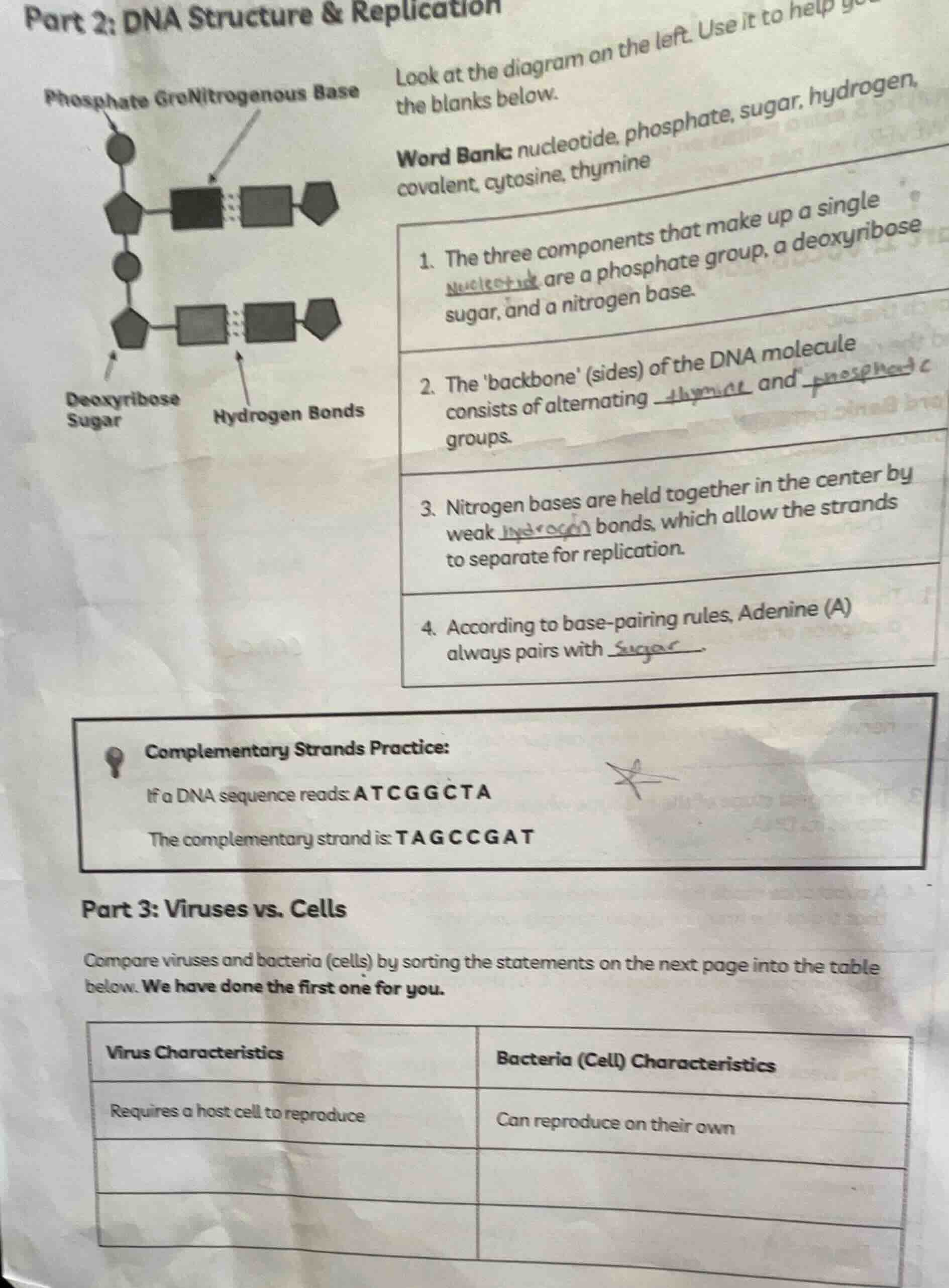
phosphate gronitrogenous base
deoxyribose sugar
hydrogen bonds
look at the diagram on the left. use it to help you fill the blanks below.
word bank: nucleotide, phosphate, sugar, hydrogen, covalent, cytosine, thymine
- the three components that make up a single ____ are a phosphate group, a deoxyribose sugar, and a nitrogen base.
- the backbone (sides) of the dna molecule consists of alternating __ and __ groups.
- nitrogen bases are held together in the center by weak ____ bonds, which allow the strands to separate for replication.
- according to base-pairing rules, adenine (a) always pairs with ____.
complementary strands practice:
if a dna sequence reads: atcggcta
the complementary strand is: tagccgat
part 3: viruses vs. cells
compare viruses and bacteria (cells) by sorting the statements on the next page into the table below. we have done the first one for you.
virus characteristics | bacteria (cell) characteristics
requires a host cell to reproduce | can reproduce on their own
- For question 1: A single nucleotide is defined as the combination of a phosphate group, deoxyribose sugar, and nitrogenous base.
- For question 2: The DNA backbone is made of alternating deoxyribose sugar and phosphate groups, connected by covalent bonds.
- For question 3: Weak hydrogen bonds between complementary nitrogenous bases hold the two DNA strands together, and these bonds break easily for replication.
- For question 4: DNA base-pairing rules state adenine (A) exclusively pairs with thymine (T).

Snap & solve any problem in the app
Get step-by-step solutions on Sovi AI
Photo-based solutions with guided steps
Explore more problems and detailed explanations
- nucleotide
- sugar, phosphate
- hydrogen
- thymine