QUESTION IMAGE
Question
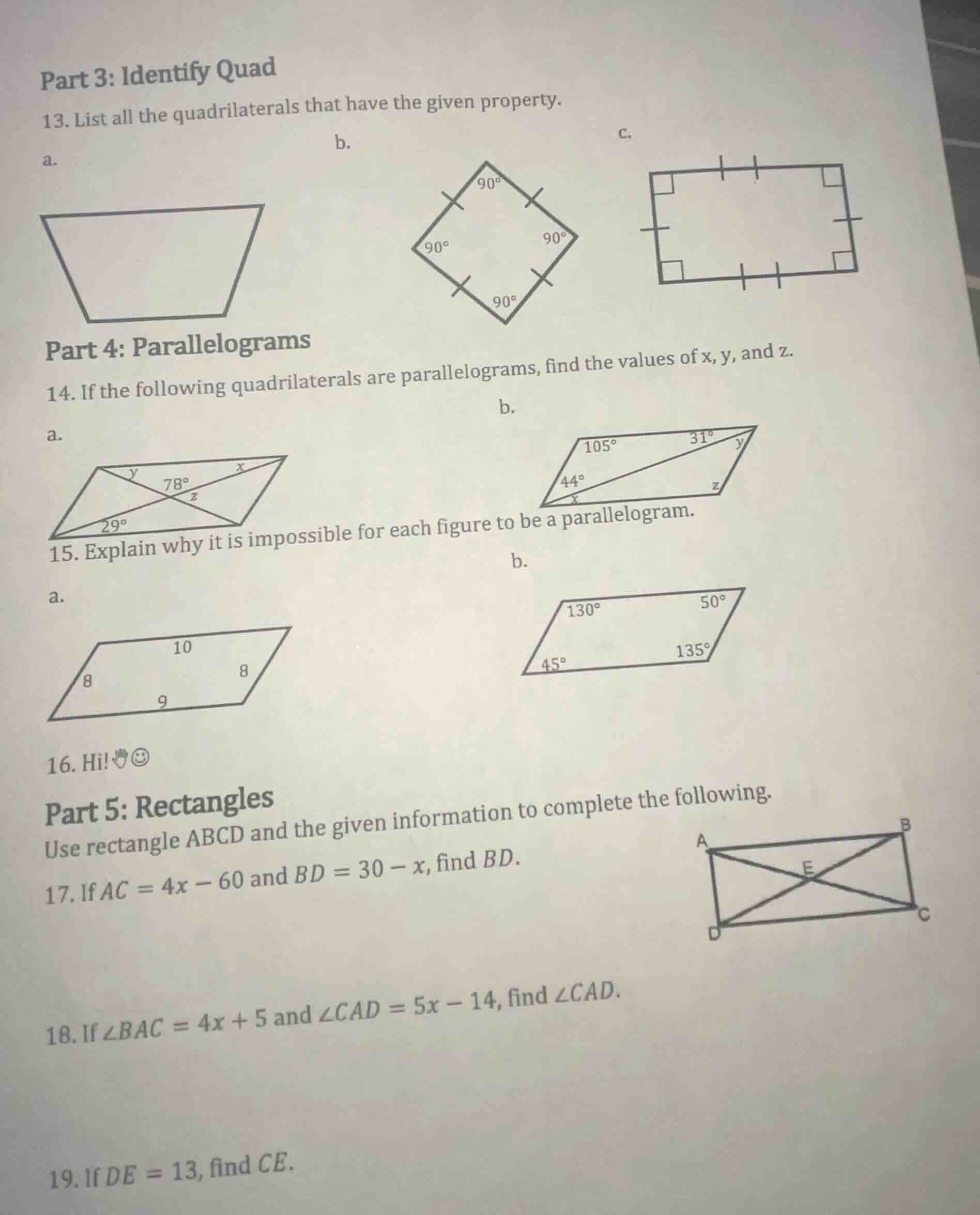
part 3: identify quad
- list all the quadrilaterals that have the given property.
a.
b.
c.
part 4: parallelograms
- if the following quadrilaterals are parallelograms, find the values of x, y, and z.
a.
b.
- explain why it is impossible for each figure to be a parallelogram.
a.
b.
- hi!
part 5: rectangles
use rectangle abcd and the given information to complete the following.
- if ( ac = 4x - 60 ) and ( bd = 30 - x ), find ( bd ).
- if ( angle bac = 4x + 5 ) and ( angle cad = 5x - 14 ), find ( angle cad ).
- if ( de = 13 ), find ( ce ).
Question 13
a. The figure has exactly one pair of parallel sides, which matches the defining property of a trapezoid.
b. The figure has four right angles and all sides congruent, which are the properties of a square (a square is also a special rhombus and rectangle, but the most specific classification here is square).
c. The figure has four right angles and opposite sides congruent, which are the defining properties of a rectangle.
Part a:
Step1: Find $x$ (alternate interior angles)
In a parallelogram, opposite sides are parallel, so $\angle x = 29^\circ$
Step2: Find $y$ (vertical angle pair)
Vertical angles are equal, so $\angle y = 29^\circ$
Step3: Find $z$ (supplementary to $78^\circ$)
Linear pairs sum to $180^\circ$, so $\angle z = 180^\circ - 78^\circ = 102^\circ$
Part b:
Step1: Find $x$ (triangle angle sum)
In the top triangle, $\angle x = 180^\circ - 105^\circ - 31^\circ = 44^\circ$
Step2: Find $y$ (alternate interior angles)
In a parallelogram, opposite sides are parallel, so $\angle y = 44^\circ$
Step3: Find $z$ (parallelogram consecutive angles)
Consecutive angles in a parallelogram are supplementary, so $\angle z = 180^\circ - 105^\circ = 75^\circ$
a. In a parallelogram, opposite sides must be congruent. Here, one pair of opposite sides is 10 and 9 (not equal), violating this rule.
b. In a parallelogram, consecutive angles must be supplementary (sum to $180^\circ$). Here, $130^\circ + 45^\circ = 175^\circ
eq 180^\circ$, violating this rule.

Snap & solve any problem in the app
Get step-by-step solutions on Sovi AI
Photo-based solutions with guided steps
Explore more problems and detailed explanations
a. Trapezoid
b. Square
c. Rectangle
---