QUESTION IMAGE
Question
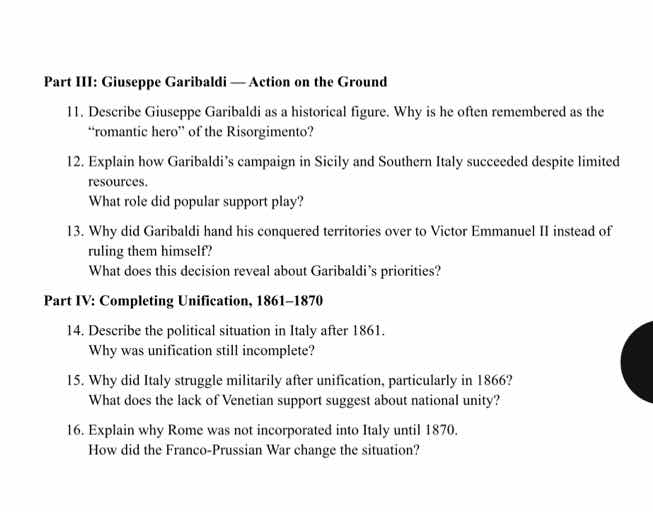
part iii: giuseppe garibaldi — action on the ground
- describe giuseppe garibaldi as a historical figure. why is he often remembered as the
omantic hero\ of the risorgimento?
- explain how garibaldi’s campaign in sicily and southern italy succeeded despite limited resources.
what role did popular support play?
- why did garibaldi hand his conquered territories over to victor emmanuel ii instead of ruling them himself?
what does this decision reveal about garibaldi’s priorities?
part iv: completing unification, 1861–1870
- describe the political situation in italy after 1861.
why was unification still incomplete?
- why did italy struggle militarily after unification, particularly in 1866?
what does the lack of venetian support suggest about national unity?
- explain why rome was not incorporated into italy until 1870.
how did the franco - prussian war change the situation?
Question 11
Giuseppe Garibaldi was an Italian general and nationalist. He led military campaigns for Italian unification (Risorgimento). His romantic hero status comes from his daring, idealism, and selfless dedication to the national cause, like the Thousand expedition, inspiring nationalistic fervor.
Garibaldi’s campaign succeeded via guerrilla tactics, charismatic leadership, and popular support: Sicilians/Italians joined his “Thousand” to fight Bourbon rule, providing manpower, local knowledge, and morale. Limited resources (small force) were offset by grassroots backing (volunteers, supplies, guerrilla collaboration).
Garibaldi handed territories to Victor Emmanuel II to advance national unification (prioritizing a united Italy over personal rule). His priority was a centralized Italian state under the House of Savoy (legitimate, pan - Italian leadership) to end fragmentation, not personal power.

Snap & solve any problem in the app
Get step-by-step solutions on Sovi AI
Photo-based solutions with guided steps
Explore more problems and detailed explanations
Giuseppe Garibaldi was an Italian nationalist, military leader in the Risorgimento. He’s a “romantic hero” for his daring (e.g., Thousand expedition to Sicily), idealistic dedication to Italian unification, and selfless sacrifice (handing over conquered lands to advance national unity over personal power).