QUESTION IMAGE
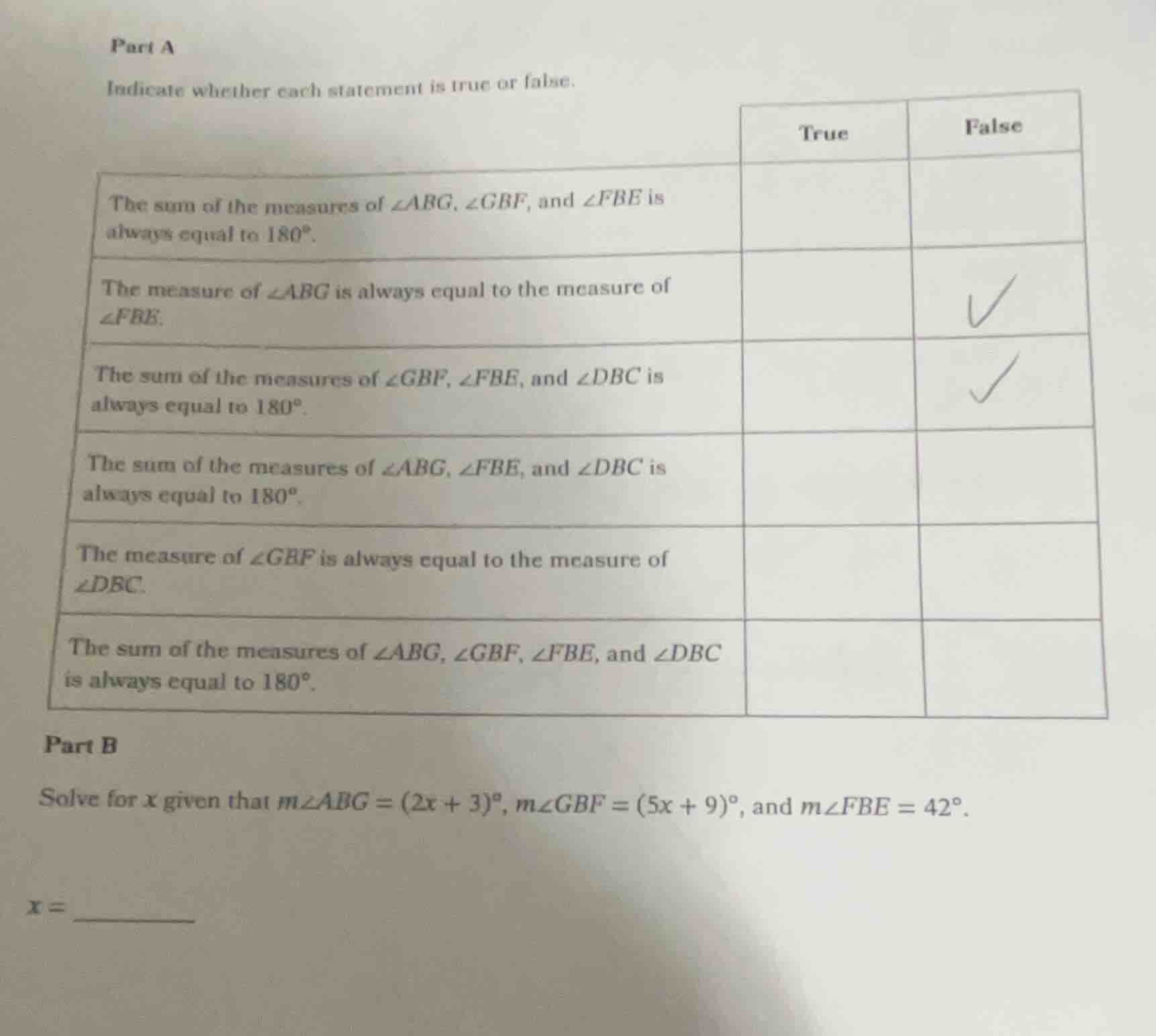
Question
part a
indicate whether each statement is true or false.
| true | false | |
|---|---|---|
| the measure of $\angle abg$ is always equal to the measure of $\angle fbe$. | \checkmark | |
| the sum of the measures of $\angle gbf$, $\angle fbe$, and $\angle dbc$ is always equal to $180^\circ$. | \checkmark | |
| the sum of the measures of $\angle abg$, $\angle fbe$, and $\angle dbc$ is always equal to $180^\circ$. | ||
| the measure of $\angle gbf$ is always equal to the measure of $\angle dbc$. | ||
| the sum of the measures of $\angle abg$, $\angle gbf$, $\angle fbe$, and $\angle dbc$ is always equal to $180^\circ$. |
part b
solve for $x$ given that $m\angle abg = (2x + 3)^\circ$, $m\angle gbf = (5x + 9)^\circ$, and $m\angle fbe = 42^\circ$.
$x = \underline{\quad\quad\quad}$
Part A
To determine the truth value of each statement, we assume the angles are on a straight line (since the sum of angles on a straight line is \(180^\circ\)):
- The sum of \( \angle ABG \), \( \angle GBF \), and \( \angle FBE \) is always \( 180^\circ \):
If \( ABE \) is a straight line, then \( \angle ABG + \angle GBF + \angle FBE = 180^\circ \) (linear pair/supplementary angles). Thus, this is True.
- \( m\angle ABG = m\angle FBE \):
There is no information (e.g., vertical angles, bisectors) to guarantee \( \angle ABG \cong \angle FBE \). Thus, this is False (as marked).
- The sum of \( \angle GBF \), \( \angle FBE \), and \( \angle DBC \) is always \( 180^\circ \):
\( \angle GBF + \angle FBE \) is part of \( \angle GBE \), but \( \angle DBC \) is unrelated to a straight line with them (no indication \( GBE \) and \( DBC \) form a straight line). Thus, this is False (as marked).
- The sum of \( \angle ABG \), \( \angle FBE \), and \( \angle DBC \) is always \( 180^\circ \):
No guarantee these angles lie on a straight line. Thus, this is False.
- \( m\angle GBF = m\angle DBC \):
No information (e.g., vertical angles, bisectors) to guarantee \( \angle GBF \cong \angle DBC \). Thus, this is False.
- The sum of \( \angle ABG \), \( \angle GBF \), \( \angle FBE \), and \( \angle DBC \) is always \( 180^\circ \):
Four angles summing to \( 180^\circ \) is impossible (since three angles on a straight line sum to \( 180^\circ \); adding a fourth would exceed \( 180^\circ \) unless the fourth is \( 0^\circ \), which is not stated). Thus, this is False.
Part B
Step 1: Set up the equation
Since \( \angle ABG \), \( \angle GBF \), and \( \angle FBE \) lie on a straight line, their measures sum to \( 180^\circ \).
Given \( m\angle ABG = (2x + 3)^\circ \), \( m\angle GBF = (5x + 9)^\circ \), and \( m\angle FBE = 42^\circ \), we write:
$$(2x + 3) + (5x + 9) + 42 = 180$$
Step 2: Simplify and solve for \( x \)
Combine like terms:
$$2x + 5x + 3 + 9 + 42 = 180$$
$$7x + 54 = 180$$
Subtract 54 from both sides:
$$7x = 180 - 54$$
$$7x = 126$$
Divide by 7:
$$x = \frac{126}{7}$$
$$x = 18$$
Final Answers
Part A (True/False):
- True
- False (marked)
- False (marked)
- False
- False
- False
Part B:

Snap & solve any problem in the app
Get step-by-step solutions on Sovi AI
Photo-based solutions with guided steps
Explore more problems and detailed explanations
\( x = \boldsymbol{18} \)