QUESTION IMAGE
Question
part iv: from company rule to the british
aj\
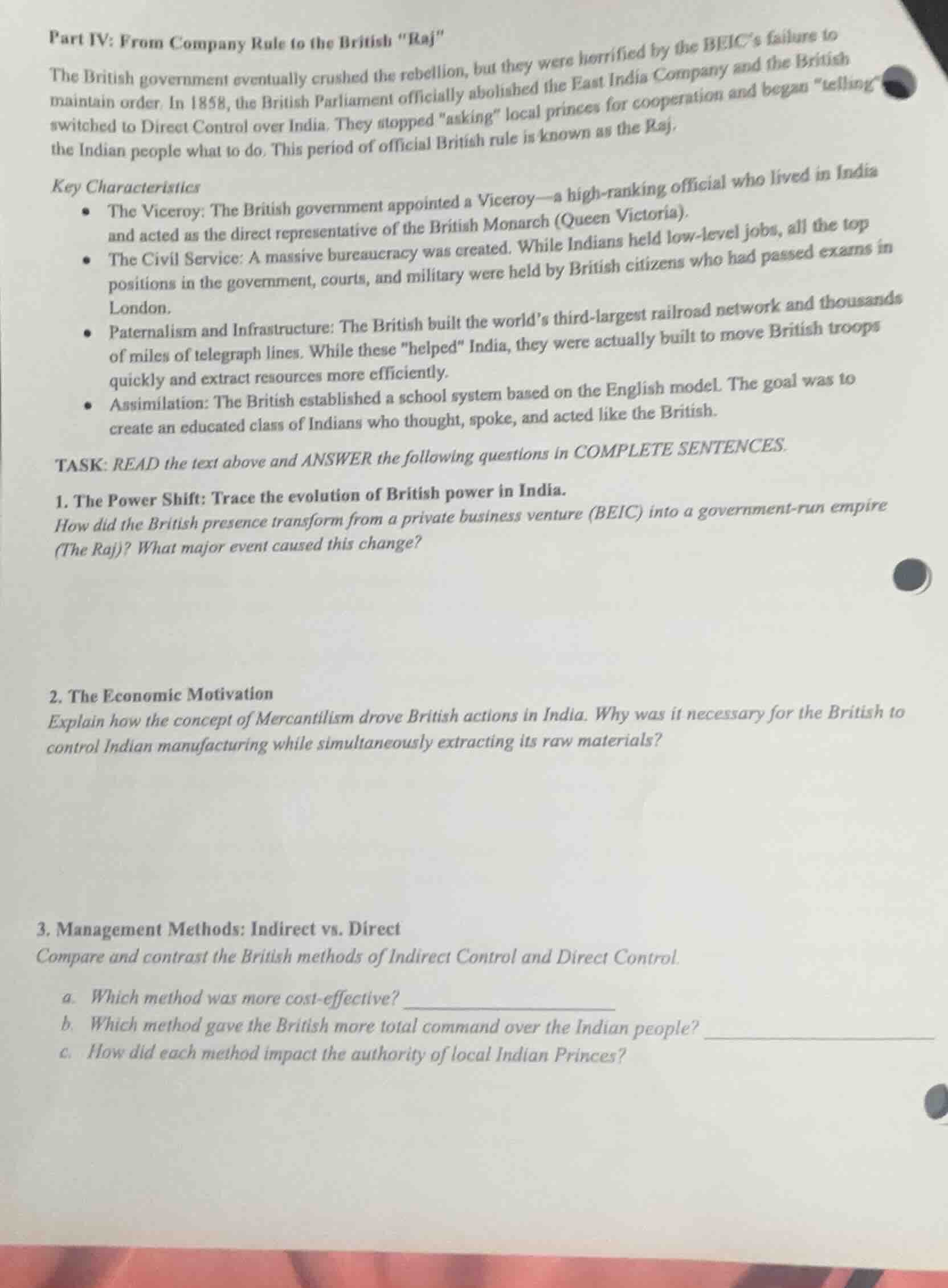
the british government eventually crushed the rebellion, but they were horrified by the beic’s failure to maintain order. in 1858, the british parliament officially abolished the east india company and the british switched to direct control over india. they stopped \asking\ local princes for cooperation and began \telling\ the indian people what to do. this period of official british rule is known as the raj.
key characteristics
- the viceroy: the british government appointed a viceroy—a high - ranking official who lived in india and acted as the direct representative of the british monarch (queen victoria).
- the civil service: a massive bureaucracy was created. while indians held low - level jobs, all the top positions in the government, courts, and military were held by british citizens who had passed exams in london.
- paternalism and infrastructure: the british built the world’s third - largest railroad network and thousands of miles of telegraph lines. while these \helped\ india, they were actually built to move british troops quickly and extract resources more efficiently.
- assimilation: the british established a school system based on the english model. the goal was to create an educated class of indians who thought, spoke, and acted like the british.
task: read the text above and answer the following questions in complete sentences.
- the power shift: trace the evolution of british power in india.
how did the british presence transform from a private business venture (beic) into a government - run empire (the raj)? what major event caused this change?
- the economic motivation
explain how the concept of mercantilism drove british actions in india. why was it necessary for the british to control indian manufacturing while simultaneously extracting its raw materials?
- management methods: indirect vs. direct
compare and contrast the british methods of indirect control and direct control.
a. which method was more cost - effective?
b. which method gave the british more total command over the indian people?
c. how did each method impact the authority of local indian princes?
Question 1: The Power Shift
To answer, we analyze the text: Initially, the British East India Company (BEIC) operated in India as a private business venture. After a rebellion (implied as the trigger for change), the British government abolished the BEIC in 1858 and took Direct Control, creating the Raj. The major event was the BEIC’s failure to maintain order (likely the 1857 rebellion, though the text says “the rebellion” crushed by the government), leading to Parliament’s 1858 decision to switch to Direct Control.
Mercantilism is about a nation increasing wealth via trade (exports > imports) and controlling colonies for resources and markets. The British wanted to control Indian manufacturing to prevent competition (so Indians couldn’t make goods to export) and extract raw materials to produce goods in Britain for export, maximizing profits and wealth.
Indirect Control (via local princes) would be more cost - effective. The British wouldn’t need to send as many of their own officials or resources; they could rely on local rulers to administer, reducing expenses. Direct Control required a massive bureaucracy with British citizens in top positions, which would be more costly.

Snap & solve any problem in the app
Get step-by-step solutions on Sovi AI
Photo-based solutions with guided steps
Explore more problems and detailed explanations
The British presence in India evolved from a private business venture (the BEIC) to a government - run empire (the Raj) as follows: The British government was horrified by the BEIC’s failure to maintain order. In 1858, the British Parliament abolished the East India Company and switched to Direct Control over India, stopping “asking” local princes for cooperation and beginning to “tell” the Indian people what to do. The major event that caused this change was the rebellion (that the British government eventually crushed), which revealed the BEIC’s inability to maintain order.