QUESTION IMAGE
Question
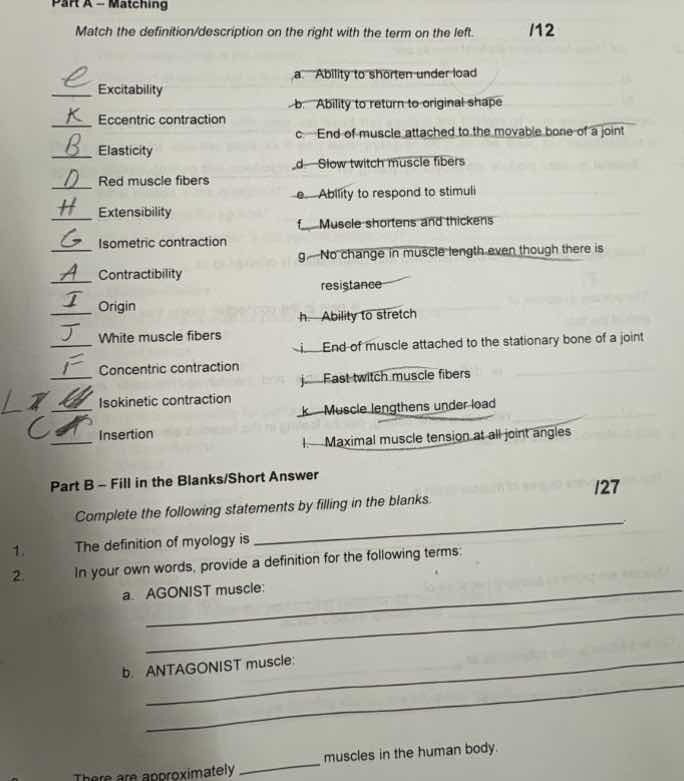
part a - matching
match the definition/description on the right with the term on the left. /12
____ excitability a. ability to shorten under load
____ eccentric contraction b. ability to return to original shape
____ elasticity c. end of muscle attached to the movable bone of a joint
____ red muscle fibers d. slow twitch muscle fibers
____ extensibility e. ability to respond to stimuli
____ isometric contraction f. muscle shortens and thickens
____ contractibility g. no change in muscle length even though there is resistance
____ origin h. ability to stretch
____ white muscle fibers i. end of muscle attached to the stationary bone of a joint
____ concentric contraction j. fast - twitch muscle fibers
____ isokinetic contraction k. muscle lengthens under load
____ insertion l. maximal muscle tension at all joint angles
part b - fill in the blanks/short answer /27
complete the following statements by filling in the blanks.
- the definition of myology is ______________________.
- in your own words, provide a definition for the following terms:
a. agonist muscle:
______________________________________________
______________________________________________
b. antagonist muscle:
______________________________________________
______________________________________________
there are approximately ______ muscles in the human body.
Part A - Matching
To solve the matching, we analyze each term and its corresponding definition:
- Excitability: Ability to respond to stimuli (matches e).
- Eccentric contraction: Muscle lengthens under load (matches k).
- Elasticity: Ability to return to original shape (matches b).
- Red muscle fibers: Slow - twitch muscle fibers (matches d).
- Extensibility: Ability to stretch (matches h).
- Isometric contraction: No change in muscle length even though there is resistance (matches g).
- Contractibility: Ability to shorten under load (matches a).
- Origin: End of muscle attached to the stationary bone of a joint (matches i).
- White muscle fibers: Fast - twitch muscle fibers (matches j).
- Concentric contraction: Muscle shortens and thickens (matches f).
- Isokinetic contraction: Maximal muscle tension at all joint angles (matches l).
- Insertion: End of muscle attached to the movable bone of a joint (matches c).
Part B - Fill in the Blanks/Short Answer
- Definition of myology: Myology is the scientific study of muscles, including their structure, function, physiology, and pathology.
- Definitions:
- a. AGONIST muscle: An agonist muscle is a muscle that contracts to produce a specific movement at a joint. It is the primary muscle responsible for initiating and carrying out a particular action (e.g., the biceps brachii is the agonist when flexing the elbow).
- b. ANTAGONIST muscle: An antagonist muscle is a muscle that opposes the action of the agonist muscle. When the agonist contracts to perform a movement, the antagonist relaxes to allow the movement, and it can also contract to reverse the movement (e.g., the triceps brachii is the antagonist to the biceps brachii during elbow flexion).
- Number of muscles in the human body: There are approximately 600 muscles in the human body.
Part A Answers (Matching)
- Excitability: e
- Eccentric contraction: k
- Elasticity: b
- Red muscle fibers: d
- Extensibility: h
- Isometric contraction: g
- Contractibility: a
- Origin: i
- White muscle fibers: j
- Concentric contraction: f
- Isokinetic contraction: l
- Insertion: c
Part B Answers (Fill in the Blanks/Short Answer)
- The definition of myology is the scientific study of muscles (including their structure, function, etc.).
- a. AGONIST muscle: A muscle that contracts to produce a movement (primary mover for an action).
b. ANTAGONIST muscle: A muscle that opposes the action of the agonist muscle.
- There are approximately 600 muscles in the human body.

Snap & solve any problem in the app
Get step-by-step solutions on Sovi AI
Photo-based solutions with guided steps
Explore more problems and detailed explanations
Part A - Matching
To solve the matching, we analyze each term and its corresponding definition:
- Excitability: Ability to respond to stimuli (matches e).
- Eccentric contraction: Muscle lengthens under load (matches k).
- Elasticity: Ability to return to original shape (matches b).
- Red muscle fibers: Slow - twitch muscle fibers (matches d).
- Extensibility: Ability to stretch (matches h).
- Isometric contraction: No change in muscle length even though there is resistance (matches g).
- Contractibility: Ability to shorten under load (matches a).
- Origin: End of muscle attached to the stationary bone of a joint (matches i).
- White muscle fibers: Fast - twitch muscle fibers (matches j).
- Concentric contraction: Muscle shortens and thickens (matches f).
- Isokinetic contraction: Maximal muscle tension at all joint angles (matches l).
- Insertion: End of muscle attached to the movable bone of a joint (matches c).
Part B - Fill in the Blanks/Short Answer
- Definition of myology: Myology is the scientific study of muscles, including their structure, function, physiology, and pathology.
- Definitions:
- a. AGONIST muscle: An agonist muscle is a muscle that contracts to produce a specific movement at a joint. It is the primary muscle responsible for initiating and carrying out a particular action (e.g., the biceps brachii is the agonist when flexing the elbow).
- b. ANTAGONIST muscle: An antagonist muscle is a muscle that opposes the action of the agonist muscle. When the agonist contracts to perform a movement, the antagonist relaxes to allow the movement, and it can also contract to reverse the movement (e.g., the triceps brachii is the antagonist to the biceps brachii during elbow flexion).
- Number of muscles in the human body: There are approximately 600 muscles in the human body.
Part A Answers (Matching)
- Excitability: e
- Eccentric contraction: k
- Elasticity: b
- Red muscle fibers: d
- Extensibility: h
- Isometric contraction: g
- Contractibility: a
- Origin: i
- White muscle fibers: j
- Concentric contraction: f
- Isokinetic contraction: l
- Insertion: c
Part B Answers (Fill in the Blanks/Short Answer)
- The definition of myology is the scientific study of muscles (including their structure, function, etc.).
- a. AGONIST muscle: A muscle that contracts to produce a movement (primary mover for an action).
b. ANTAGONIST muscle: A muscle that opposes the action of the agonist muscle.
- There are approximately 600 muscles in the human body.