QUESTION IMAGE
Question
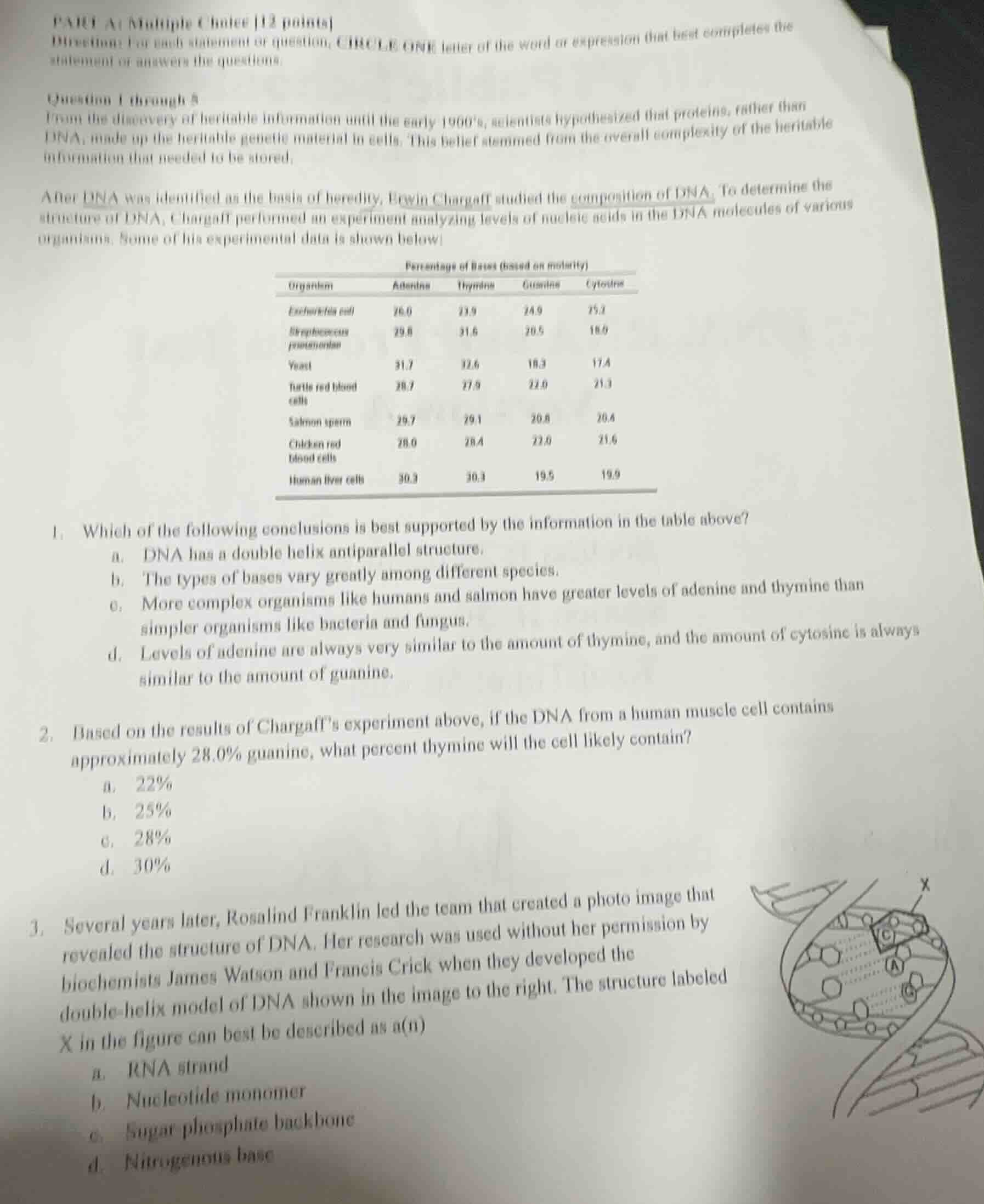
part a: multiple choice 12 pointsdirection: for each statement or question, circle one letter of the word or expression that best completes the statement or answers the questions.question 1 through 3from the discovery of heritable information until the early 1900s, scientists hypothesized that proteins, rather than dna, made up the heritable genetic material in cells. this belief stemmed from the overall complexity of the heritable information that needed to be stored.after dna was identified as the basis of heredity, erwin chargaff studied the composition of dna. to determine the structure of dna, chargaff performed an experiment analyzing levels of nucleic acids in the dna molecules of various organisms. some of his experimental data is shown below:percentage of bases (based on molarity)organism adenine thymine guanine cytosineescherichia coli 26.0 23.9 24.9 25.2staphylococcus pneumoniae 29.8 31.6 20.5 18.0yeast 31.7 32.6 18.3 17.4turtle red blood cells 28.7 27.9 22.0 21.3salmon sperm 29.7 29.1 20.8 20.4chicken red blood cells 28.0 28.4 22.0 21.6human liver cells 30.3 30.3 19.5 19.91. which of the following conclusions is best supported by the information in the table above?a. dna has a double helix antiparallel structure.b. the types of bases vary greatly among different species.c. more complex organisms like humans and salmon have greater levels of adenine and thymine than simpler organisms like bacteria and fungus.d. levels of adenine are always very similar to the amount of thymine, and the amount of cytosine is always similar to the amount of guanine.2. based on the results of chargaffs experiment above, if the dna from a human muscle cell contains approximately 28.0% guanine, what percent thymine will the cell likely contain?a. 22%b. 25%c. 28%d. 30%3. several years later, rosalind franklin led the team that created a photo image that revealed the structure of dna. her research was used without her permission by biochemists james watson and francis crick when they developed the double-helix model of dna shown in the image to the right. the structure labeled x in the figure can best be described as a(n)a. rna strandb. nucleotide monomerc. sugar phosphate backboned. nitrogenous base
Question 1
Step1: Analyze table base pairs
Check each organism's base percentages:
- E. coli: Adenine=26.0, Thymine=23.9; Guanine=24.9, Cytosine=25.2
- Human liver cells: Adenine=30.3, Thymine=30.3; Guanine=19.5, Cytosine=19.9
All show adenine ≈ thymine, guanine ≈ cytosine.
Question 2
Step1: Apply Chargaff's rule
Guanine = Cytosine, so total G+C = $28.0\% + 28.0\% = 56.0\%$
Step2: Calculate remaining base percentage
Total bases = 100%, so Adenine + Thymine = $100\% - 56.0\% = 44.0\%$
Step3: Find thymine percentage
Adenine = Thymine, so Thymine = $\frac{44.0\%}{2} = 22.0\%$
Question 3
Step1: Identify DNA structure parts
Label X is the outer framework of the double helix, which is the sugar-phosphate backbone.

Snap & solve any problem in the app
Get step-by-step solutions on Sovi AI
Photo-based solutions with guided steps
Explore more problems and detailed explanations
- d. Levels of adenine are always very similar to the amount of thymine, and the amount of cytosine is always similar to the amount of guanine.
- a. 22%
- c. Sugar phosphate backbone