QUESTION IMAGE
Question
part i. multiple choice & multi select
select the best answer(s) for each question.
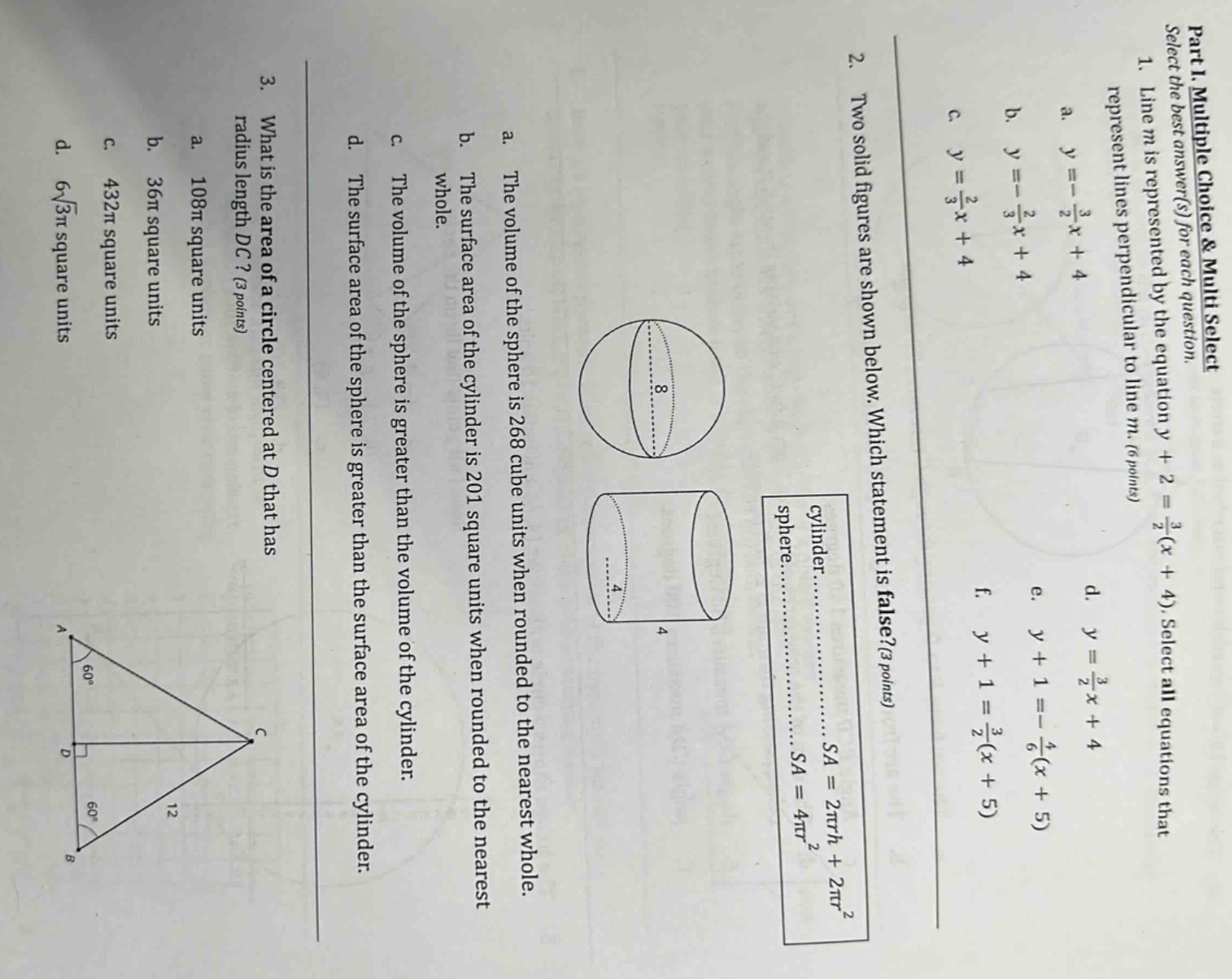
- line ( m ) is represented by the equation ( y + 2 = \frac{3}{2}(x + 4) ). select all equations that represent lines perpendicular to line ( m ). (6 points)
a. ( y = -\frac{2}{3}x + 4 )
b. ( y = -\frac{2}{3}x + 4 )
c. ( y = \frac{2}{3}x + 4 )
d. ( y = \frac{3}{2}x + 4 )
e. ( y + 1 = -\frac{4}{6}(x + 5) )
f. ( y + 1 = \frac{3}{2}(x + 5) )
- two solid figures are shown below. which statement is false? (3 points)
image of a sphere with diameter 8 and a cylinder with radius 4 and height 4
cylinder: ( sa = 2pi rh + 2pi r^2 )
sphere: ( sa = 4pi r^2 )
a. the volume of the sphere is 268 cube units when rounded to the nearest whole.
b. the surface area of the cylinder is 201 square units when rounded to the nearest whole.
c. the volume of the sphere is greater than the volume of the cylinder.
d. the surface area of the sphere is greater than the surface area of the cylinder.
- what is the area of a circle centered at ( d ) that has radius length ( dc )? (3 points)
image of triangle ( abc ) with ( angle a = 60^circ ), ( angle b = 60^circ ), ( cd = 12 ), ( angle adc = 90^circ )
a. ( 108pi ) square units
b. ( 36pi ) square units
c. ( 432pi ) square units
d. ( 6sqrt{3}pi ) square units
Question 1
Step 1: Find the slope of line \( m \)
First, rewrite the equation of line \( m \): \( y + 2=\frac{3}{2}(x + 4) \). In slope - intercept form \( y=mx + b \), we expand it: \( y+2=\frac{3}{2}x+6 \), so \( y=\frac{3}{2}x + 4 \). The slope of line \( m \) is \( m=\frac{3}{2} \).
Step 2: Determine the slope of perpendicular lines
If two lines are perpendicular, the product of their slopes is \( - 1 \). Let the slope of the perpendicular line be \( m_{\perp} \). Then \( \frac{3}{2}\times m_{\perp}=-1 \), so \( m_{\perp}=-\frac{2}{3} \).
Step 3: Analyze each option
- Option a: \( y =-\frac{3}{2}x + 4 \), slope is \( -\frac{3}{2}
eq-\frac{2}{3} \), not perpendicular.
- Option b: \( y=-\frac{2}{3}x + 4 \), slope is \( -\frac{2}{3} \), perpendicular.
- Option c: \( y=\frac{2}{3}x + 4 \), slope is \( \frac{2}{3}
eq-\frac{2}{3} \), not perpendicular.
- Option d: \( y=\frac{3}{2}x + 4 \), slope is \( \frac{3}{2} \), same as line \( m \), parallel, not perpendicular.
- Option e: Rewrite \( y + 1=-\frac{4}{6}(x + 5) \), simplify \( -\frac{4}{6}=-\frac{2}{3} \), so \( y+1 =-\frac{2}{3}(x + 5) \), \( y=-\frac{2}{3}x-\frac{10}{3}-1=-\frac{2}{3}x-\frac{13}{3} \), slope is \( -\frac{2}{3} \), perpendicular.
- Option f: Rewrite \( y + 1=\frac{3}{2}(x + 5) \), \( y=\frac{3}{2}x+\frac{15}{2}-1=\frac{3}{2}x+\frac{13}{2} \), slope is \( \frac{3}{2} \), parallel, not perpendicular.
Step 1: Find the volume of the sphere
The diameter of the sphere \( d = 8 \), so radius \( r=\frac{d}{2}=4 \). The volume of a sphere is \( V_{sphere}=\frac{4}{3}\pi r^{3}=\frac{4}{3}\pi(4)^{3}=\frac{4}{3}\pi\times64=\frac{256}{3}\pi\approx268.08 \) cubic units (when rounded to the nearest whole number, it is 268 cubic units), so option a is true.
Step 2: Find the surface area of the cylinder
The radius of the cylinder \( r = 4 \), height \( h = 4 \). The surface area of a cylinder \( SA_{cylinder}=2\pi rh+2\pi r^{2}=2\pi\times4\times4 + 2\pi\times4^{2}=32\pi+32\pi = 64\pi\approx201.06 \) square units (when rounded to the nearest whole number, it is 201 square units), so option b is true.
Step 3: Compare the volumes of the sphere and the cylinder
The volume of the cylinder \( V_{cylinder}=\pi r^{2}h=\pi\times4^{2}\times4 = 64\pi\approx201.06 \) cubic units. The volume of the sphere \( V_{sphere}=\frac{256}{3}\pi\approx268.08 \) cubic units. Since \( 268.08>201.06 \), the volume of the sphere is greater than the volume of the cylinder, option c is true.
Step 4: Compare the surface areas of the sphere and the cylinder
The surface area of the sphere \( SA_{sphere}=4\pi r^{2}=4\pi\times4^{2}=64\pi\approx201.06 \) square units. The surface area of the cylinder \( SA_{cylinder}=64\pi\approx201.06 \) square units. So the surface area of the sphere is not greater than the surface area of the cylinder, option d is false.
Step 1: Analyze the triangle
In triangle \( ABC \), \( \angle A = 60^{\circ} \), \( \angle B=60^{\circ} \), so triangle \( ABC \) is an equilateral triangle, so \( AC = BC = AB \). Also, \( CD \) is the altitude of the equilateral triangle (since \( \angle ADC = 90^{\circ} \) and in an equilateral triangle, the altitude, median, and angle - bisector coincide). In right - triangle \( ADC \), \( \angle A = 60^{\circ} \), \( \angle ACD = 30^{\circ} \), and \( AC = 12 \).
Step 2: Use trigonometric ratios to find \( DC \)
In right - triangle \( ADC \), \( \sin A=\frac{DC}{AC} \). Since \( \angle A = 60^{\circ} \) and \( AC = 12 \), \( \sin60^{\circ}=\frac{\sqrt{3}}{2}=\frac{DC}{12} \), so \( DC = 12\times\frac{\sqrt{3}}{2}=6\sqrt{3} \). Wait, no, we need the radius of the circle centered at \( D \) that has radius \( DC \). Wait, maybe I made a mistake. Wait, in triangle \( ABC \), if \( AC = 12 \), and \( CD \) is the altitude, in an equilateral triangle with side length \( a \), the altitude \( h=\frac{\sqrt{3}}{2}a \). But maybe the triangle is isosceles with \( \angle A=\angle B = 60^{\circ} \), so it's equilateral. Wait, but the length of \( DC \): let's use another approach. If we consider triangle \( ADC \), \( \angle A = 60^{\circ} \), \( \angle ADC = 90^{\circ} \), \( AC = 12 \), then \( \cos A=\frac{AD}{AC} \), \( AD=\frac{1}{2}AC = 6 \), and by Pythagoras theorem, \( DC=\sqrt{AC^{2}-AD^{2}}=\sqrt{12^{2}-6^{2}}=\sqrt{144 - 36}=\sqrt{108}=6\sqrt{3} \). Wait, no, the area of the circle is \( A=\pi r^{2} \), where \( r = DC \). Wait, maybe I misread the problem. Wait, the problem says "What is the area of a circle centered at \( D \) that has radius length \( DC \)?".
Wait, let's re - evaluate. If \( DC = 6\sqrt{3} \), then the area \( A=\pi r^{2}=\pi(6\sqrt{3})^{2}=\pi\times108 = 108\pi \)? No, \( (6\sqrt{3})^{2}=36\times3 = 108 \), so \( A = 108\pi \)? Wait, no, wait \( (6\sqrt{3})^{2}=6^{2}\times(\sqrt{3})^{2}=36\times3 = 108 \), so the area of the circle is \( \pi r^{2}=\pi\times(6\sqrt{3})^{2}=108\pi \)? Wait, no, maybe \( DC = 6 \). Wait, maybe the triangle is such that \( AC = 12 \), and \( CD \) is the radius. Wait, maybe I made a mistake in the triangle analysis. Let's start over.
In triangle \( ABC \), \( \angle A=\angle B = 60^{\circ} \), so \( \angle ACB=60^{\circ} \), so triangle \( ABC \) is equilateral. \( CD \) is perpendicular to \( AB \), so \( D \) is the mid - point of \( AB \), and \( CD \) is the altitude. The length of the altitude of an equilateral triangle with side length \( s \) is \( h=\frac{\sqrt{3}}{2}s \). If \( AC = 12 \) (side length), then \( h = 6\sqrt{3} \). But the radius of the circle is \( DC = 6\sqrt{3} \)? No, wait, maybe the side length is 12, and \( CD \) is 6? No, that can't be. Wait, the options are \( 108\pi \), \( 36\pi \), \( 432\pi \), \( 6\sqrt{3}\pi \). Wait, if \( DC = 6 \), then the area is \( \pi\times6^{2}=36\pi \). Wait, maybe I made a mistake in the triangle angle. Maybe \( \angle A = 30^{\circ} \)? No, the diagram shows \( \angle A = 60^{\circ} \), \( \angle B = 60^{\circ} \). Wait, maybe \( CD \) is equal to 6. Let's assume that \( AD = 6 \), \( AC = 12 \), then by Pythagoras, \( DC=\sqrt{12^{2}-6^{2}}=\sqrt{108}=6\sqrt{3} \), then the area of the circle is \( \pi\times(6\sqrt{3})^{2}=\pi\times108 = 108\pi \). Wait, \( (6\sqrt{3})^{2}=36\times3 = 108 \), so the area is \( 108\pi \) square units.

Snap & solve any problem in the app
Get step-by-step solutions on Sovi AI
Photo-based solutions with guided steps
Explore more problems and detailed explanations
b. \( y =-\frac{2}{3}x + 4 \), e. \( y + 1=-\frac{4}{6}(x + 5) \)