QUESTION IMAGE
Question
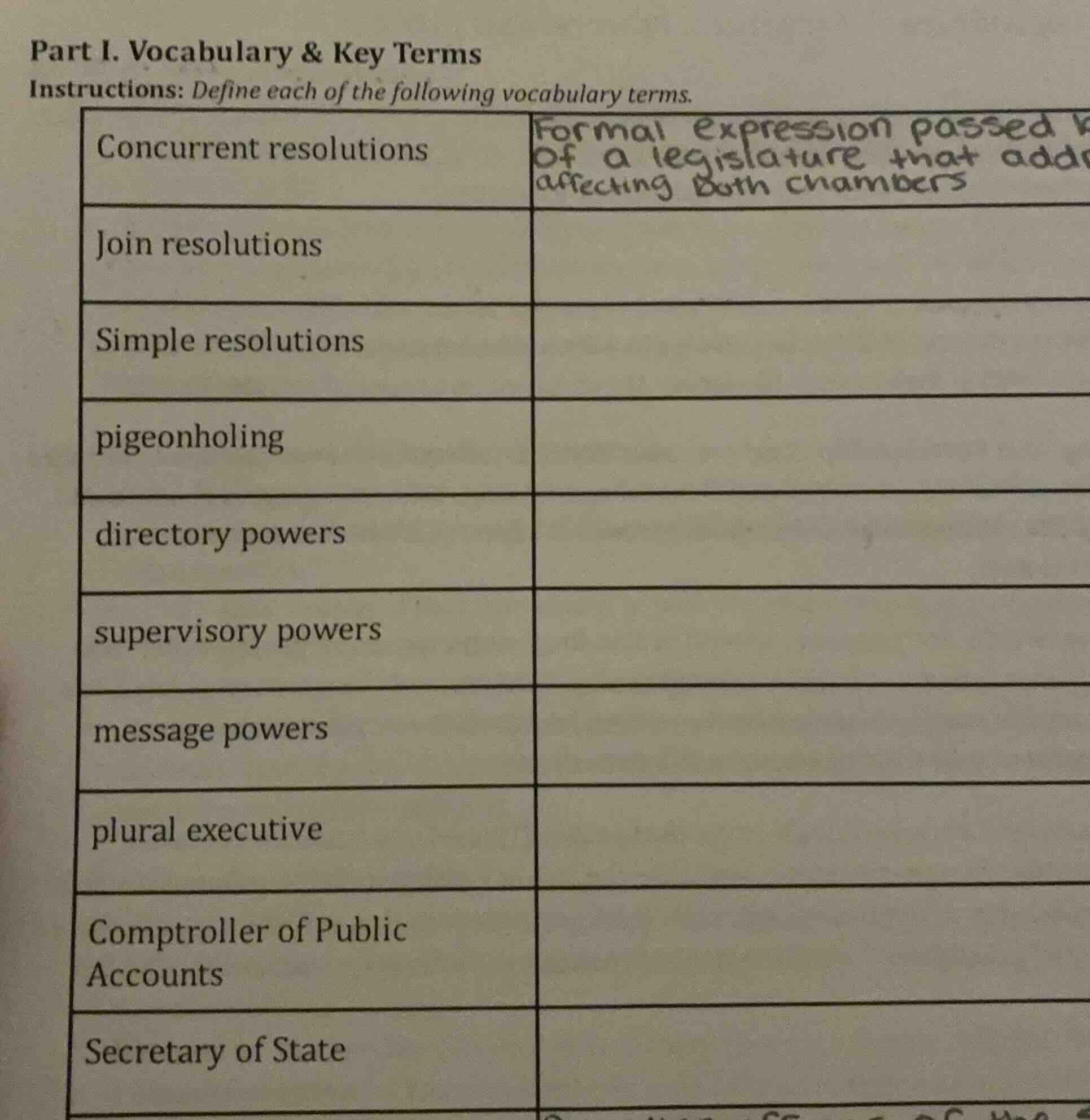
part i. vocabulary & key terms
instructions: define each of the following vocabulary terms.
concurrent resolutions
join resolutions
simple resolutions
pigeonholing
directory powers
supervisory powers
message powers
plural executive
comptroller of public
accounts
secretary of state
To solve this, we'll define each term based on political science (a subfield of Social Science, specifically Politics) concepts:
1. Concurrent resolutions
Formal expressions passed by a legislature (e.g., U.S. Congress) addressing matters affecting both chambers (House & Senate). They don’t have the force of law (unlike bills) and often express opinions or address internal matters.
Formal measures passed by both legislative chambers (like a bill) and can have the force of law if signed by the executive (or passed over a veto). They’re used for constitutional amendments, emergency actions, or matters needing “law-like” effect but structured as a resolution.
Resolutions adopted by one legislative chamber (House or Senate) to address matters affecting only that chamber (e.g., internal rules, chamber-specific policy, or expressing opinions). They do not have the force of law and do not require action from the other chamber or executive.

Snap & solve any problem in the app
Get step-by-step solutions on Sovi AI
Photo-based solutions with guided steps
Explore more problems and detailed explanations
Formal expressions passed by a legislature (e.g., U.S. Congress) that address matters affecting both chambers (e.g., House and Senate). They do not have the force of law (unlike bills) and often express opinions, address internal procedures, or commemorate events.