QUESTION IMAGE
Question
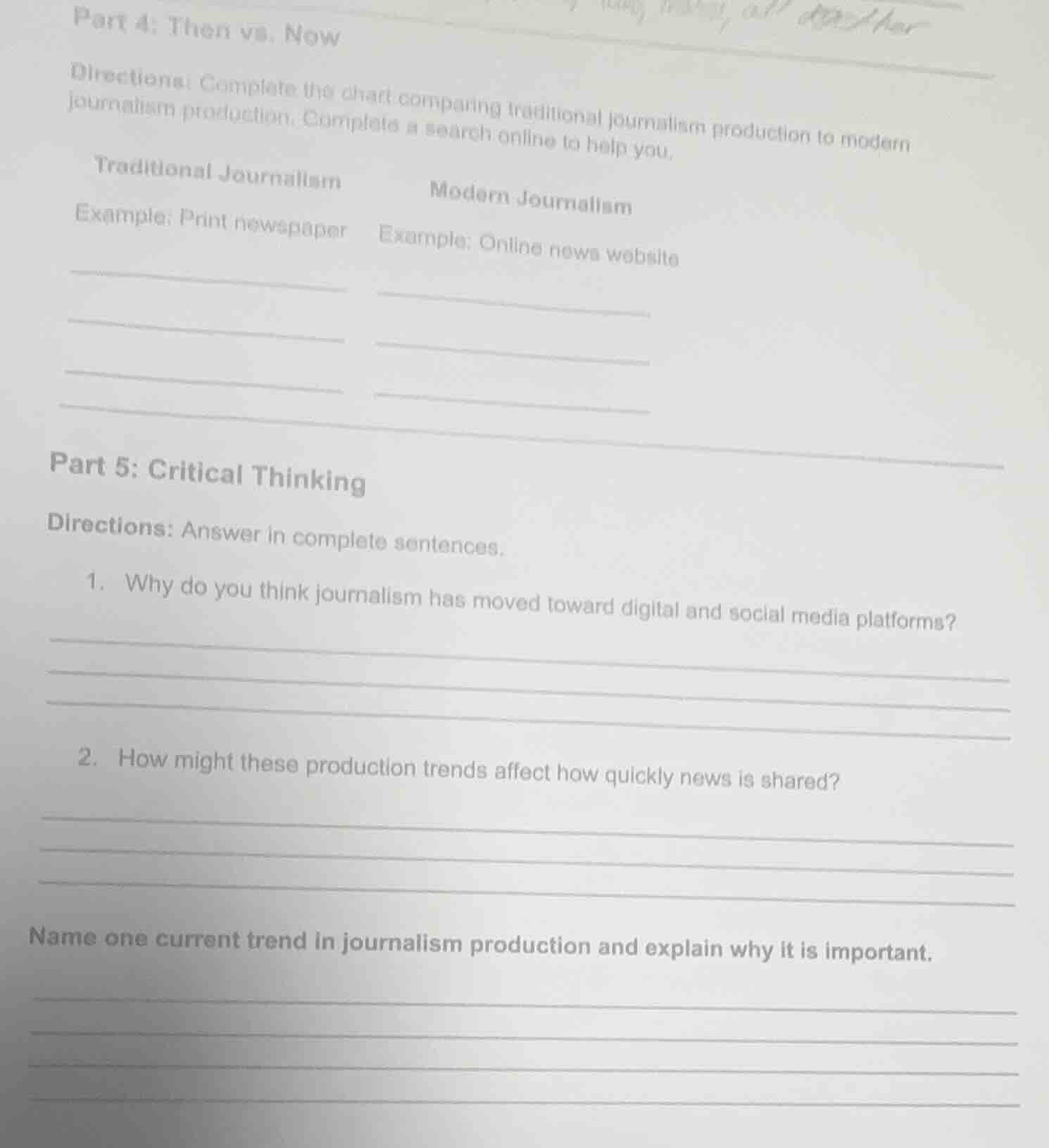
part 4: then vs. now
directions: complete the chart comparing traditional journalism production to modern journalism production. complete a search online to help you.
traditional journalism
example: print newspaper
modern journalism
example: online news website
part 5: critical thinking
directions: answer in complete sentences.
- why do you think journalism has moved toward digital and social media platforms?
- how might these production trends affect how quickly news is shared?
name one current trend in journalism production and explain why it is important.
Part 4: Then vs. Now (Chart Completion)
To complete the chart, we identify key differences between traditional and modern journalism:
| Traditional Journalism | Modern Journalism |
|---|---|
| Radio news broadcasts | Social media news (e.g., Twitter, Facebook) |
| Television news (evening broadcasts) | Mobile news apps (e.g., CNN App, BBC News App) |
| Physical newsstands for distribution | Live streaming news (e.g., YouTube Live, Twitch) |
| Weekly news magazines (e.g., Time, Newsweek) | Citizen journalism (user-generated content) |
Part 5: Critical Thinking (Answers)
- Why has journalism moved toward digital and social media platforms?
Journalism has shifted to digital and social media because these platforms offer faster distribution, wider global reach, and real - time interaction with audiences. Additionally, the rise of mobile technology means people increasingly consume news on their devices, and social media algorithms can target specific audiences, increasing engagement.
- How do production trends affect news sharing speed?
Modern production trends (digital/social media) accelerate news sharing. Digital platforms allow instant publishing, and social media’s share - buttons enable rapid dissemination to large networks. Unlike traditional print/TV with fixed schedules, digital news is updated in real - time, so breaking stories reach audiences much faster.
- Name a current trend and explain its importance.
A current trend is data - driven journalism (using analytics to inform stories). It’s important because it helps journalists identify audience interests, verify information (e.g., fact - checking with data), and create personalized content. This improves story relevance, builds audience trust, and adapts to how modern audiences consume news (seeking evidence - based, tailored information).

Snap & solve any problem in the app
Get step-by-step solutions on Sovi AI
Photo-based solutions with guided steps
Explore more problems and detailed explanations
Part 4: Then vs. Now (Chart Completion)
To complete the chart, we identify key differences between traditional and modern journalism:
| Traditional Journalism | Modern Journalism |
|---|---|
| Radio news broadcasts | Social media news (e.g., Twitter, Facebook) |
| Television news (evening broadcasts) | Mobile news apps (e.g., CNN App, BBC News App) |
| Physical newsstands for distribution | Live streaming news (e.g., YouTube Live, Twitch) |
| Weekly news magazines (e.g., Time, Newsweek) | Citizen journalism (user-generated content) |
Part 5: Critical Thinking (Answers)
- Why has journalism moved toward digital and social media platforms?
Journalism has shifted to digital and social media because these platforms offer faster distribution, wider global reach, and real - time interaction with audiences. Additionally, the rise of mobile technology means people increasingly consume news on their devices, and social media algorithms can target specific audiences, increasing engagement.
- How do production trends affect news sharing speed?
Modern production trends (digital/social media) accelerate news sharing. Digital platforms allow instant publishing, and social media’s share - buttons enable rapid dissemination to large networks. Unlike traditional print/TV with fixed schedules, digital news is updated in real - time, so breaking stories reach audiences much faster.
- Name a current trend and explain its importance.
A current trend is data - driven journalism (using analytics to inform stories). It’s important because it helps journalists identify audience interests, verify information (e.g., fact - checking with data), and create personalized content. This improves story relevance, builds audience trust, and adapts to how modern audiences consume news (seeking evidence - based, tailored information).