QUESTION IMAGE
Question
and particularly the president, a greater role in shaping the economy. it did this by putting millions of dollars into the economy, creating federal jobs, regulating supply and demand, and participating in settling labor disputes. the government also created agencies such as the federal deposit insurance corporation (fdic) and the securities and exchange commission (sec) to regulate banking and investment activities. to do all this, the government went deeply into debt. in the end, what really ended the depression was the massive spending for world war ii.
the new deal left a lasting impact on workers rights, banking, and investment. today the national labor relations board (nlrb) still mediates labor disputes. and the fdic and sec help regulate the banking and securities industries.
1、how did some liberals and conservatives criticize the new deal?
social and environmental effects (pages 518 - 519)
how did the new deal make the economy more stable?
new deal reforms had lasting effects. they helped make the economy... the nation has had economic downturns. but none have been as bad as the great depression. and peoples savings are insured.
one of the most important and lasting benefits of the new deal is the social security system. it provides old - age insurance and unemployment benefits. it also helps families with dependent children and those who are disabled. for the first time, the federal government took responsibility for the welfare of its citizens.
the second agricultural adjustment act made loans to farmers. the loans were based on the parity value - a price based on 1910 - 1914 levels - of farmers surplus crops. projects that spread electric power to rural areas also helped farmers.
the new deal also helped the environment. roosevelt was very interested in protecting the nations natural resources. new deal policies promoted soil conservation to prevent a repeat of the dust bowl. the tennessee valley authority (tva) helped prevent floods and provided electricity. and new deal programs also added to the national park system. they set up areas to protect wildlife. however, the tva did contribute to pollution through strip mining.
- what are two continuing benefits of the new deal?
skillbuilder
use the chart to answer these questions.
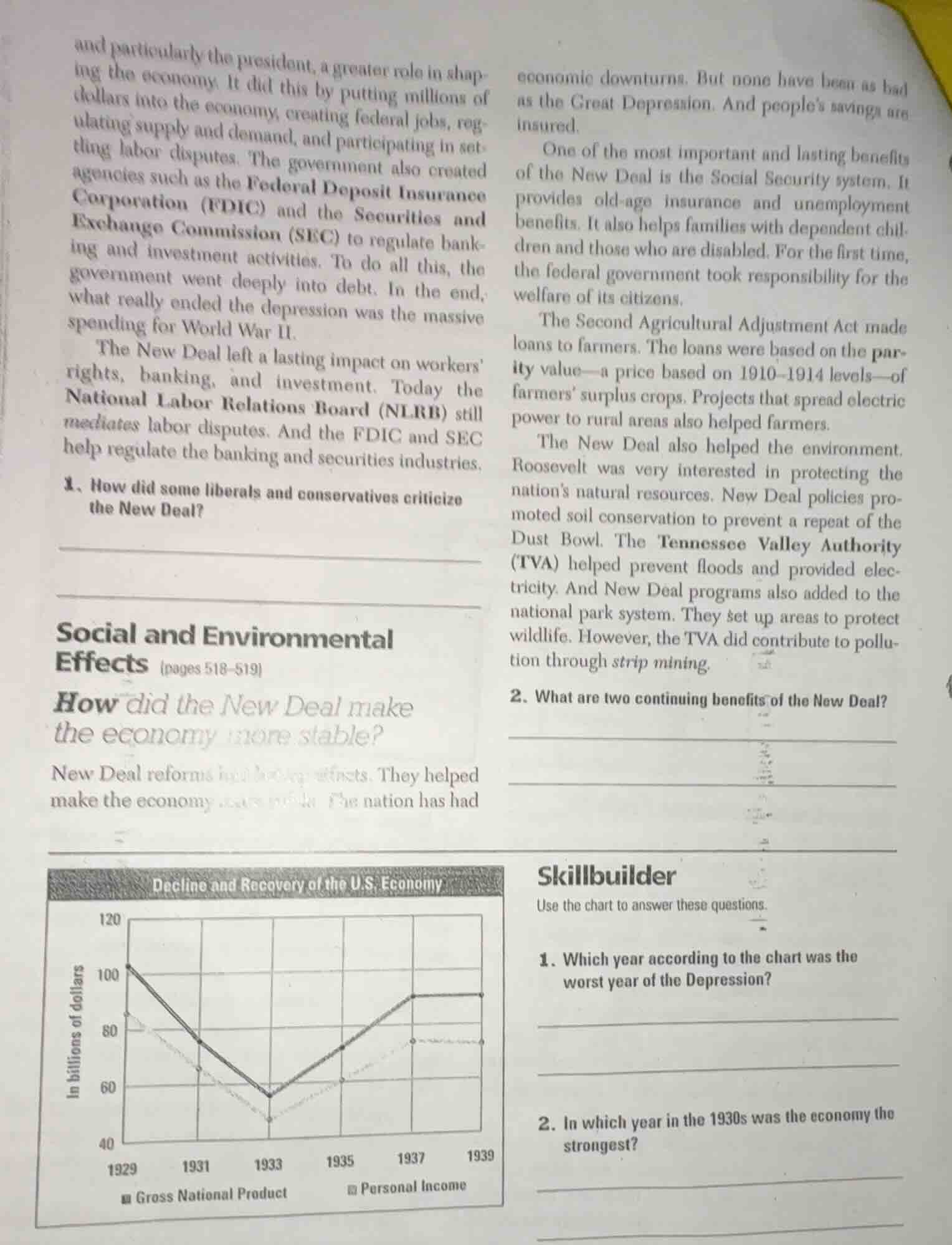
decline and recovery of the u.s. economy
chart: in billions of dollars, with years 1929, 1931, 1933, 1935, 1937, 1939. lines for gross national product and personal income
- which year according to the chart was the worst year of the depression?
- in which year in the 1930s was the economy the strongest?
Question 1: How did some liberals and conservatives criticize the New Deal? (Note: The text provided doesn't have the direct criticism details, but based on historical context and typical New Deal criticism: )
Liberals often criticized the New Deal for not going far enough in redistributing wealth or providing more extensive social welfare. Conservatives criticized it for expanding the federal government's power too much, interfering with free enterprise, and increasing the national debt. (Since the given text doesn't include this criticism, this is based on historical knowledge of New Deal critiques.)
From the text: 1. The Social Security system (provides old - age insurance, unemployment benefits, helps families with dependent children and the disabled, and marked the federal government's responsibility for citizens' welfare). 2. Regulatory agencies like FDIC (regulates banking) and SEC (regulates investment activities) still function, or the National Labor Relations Board (NLRB) still mediates labor disputes, or programs that helped farmers (e.g., loans, rural electrification) had lasting impacts, or environmental protections (e.g., soil conservation, national park system additions). We can pick two, for example, the Social Security system and the regulatory role of FDIC/SEC.
Step 1: Analyze the chart axes and lines
The chart has two lines: Gross National Product (GNP) and Personal Income, both in billions of dollars, with years from 1929 to 1939. The worst year of the Depression would be when these economic indicators (GNP and Personal Income) were at their lowest.
Step 2: Identify the lowest point
Looking at the GNP (the dark line) and Personal Income (the light line), in 1933, both GNP and Personal Income reach their lowest values on the chart.

Snap & solve any problem in the app
Get step-by-step solutions on Sovi AI
Photo-based solutions with guided steps
Explore more problems and detailed explanations
Liberals: Felt it didn't go far enough (e.g., in wealth redistribution, social welfare). Conservatives: Felt it expanded federal power too much, interfered with free enterprise, and increased debt.