QUESTION IMAGE
Question
passage 1: the benefits of problem-solving in math instruction
problem-solving math instruction
1 a group of high school students discusses the best way to create a model that reflects population growth over time. another group determines how much wood is needed to construct a tiny house. a third group reflects on the accuracy of data they created based on a school-wide survey. lively sounds of discussion, disagreement, and laughter can be heard from third period math class.
2 these students are actively engaged in problem-solving based math instruction, a method which many teachers feel is the best way to approach math instruction overall. the benefits of problem-solving based instruction are many.
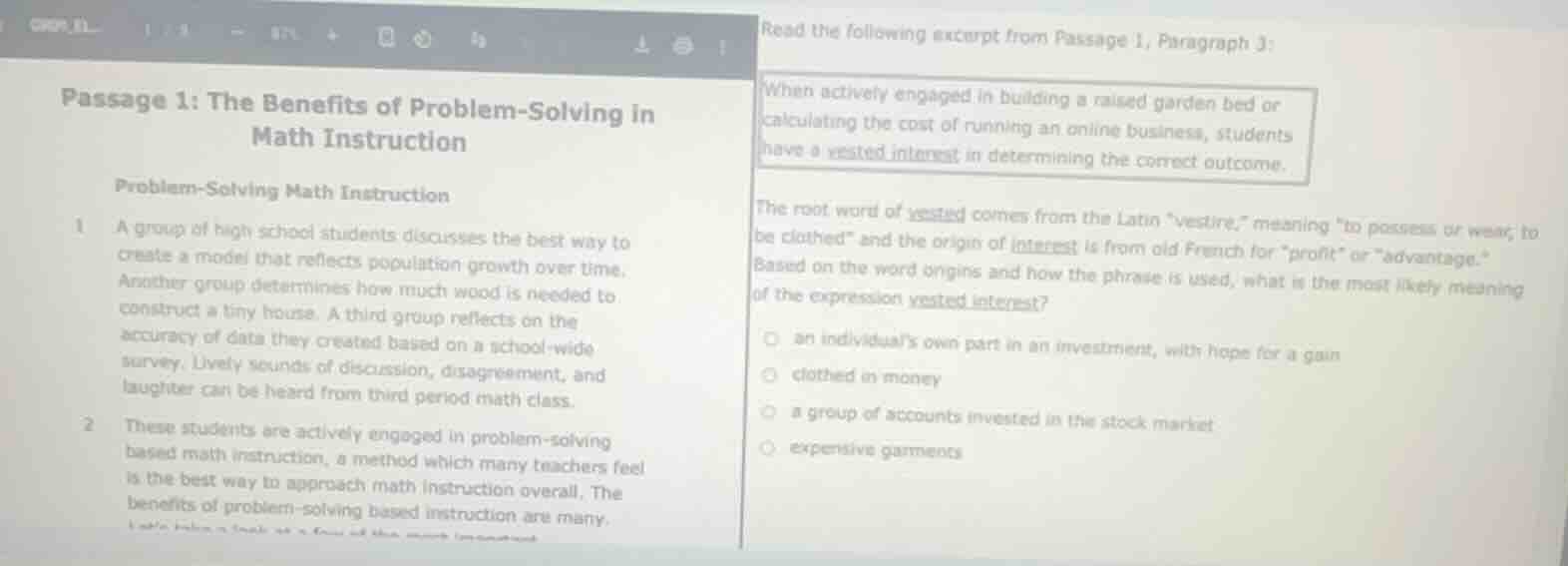
read the following excerpt from passage 1, paragraph 3:
when actively engaged in building a raised garden bed or calculating the cost of running an online business, students have a vested interest in determining the correct outcome.
the root word of vested comes from the latin \vestire,\ meaning \to possess or wear; to be clothed\ and the origin of interest is from old french for \profit\ or \advantage.\ based on the word origins and how the phrase is used, what is the most likely meaning of the expression vested interest?
○ an individuals own part in an investment, with hope for a gain
○ clothed in money
○ a group of accounts invested in the stock market
○ expensive garments
The root "vestire" means "to possess or wear", and "interest" originates from terms for "profit/advantage". In the context, students are invested in the outcome of their practical math tasks, tying personal involvement to a desired positive result. The first option matches this: personal stake with hope for gain, while others are literal or irrelevant misinterpretations.

Snap & solve any problem in the app
Get step-by-step solutions on Sovi AI
Photo-based solutions with guided steps
Explore more problems and detailed explanations
an individual's own part in an investment, with hope for a gain