QUESTION IMAGE
Question
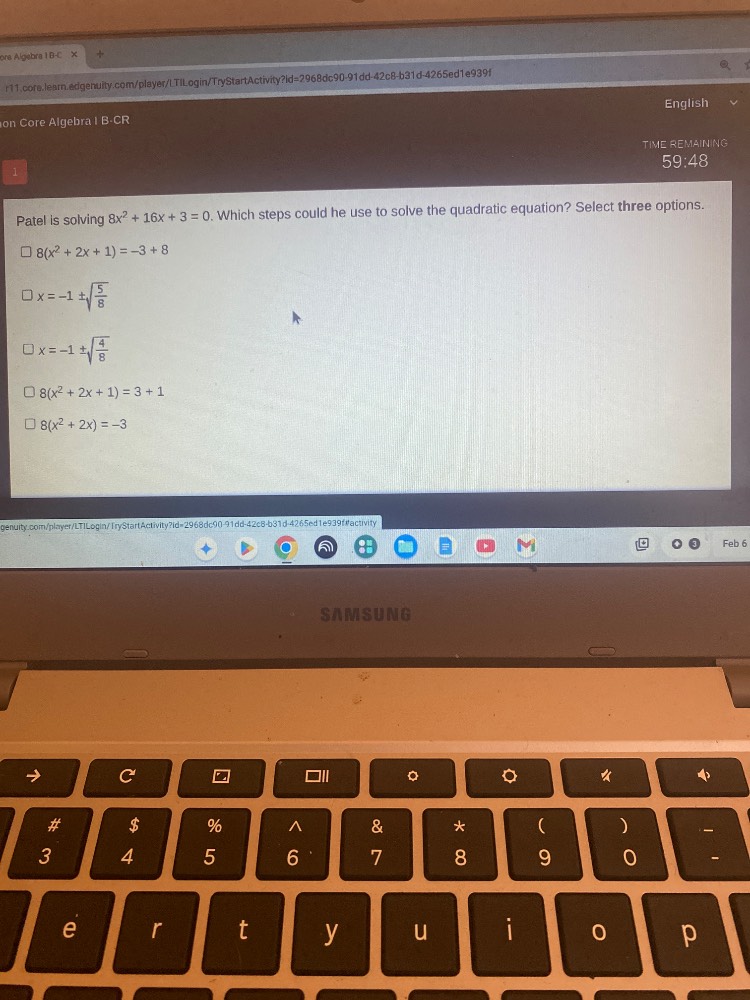
patel is solving ( 8x^2 + 16x + 3 = 0 ). which steps could he use to solve the quadratic equation? select three options.
( 8(x^2 + 2x + 1) = -3 + 8 )
( x = -1 pm sqrt{\frac{5}{8}} )
( x = -1 pm sqrt{\frac{4}{8}} )
( 8(x^2 + 2x + 1) = 3 + 1 )
( 8(x^2 + 2x) = -3 )
We start with the quadratic equation \(8x^{2}+16x + 3=0\).
Step 1: Isolate the \(x\) terms
Subtract 3 from both sides:
\(8x^{2}+16x=- 3\)
We can factor out 8 from the left - hand side:
\(8(x^{2}+2x)=-3\)
This matches the option \(8(x^{2}+2x)=-3\).
Step 2: Complete the square inside the parentheses
For the expression \(x^{2}+2x\), to complete the square, we take half of the coefficient of \(x\) (which is 2), square it \((\frac{2}{2})^{2}=1\), and add and subtract it. But since we have a factor of 8 outside the parentheses, when we add 1 inside the parentheses, we are actually adding \(8\times1 = 8\) to the left - hand side. So we need to add 8 to the right - hand side as well.
Starting from \(8(x^{2}+2x)=-3\), we add 8 to both sides:
\(8(x^{2}+2x + 1)=-3 + 8\)
This matches the option \(8(x^{2}+2x + 1)=-3 + 8\).
Step 3: Solve for \(x\)
We know that \(x^{2}+2x + 1=(x + 1)^{2}\), so \(8(x + 1)^{2}=5\)
Divide both sides by 8: \((x + 1)^{2}=\frac{5}{8}\)
Take the square root of both sides: \(x + 1=\pm\sqrt{\frac{5}{8}}\)
Subtract 1 from both sides: \(x=-1\pm\sqrt{\frac{5}{8}}\)
This matches the option \(x=-1\pm\sqrt{\frac{5}{8}}\)

Snap & solve any problem in the app
Get step-by-step solutions on Sovi AI
Photo-based solutions with guided steps
Explore more problems and detailed explanations
The three correct options are:
- \(8(x^{2}+2x)=-3\)
- \(8(x^{2}+2x + 1)=-3 + 8\)
- \(x=-1\pm\sqrt{\frac{5}{8}}\)