QUESTION IMAGE
Question
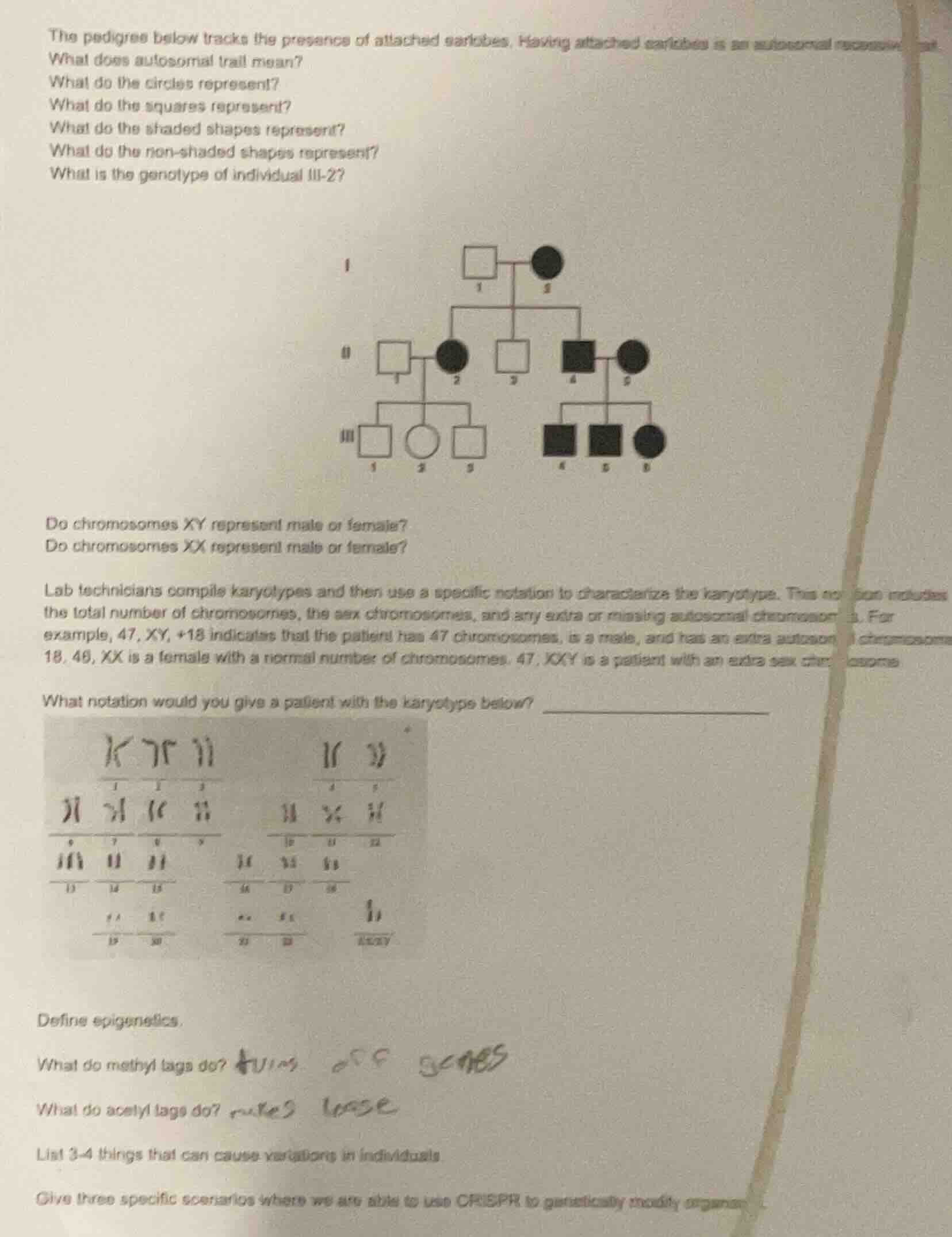
the pedigree below tracks the presence of attached earlobes. having attached earlobes is an autosomal recessive trait.
what does autosomal trait mean?
what do the circles represent?
what do the squares represent?
what do the shaded shapes represent?
what do the non - shaded shapes represent?
what is the genotype of individual iii - 2?
pedigree diagram showing generations i, ii, iii with squares (males) and circles (females), shaded and non - shaded
do chromosomes xy represent male or female?
do chromosomes xx represent male or female?
lab technicians compile karyotypes and then use a specific notation to characterize the karyotype. this notation includes the total number of chromosomes, the sex chromosomes, and any extra or missing autosomal chromosomes. for example, 47, xy, +18 indicates that the patient has 47 chromosomes, is a male, and has an extra autosomal chromosome 18. 46, xx is a female with a normal number of chromosomes. 47, xxy is a patient with an extra sex chromosome.
what notation would you give a patient with the karyotype below?
karyotype image showing chromosome pairs
define epigenetics.
what do methyl tags do?
what do acetyl tags do?
list 3 - 4 things that can cause variations in individuals.
give three specific scenarios where we are able to use crispr to genetically modify organisms.
- Autosomal trait: Determined by non-sex chromosomes, equal in males/females.
- Circles: Female individuals in the pedigree.
- Squares: Male individuals in the pedigree.
- Shaded shapes: Individuals with attached earlobes (affected).
- Non-shaded shapes: Individuals without attached earlobes (unaffected).
- Genotype III-2: Unaffected child of affected (aa) parent, so carries one recessive allele: $Aa$.
- XY chromosomes: Represent male.
- XX chromosomes: Represent female.
- Karyotype notation: Count total chromosomes (47), sex chromosomes (XXY), so notation is 47, XXY.
- Epigenetics: Study of heritable gene expression changes without DNA sequence alteration.
- Methyl tags: Bind to DNA/histones, repress gene expression.
- Acetyl tags: Attach to histones, loosen chromatin, activate gene expression.
- Variation causes: Genetic mutations, environmental factors, genetic recombination, epigenetic changes.
- CRISPR scenarios: Correcting cystic fibrosis-causing mutations in human cells; engineering crop plants to resist drought; editing mosquito DNA to block malaria transmission.

Snap & solve any problem in the app
Get step-by-step solutions on Sovi AI
Photo-based solutions with guided steps
Explore more problems and detailed explanations
- A trait carried on non-sex chromosomes, affecting males/females equally.
- Female family members in the pedigree.
- Male family members in the pedigree.
- Individuals who have attached earlobes (affected by the trait).
- Individuals who do not have attached earlobes (unaffected by the trait).
- $Aa$
- Male
- Female
- 47, XXY
- The study of heritable changes in gene activity that do not involve changes to the underlying DNA sequence.
- They typically turn genes off (repress gene expression) by tightening chromatin structure or blocking gene promoters.
- They turn genes on (activate gene expression) by loosening the structure of chromatin to make DNA accessible.
- Genetic mutations, environmental influences, genetic recombination during reproduction, epigenetic modifications
- 1. Correcting the genetic mutation that causes cystic fibrosis in human lung cells to treat the disease.
- Engineering corn plants to have a gene that makes them resistant to corn borers, reducing crop loss.
- Editing the DNA of Anopheles mosquitoes to make them unable to carry and transmit the malaria-causing parasite.